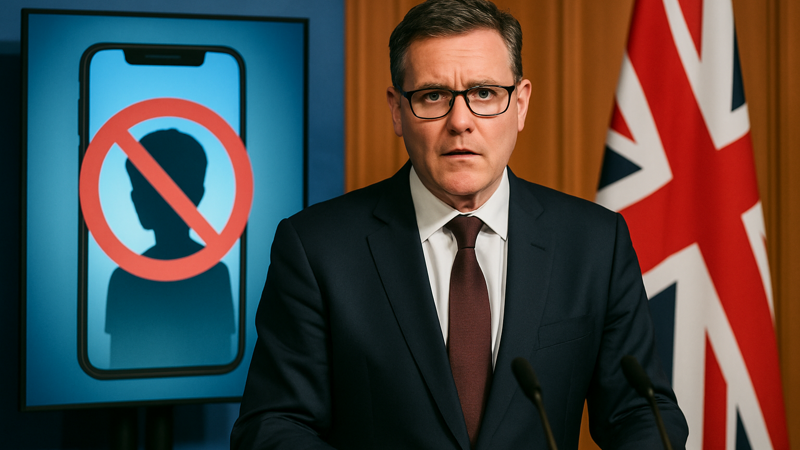
Britain could implement an Australian-style social media ban for children under 16 as early as this year, marking the latest development in an unprecedented global movement to restrict youth access to digital platforms amid growing concerns about mental health and online safety.
Prime Minister Keir Starmer's government launched a consultation on social media restrictions last month and is now working to change legislation to enable rapid implementation within months of the consultation's conclusion. The move follows Australia's groundbreaking under-16 ban, which eliminated 4.7 million teen accounts in December 2025, providing a successful model for international adoption.
"As a dad of two teenagers, I know the challenges and the worries that parents face making sure their kids are safe online," Starmer stated, announcing a series of measures to address what ministers believe are significant harms caused by online platforms to young users.
European Coordination Intensifies
The UK's announcement comes as part of an extraordinary coordinated European response that has seen multiple nations simultaneously pursue age-based social media restrictions. Spain leads the charge with the world's first criminal executive liability framework, threatening imprisonment for tech executives whose platforms violate child protection measures.
Greece stands "very close" to implementing under-15 restrictions through its Kids Wallet enforcement system, while Slovenia has officially announced plans for similar under-15 bans. Germany's federal government is deliberating restrictions, with the Family Ministry establishing a commission to examine social media regulation before making decisions expected after summer 2026.
France, Denmark, and Austria are conducting formal national consultations, representing a unified European approach designed to prevent platforms from simply relocating to more permissive jurisdictions—a practice known as "jurisdictional shopping."
Scientific Evidence Drives Policy
The regulatory momentum is underpinned by compelling scientific research demonstrating the harmful effects of early digital exposure. Dr. Ran Barzilay's studies at the University of Pennsylvania show that children exposed to smartphones before age 5 experience significantly higher rates of sleep disorders, weight problems, and cognitive decline.
Global statistics reveal the scope of the challenge: 96% of children aged 10-15 use social media, with 70% experiencing harmful content exposure and over 50% encountering cyberbullying. Recent large-scale U.S. research found that children spending four or more hours daily on screens face a 61% increased risk of depression through sleep disruption and decreased physical activity.
The European Commission has found TikTok in violation of the Digital Services Act for employing "addictive design" features including unlimited scrolling, automatic playback, and personalized recommendations that prioritize engagement over user wellbeing, potentially facing penalties worth billions of euros.
Industry Resistance and Implementation Challenges
Technology companies have mounted fierce opposition to the regulatory wave. Elon Musk has characterized Spain's measures as "fascist totalitarian," while Telegram's Pavel Durov has sent mass alerts to Spanish users warning of a "surveillance state." Government officials across Europe are using this industry resistance as evidence supporting the need for stronger regulation.
The technical implementation of age restrictions presents significant challenges. "Real age verification" systems require biometric authentication or identity document validation, raising privacy concerns about government surveillance capabilities. Critics warn that infrastructure designed for child protection could evolve into broader monitoring systems.
Cross-border enforcement requires unprecedented international cooperation, while compliance costs may advantage large platforms over smaller competitors, potentially consolidating market power in the technology sector.
Alternative Approaches and Global Perspectives
Not all nations are pursuing regulatory restrictions. Malaysia emphasizes parental responsibility through digital safety campaigns, with Communications Minister Datuk Fahmi Fadzil stressing that parents must control device access rather than using technology as "babysitters."
Oman has launched "Smart tech, safe choices" initiatives focused on conscious digital awareness, teaching recognition of digital threats while promoting responsible AI use. This educational approach contrasts with European enforcement models, representing a fundamental philosophical divide between government intervention and individual agency.
Criminal Liability Revolution
Spain's framework represents the most aggressive platform regulation in history, introducing personal criminal liability for technology executives—a precedent no other country has implemented. This approach could fundamentally alter executive risk calculations and corporate behavior if successful.
The European approach includes mandatory biometric age verification, legal definitions of algorithmic manipulation, and digital sovereignty protections. Success could trigger worldwide adoption of criminal liability standards, while failure might strengthen anti-regulation arguments across the industry.
Infrastructure and Economic Implications
The implementation faces additional challenges from a global memory crisis, with semiconductor prices surging sixfold due to AI demand overwhelming capacity at Samsung, SK Hynix, and Micron. This shortage is expected to constrain age verification infrastructure until new fabrication facilities come online in 2027.
The "SaaSpocalypse" of February 2026 has eliminated hundreds of billions in technology market capitalization amid regulatory uncertainty, demonstrating the significant economic implications of coordinated government action.
Parliamentary Approval and Timeline
Parliamentary approval is required across participating European nations throughout 2026 for coordinated year-end implementation. The simultaneous timing is designed to prevent platform jurisdiction shopping and represents the most sophisticated global technology governance attempt since internet commercialization.
The UK's consultation process will determine specific implementation details, with technology minister Liz Kendall indicating that current regulations have loopholes, particularly regarding one-to-one interactions with AI chatbots that don't share information with other users.
Global Precedent Significance
This represents the most significant test of democratic governments' ability to regulate multinational technology platforms while balancing child protection with digital rights and economic competitiveness. The outcome will establish precedents affecting millions of children globally and determine the framework for 21st-century technology governance.
International observers are monitoring developments closely, as success could trigger continental and global adoption of similar measures, while failure might strengthen industry arguments against regulatory intervention. The stakes extend beyond social media to fundamental questions about democratic governance, childhood development, and human agency in an increasingly digital world.
As governments worldwide grapple with protecting children in digital spaces while preserving beneficial aspects of technological connectivity, the resolution of this unprecedented regulatory wave will shape the relationship between technology companies, democratic institutions, and citizens for years to come.