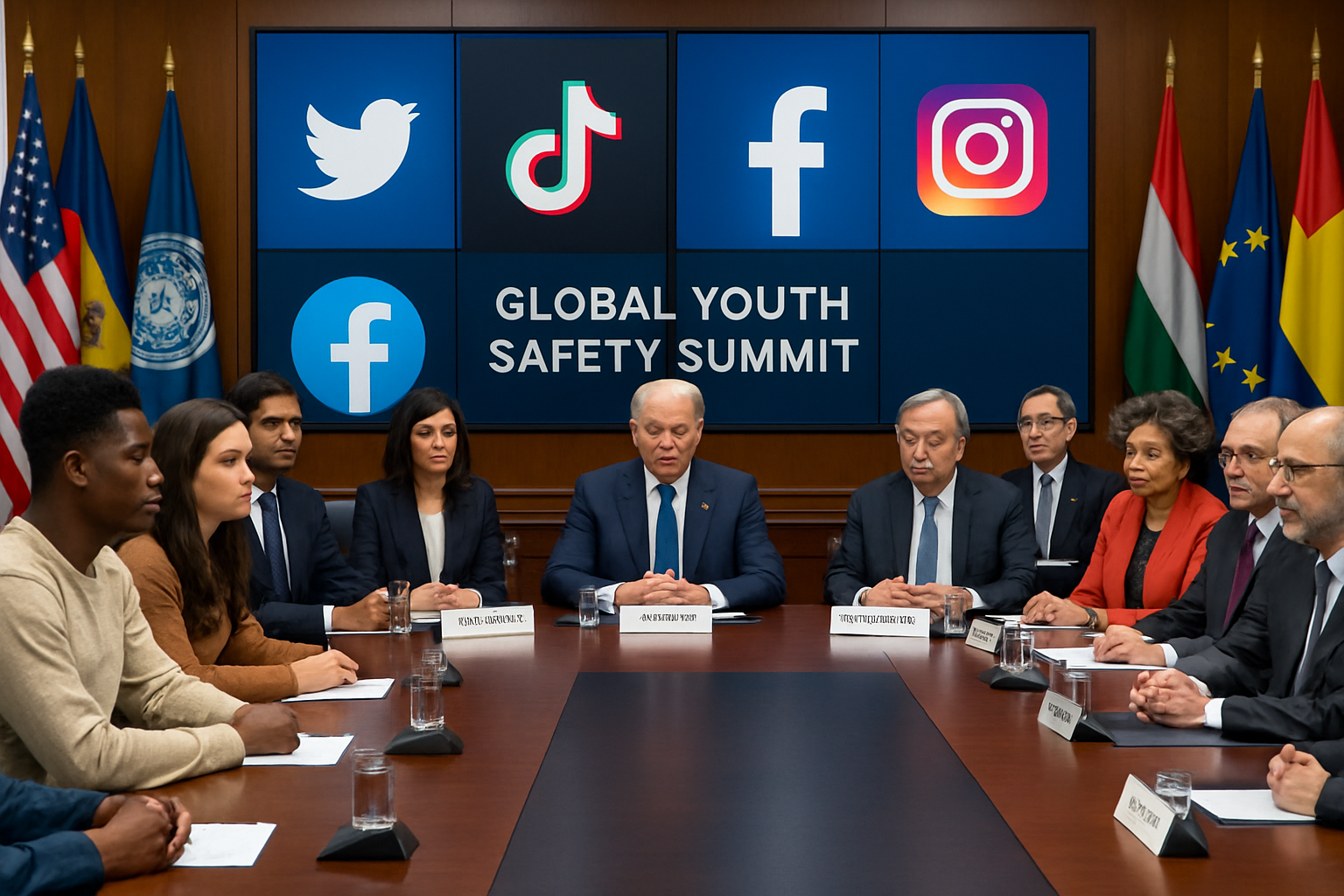
From Europe to Southeast Asia, governments are moving with unprecedented speed to implement comprehensive bans on social media access for children, marking the most significant regulatory wave in internet history as mounting scientific evidence reveals devastating impacts on youth mental health and development.
The movement reached critical mass in April 2026, with world leaders coordinating through formal consultations, legislative changes, and enforcement mechanisms that have already proven their effectiveness. Australia's pioneering under-16 ban has eliminated 4.7 million teen accounts since December 2025, providing a successful implementation model that countries across four continents are now adapting.
Scientific Evidence Driving Global Action
The regulatory momentum stems from overwhelming scientific research documenting severe developmental harm. Dr. Ran Barzilay's University of Pennsylvania research confirms that 96% of children aged 10-15 use social media, with 70% experiencing harmful content exposure and over 50% encountering cyberbullying.
"Early smartphone exposure before age 5 causes persistent sleep disorders, cognitive decline, and weight problems that extend into adulthood,"
— Dr. Ran Barzilay, University of Pennsylvania
Austrian neuroscience research reveals what experts call a "perfect storm" - children's reward systems are extremely vulnerable to smartphone stimulation while impulse control remains underdeveloped until age 25, creating ideal conditions for addiction. University of Macau studies definitively prove that short-form video consumption damages cognitive development, causing social anxiety and academic disengagement.
The health crisis is quantifiable: children spending 4+ hours daily on screens face a 61% increased depression risk through sleep disruption and decreased physical activity.
European Criminal Liability Revolution
Spain is leading the most aggressive regulatory framework in history, implementing the world's first criminal executive liability system that creates imprisonment risks for technology executives. Prime Minister Pedro Sánchez's five-point plan includes complete under-16 social media prohibition, mandatory biometric age verification, legal definitions of algorithmic manipulation, and unprecedented criminal penalties for platform leaders who fail to comply.
The European coordination is sophisticated and comprehensive. Greece is implementing under-15 restrictions through its Kids Wallet application, while France, Denmark, and Austria are conducting formal consultations. The UK has launched fast-track implementation processes, and Germany's ruling CDU party has passed motions supporting under-14 bans with substantial platform fines.
This coordinated timing prevents "jurisdictional shopping" - the practice of platforms relocating operations to avoid regulatory oversight. The European Commission has found TikTok in violation of Digital Services Act provisions for "addictive design" features including unlimited scrolling, autoplay, and personalized recommendations, facing potential penalties of 6% of global revenue - billions of dollars.
Historic Legal Victories Against Big Tech
The regulatory revolution has coincided with unprecedented legal defeats for major platforms. Meta faces historic $381 million in combined damages across two groundbreaking jury verdicts - $375 million in New Mexico for child sexual exploitation violations and $6 million in California for Instagram addiction causing depression and suicidal thoughts in a young user.
Mark Zuckerberg's February 2026 courtroom testimony revealed internal Meta documents from 2014-2015 showing explicit goals to increase user engagement time, directly contradicting public statements about prioritizing user wellbeing. When confronted with these contradictions, Zuckerberg denied misleading Congress, stating he "strongly disagreed" that his testimony was inaccurate.
"If your interest is little girls, they will be very good at connecting you with little girls."
— Arturo Béjar, Meta Whistleblower, on algorithmic targeting
Southeast Asian Leadership
Indonesia became the first Southeast Asian nation to implement comprehensive under-16 restrictions in March 2026, targeting major platforms including YouTube, TikTok, Facebook, Instagram, and X. Communications Minister Meutya Hafid articulated the broader philosophy driving global action: "We want technology to humanize humans, not sacrifice our children."
Malaysia has taken a different approach, emphasizing parental responsibility through digital safety campaigns rather than regulatory bans. Communications Minister Datuk Fahmi Fadzil stresses that parents must control device access rather than using technology as "digital babysitters." This represents a philosophical divide between regulatory enforcement and educational empowerment that is playing out globally.
Implementation Challenges and Solutions
Real age verification presents significant technical and privacy challenges. Effective systems require biometric authentication and identity document validation, creating comprehensive databases that privacy advocates warn could enable broader government monitoring beyond child protection purposes.
The Netherlands' Odido telecommunications breach affecting 6.2 million people - nearly one-third of the population - demonstrates the vulnerability of centralized data repositories. Additionally, a global semiconductor crisis has driven memory chip prices up sixfold, constraining verification infrastructure development until 2027 when new fabrication facilities come online.
Cross-border enforcement requires unprecedented international cooperation, as platforms operate across multiple jurisdictions with varying regulatory frameworks. However, the coordinated timing of European implementation is specifically designed to prevent platforms from simply relocating operations.
Industry Resistance and Market Impact
Technology executives have escalated their opposition, with Elon Musk characterizing Spanish measures as "fascist totalitarian" and Pavel Durov warning of "surveillance state" implications. However, government officials are using this coordinated industry resistance as evidence supporting the regulatory necessity.
The "SaaSpocalypse" of February 2026 eliminated hundreds of billions in technology stock market capitalization amid regulatory uncertainty. Platform compliance costs may advantage large companies over smaller competitors, potentially accelerating market consolidation while raising innovation barriers.
The Therapeutic Revolution of 2026
Parallel to regulatory changes, a global paradigm shift toward prevention-first mental healthcare is transforming how societies address youth wellbeing. Montana achieved an 80% reduction in police mental health calls through proactive mobile crisis teams. Finland maintains its status as the world's happiest country for the ninth consecutive year through educational reforms that balance achievement with psychological wellbeing.
Healthcare providers report patient relief when therapy acknowledges the complexity of digital relationships rather than offering simplistic "screen time" solutions. Treatment centers are implementing trauma-informed care specifically addressing childhood digital exposure neural patterns.
The Wellness Paradox
Mental health professionals have identified what they term the "wellness paradox" - constant self-improvement pursuits often create psychological exhaustion rather than genuine healing. Successful interventions emphasize authentic community connections over performance metrics and sustainable wellness that accommodates human imperfection.
Global Precedent and Future Implications
The April 2026 developments represent a critical inflection point in technology governance. Parliamentary approval is required across European nations throughout 2026 for coordinated year-end implementation of criminal liability frameworks. Success would establish these standards globally, affecting millions of children worldwide. Failure might strengthen anti-regulation arguments and corporate resistance.
The stakes extend beyond regulatory debates to fundamental questions about democratic accountability, childhood development, and human agency in an age where digital and physical realities intersect in complex ways.
"This is the most significant test of democratic institutions' capability to regulate multinational platforms while preserving the beneficial aspects of digital connectivity."
— European Commission Analysis, 2026
Alternative Approaches and Cultural Adaptation
Not all countries are pursuing regulatory enforcement. Oman has implemented "Smart tech, safe choices" educational initiatives focusing on conscious digital awareness and teaching children to recognize "digital ambushes" where malicious actors exploit vulnerabilities.
Evidence suggests that culturally adapted approaches integrating local wisdom with evidence-based practices consistently outperform standardized Western frameworks. The most effective interventions treat mental wellness as fundamental community infrastructure, comparable to transportation or education, rather than individual crisis management.
Looking Forward: April 2026 as Historic Turning Point
The convergence of scientific research, legal accountability, regulatory coordination, and alternative governance approaches in 2026 is determining the trajectory of human-technology relationships for decades to come. Countries implementing prevention-first strategies are demonstrating substantial benefits through decreased crisis interventions, improved community resilience, and enhanced workplace productivity.
The fundamental question remains whether social media platforms designed to maximize engagement can coexist with the healthy development of young minds. The choices made in 2026 regarding youth mental health, digital wellness, and community support systems will echo through decades of human development.
As governments worldwide grapple with these challenges, the template emerging suggests that organizing societies around human flourishing rather than corporate engagement metrics may be the most significant transformation of the digital age. The window for effective coordinated action is narrowing as platform capabilities advance faster than regulatory frameworks can adapt, making 2026 a truly historic year for global technology governance.