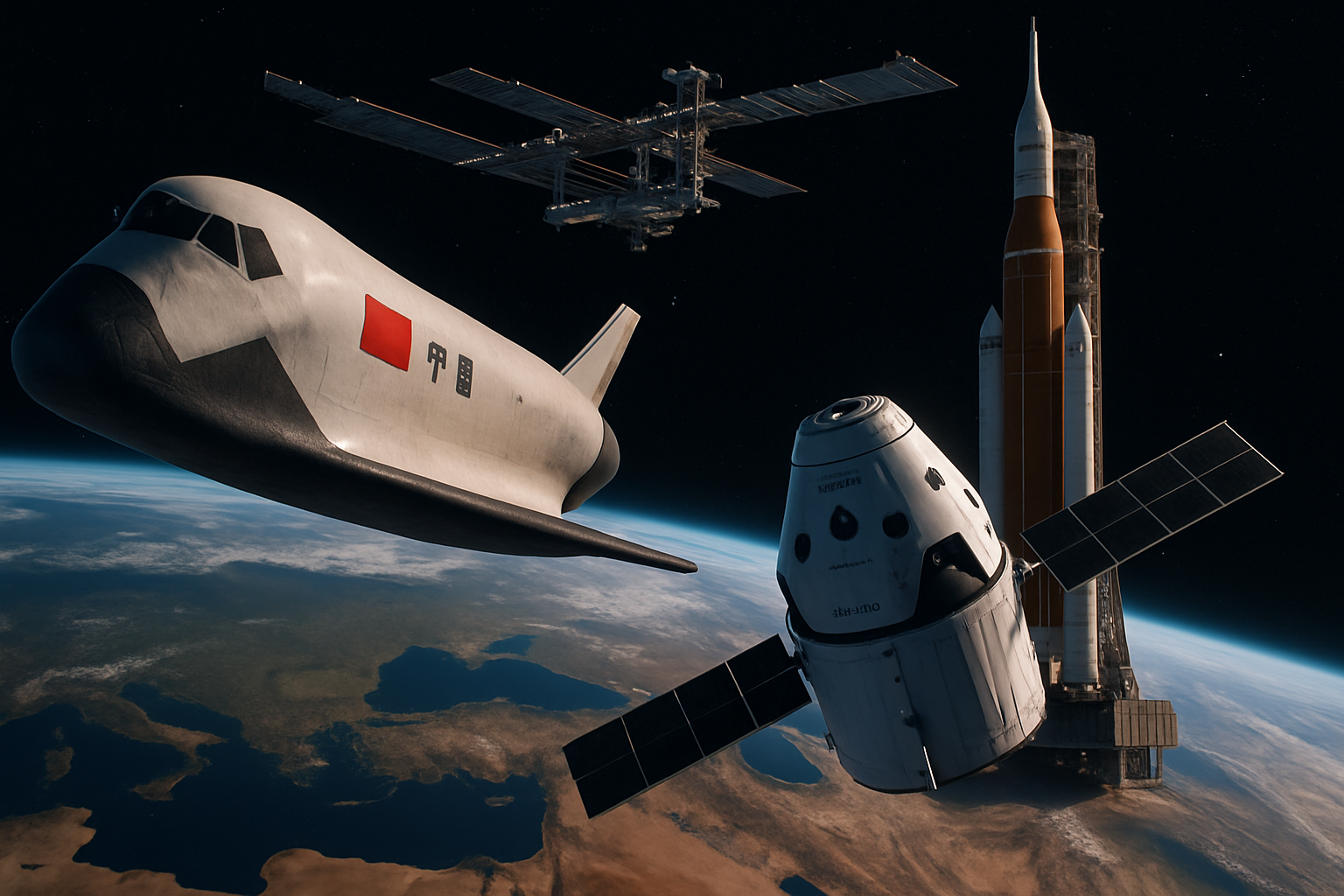
February 2026 has emerged as a watershed moment for global space exploration, with China's successful launch of its fourth reusable Shenlong spacecraft on Saturday coinciding with SpaceX's preparation to resume International Space Station missions after receiving renewed flight authorization.
China's Shenlong Program Reaches New Milestone
China achieved a significant space milestone on Saturday, February 8, 2026, with the successful launch of its latest reusable experimental spacecraft from the Jiuquan Satellite Launch Centre. The mission, conducted using the reliable Long March-2F carrier rocket, represents the fourth successful deployment of what Chinese space enthusiasts have dubbed the "Shenlong" or "Divine Dragon" spacecraft.
This latest mission positions China's secretive reusable space program as a potential rival to the U.S. Space Force's X-37B orbital test vehicle. While the official designation and technical specifications remain classified, the Shenlong program has demonstrated remarkable consistency since its inception in 2020, with all four launches conducted from the same facility using proven rocket technology.
The timing of this launch is particularly significant as it demonstrates China's growing confidence in reusable space technology, a field that has been dominated by American companies like SpaceX. The mission comes amid what space industry analysts have termed the transition from the "AI revolution to space economy golden age," with China positioning itself as a major player in the emerging space-based infrastructure sector.
SpaceX Cleared for ISS Mission Return
Simultaneously, NASA confirmed on Friday that SpaceX has been cleared to resume crewed missions to the International Space Station, with the Crew-12 mission scheduled for February 11, 2026. The mission will transport four astronauts, including French astronaut Sophie Adenot, marking the resumption of regular crew rotations after SpaceX rockets were temporarily grounded.
The authorization comes after extensive safety reviews and follows SpaceX's successful demonstration of its ability to control satellite access, including blocking Russian military use of Starlink terminals in Ukraine. This operational flexibility has enhanced confidence in SpaceX's systems management capabilities.
According to Russian media reports, SpaceX's ambitious timeline originally called for an unmanned Mars mission in 2026, but company plans have evolved to focus on lunar operations first. The Wall Street Journal reports that SpaceX now plans to conduct an unmanned Moon landing in March 2027, representing a strategic shift in Elon Musk's space exploration priorities.
NASA's Lunar Ambitions Gain Momentum
NASA's commitment to lunar exploration received renewed emphasis during recent international discussions. Veteran NASA astronaut Stephen Bowen, speaking in Vienna, reinforced the importance of returning to the Moon, stating that "the Moon is only the beginning" of humanity's space exploration journey.
Bowen, one of NASA's most experienced astronauts, shared insights from his International Space Station missions and emphasized how lunar exploration will serve as a crucial stepping stone for future Mars missions. His comments align with NASA's Artemis program goals, which have faced technical challenges but continue to advance toward the ambitious target of returning humans to the lunar surface.
The Artemis II mission, currently planned for March 2026, will send four astronauts on a 10-day lunar flyby—the first crewed mission beyond Earth orbit since Apollo 17 in 1972. Despite previous delays due to hydrogen leak issues during testing, NASA maintains its commitment to safety-first protocols while working toward this historic milestone.
International Space Station Operations Continue
The International Space Station remains a focal point of international cooperation and scientific research. Recent crew rotations have maintained full operational capacity aboard the orbital laboratory, with four astronauts scheduled to launch next week to continue essential research and maintenance operations.
Spanish media reports indicate that the upcoming mission follows a medical evacuation that temporarily reduced station staffing levels. The prompt scheduling of replacement crew members demonstrates the robust international partnership that keeps the ISS operational as a crucial platform for scientific research and space exploration technology development.
Sweden's Space Exploration Perspective
Swedish coverage of NASA's lunar exploration plans reflects growing international interest in the return to lunar exploration. As reported by Swedish media, the current lunar mission represents humanity's first return to the Moon since 1972, capturing public imagination and scientific community attention worldwide.
The international perspective on space exploration reveals how NASA's Artemis program has reinvigorated global interest in lunar science and exploration. This renewed focus comes at a time when multiple nations are developing their own space capabilities, creating both competitive and cooperative dynamics in the international space community.
Strategic Implications of Reusable Spacecraft Technology
The parallel development of reusable spacecraft by both China and private American companies represents a fundamental shift in space access economics. China's Shenlong program, while secretive, demonstrates the nation's commitment to developing cost-effective space access capabilities that could support everything from satellite deployment to space station operations.
SpaceX's proven track record with reusable Falcon 9 rockets and Dragon spacecraft has revolutionized space transportation costs, enabling more frequent and affordable access to orbit. The company's ability to rapidly iterate and improve its technology while maintaining safety standards has set new industry benchmarks for operational efficiency.
These technological advances are occurring within the broader context of what industry experts describe as an emerging "space economy golden age," where space-based infrastructure, satellite networks, and orbital manufacturing could create trillion-dollar economic opportunities.
Future Missions and International Cooperation
The current surge in space activity reflects both competitive and collaborative aspects of international space exploration. While China's Shenlong program operates independently, international cooperation continues through ISS operations, shared scientific research, and collaborative mission planning.
Pakistan's recent announcement of astronaut candidates for China's Tiangong space station and ongoing European space initiatives demonstrate the expanding global participation in human spaceflight. These developments suggest that space exploration is becoming more accessible to nations beyond the traditional space powers.
The integration of artificial intelligence into space operations, as demonstrated by NASA's successful AI-planned Mars rover missions, represents another frontier that will shape future exploration capabilities. Autonomous systems enable real-time decision-making across vast cosmic distances, dramatically improving mission efficiency and scientific output.
Challenges and Opportunities Ahead
Despite remarkable progress, space exploration faces ongoing challenges including technical complexity, funding sustainability, and international coordination requirements. The recent hydrogen leak issues that delayed Artemis II demonstrate how technical problems can impact ambitious timelines, while the global memory crisis affecting semiconductor production highlights supply chain vulnerabilities for space technology.
However, the current period also presents unprecedented opportunities. Commercial space companies are demonstrating capabilities once exclusive to government agencies, while international cooperation frameworks are enabling shared costs and risks for major exploration initiatives.
The convergence of reusable rocket technology, advanced life support systems, AI-enhanced navigation, and international partnership models is creating conditions for sustained human presence beyond Earth orbit for the first time in history.
As February 2026 progresses, the successful launch of China's fourth Shenlong mission and SpaceX's return to ISS operations symbolize the dynamic, competitive, and collaborative nature of contemporary space exploration. These developments mark not just technical achievements, but stepping stones toward humanity's expansion into the solar system—with the Moon serving as the crucial next destination in our species' greatest adventure.