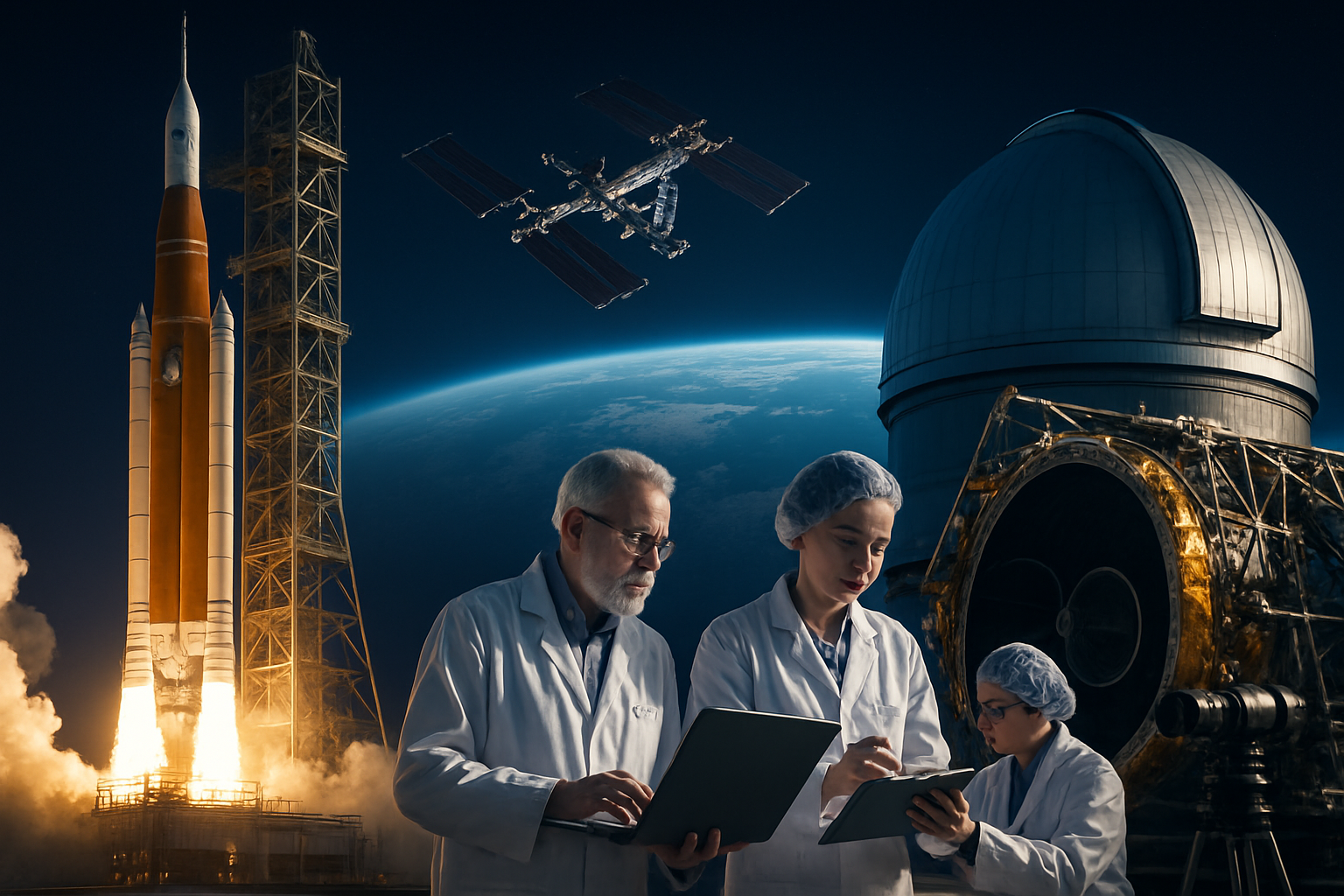
International space agencies and research institutions face a complex landscape of technical challenges and scientific breakthroughs as February 2026 unfolds, with NASA's Artemis program experiencing further delays while revolutionary advances in planetary defense and space technology development continue across multiple nations.
NASA's ambitious Artemis II mission has encountered another significant setback, with persistent fuel leaks forcing the space agency to end critical fueling tests early Tuesday morning. The hydrogen leak issues, which have plagued the giant orange rocket system for months, now threaten to delay the historic lunar flyby mission by at least a month beyond its planned launch window.
Artemis Program Faces Technical Hurdles
The latest setback represents a continuation of challenges that have dogged NASA's Space Launch System (SLS) rocket, designed to carry astronauts around the Moon for the first time since the Apollo era. According to sources familiar with the testing, the fuel leak problems that emerged during the wet dress rehearsal have proven more persistent than initially anticipated, raising questions about the rocket's readiness for its crucial mission.
This delay comes at a critical juncture for international lunar exploration efforts, as NASA's Artemis program serves as the foundation for broader international cooperation in returning humans to the Moon. The mission was already facing scrutiny following previous technical delays and cost overruns that have characterized the program's development timeline.
Russian Space Capabilities Advance
While NASA grapples with its challenges, Russia continues advancing its space infrastructure with the Khrunichev Center beginning production of three Angara-A5M rockets specifically designed for launching modules to the Russian Orbital Station (ROS). This development represents the next phase in Russia's ambitious space program modernization, with the Angara-A5M variant being adapted specifically for crewed spacecraft launches.
The Angara rocket family represents Russia's effort to establish launch independence and reduce reliance on aging Soviet-era launch systems. The modernization program signals Russia's commitment to maintaining its position as a major spacefaring nation despite ongoing geopolitical tensions affecting international space cooperation.
"The next phase in the Angara-A5 modernization program involves adapting the rocket for launching manned spacecraft."
— Russian Space Industry Sources
Revolutionary Planetary Defense Research
Greek scientists have made remarkable strides in planetary defense research, providing scientific validation for concepts previously relegated to science fiction. Their latest study suggests that nuclear weapons could indeed be effective in deflecting dangerous asteroids, lending credibility to scenarios popularized in the 1998 blockbuster "Armageddon."
This research comes at a crucial time as international space agencies increasingly focus on planetary defense capabilities. The study's findings could inform future missions designed to protect Earth from potentially hazardous asteroids, building on previous successful demonstrations like NASA's DART mission.
International Scientific Collaboration
Bulgarian research efforts in Antarctica demonstrate the global nature of scientific exploration, with the research vessel "St. Cyril and Methodius" conducting critical scientific sampling operations in the Southern Ocean. The vessel's mission to collect water samples and conduct seafloor surveys around the Bernard Peninsula and Elephant Point represents ongoing international commitment to understanding Earth's most remote environments.
The Bulgarian Antarctic expedition includes tribute ceremonies honoring fallen Argentine naval personnel, highlighting the spirit of international cooperation that characterizes modern scientific research despite geopolitical tensions elsewhere.
Astronomical Observations and Space Science
Azerbaijan's capital Baku is preparing to witness the "Great Planetary Parade," a rare astronomical phenomenon that offers exceptional opportunities for public engagement with space science. Such events serve as crucial catalysts for inspiring the next generation of scientists and engineers who will drive future space exploration efforts.
These observational opportunities complement ongoing space-based research and ground-based astronomy programs that continue expanding human understanding of the cosmos. The alignment of multiple planets provides unique research opportunities for astronomers studying planetary motions and gravitational interactions.
Defense Technology Advancement
India's Defence Research and Development Organisation (DRDO) has achieved a significant breakthrough with successful testing of Solid Fuel Ducted Ramjet (SFDR) technology. This advancement positions India among an elite group of nations possessing advanced air-breathing missile technology, with applications extending beyond military uses to potential space launch systems.
The SFDR technology represents sophisticated engineering that could revolutionize both defense and civilian aerospace applications. Air-breathing engines offer significant advantages in terms of efficiency and payload capacity, potentially influencing future space launch vehicle designs.
Simultaneously, India's maritime surveillance capabilities are receiving substantial enhancement through a planned $3 billion agreement with the United States for advanced P-8I aircraft. This development strengthens India's ability to monitor vast ocean areas and contributes to international maritime security efforts.
Challenges and Future Prospects
The current state of global space and scientific research reveals both remarkable achievements and persistent challenges. Technical difficulties with major programs like Artemis II demonstrate the inherent complexity of space exploration, while successful developments in countries like Russia and India show the distributed nature of contemporary space capabilities.
International scientific cooperation, exemplified by Antarctic research missions and astronomical observations, continues despite geopolitical tensions. These collaborative efforts prove essential for addressing global challenges that transcend national boundaries, from climate change research to planetary defense.
The convergence of military and civilian space technologies, particularly evident in India's SFDR development and maritime surveillance enhancements, reflects the dual-use nature of many advanced aerospace technologies. This trend likely will accelerate as space becomes increasingly important for national security and economic competitiveness.
Looking Ahead
As February 2026 progresses, the space and scientific research community faces critical decisions about program priorities, international cooperation frameworks, and technology development strategies. NASA's Artemis delays may provide opportunities for other nations to advance their lunar exploration capabilities, while breakthrough research in planetary defense and advanced propulsion systems opens new possibilities for protecting Earth and expanding human presence in space.
The success of international scientific collaboration in challenging environments like Antarctica provides a model for future cooperative efforts in space exploration. As space activities become more commercialized and militarized, maintaining the scientific cooperation tradition becomes increasingly important for addressing shared challenges and opportunities.
The developments of early 2026 suggest that space exploration and scientific research will continue evolving rapidly, driven by technological advancement, international competition, and the growing recognition that space activities are essential for addressing terrestrial challenges and ensuring humanity's long-term survival and prosperity.