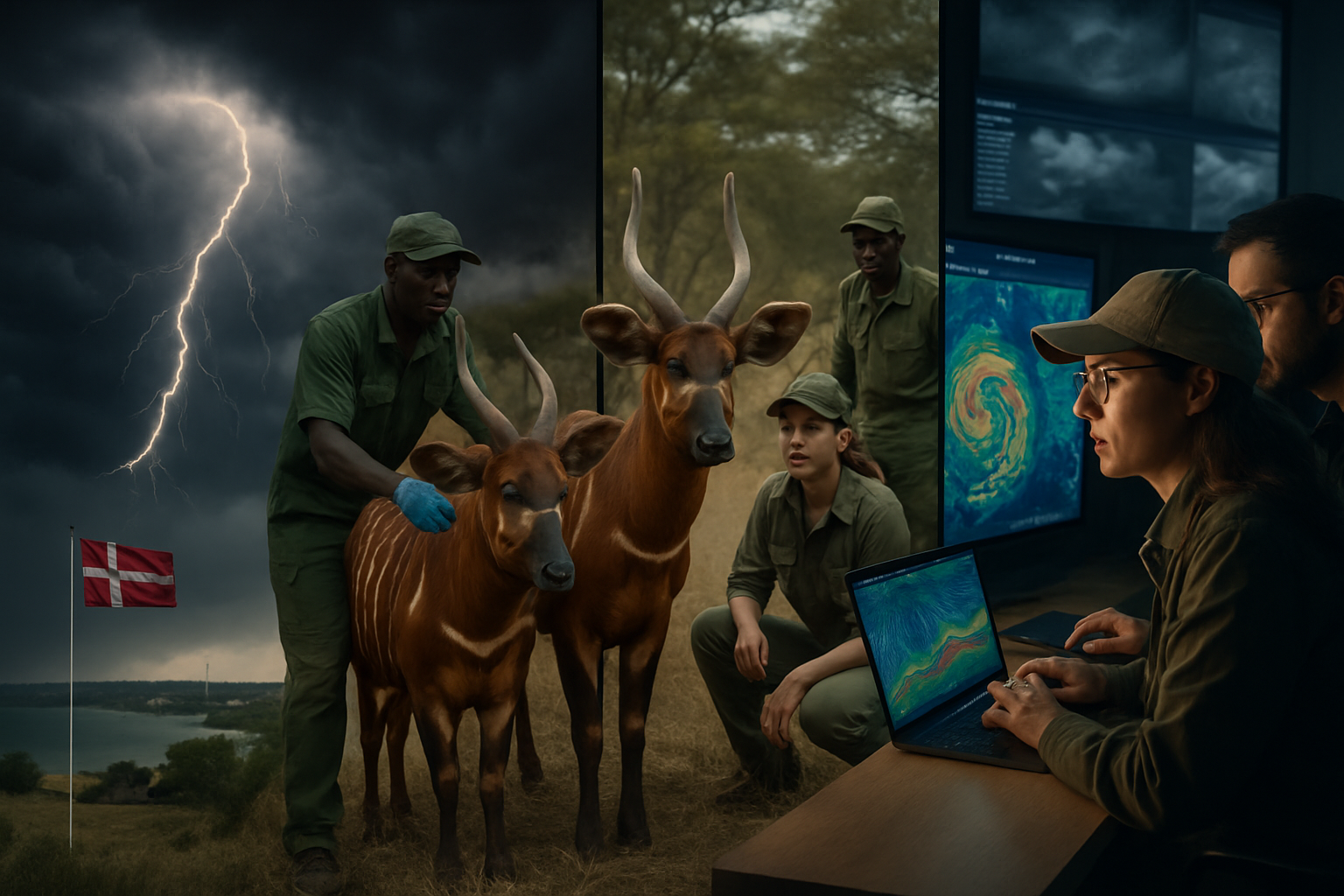
Europe faces another devastating storm as Storm Dave, the fourth named storm of 2026, unleashes winds up to 90 mph across Scotland, Northern Ireland, Wales, and northern England, while halfway around the world, critically endangered mountain bongos bred in European zoos prepare for a historic return to Kenya—two contrasting stories that epitomize the environmental challenges facing our planet during its 23rd consecutive month of temperatures exceeding 1.5°C above pre-industrial levels.
This unprecedented warming streak, confirmed as the longest sustained temperature elevation in recorded human history, forms the backdrop for both devastating weather disasters and remarkable conservation breakthroughs that demonstrate humanity's dual challenge of adapting to climate change while protecting biodiversity.
Storm Dave: Europe's Fourth Weather Emergency of 2026
Ireland's Met Éireann has extended yellow wind warnings to all counties for Easter weekend, with alerts effective from 1pm Saturday to 2am Sunday. Forecaster Gerry Murphy warns that Donegal and the northwest will bear the brunt of the storm, with counties Sligo, Donegal, Leitrim, plus Derry and Antrim facing "very strong winds through the evening."
The storm's intensity has already forced significant disruptions across Northern Europe. In Norway, southern regions face storm warnings with 8,000 households experiencing power outages, while authorities warn residents to avoid parks due to the risk of falling trees. Sweden's SMHI has issued warnings as Nitzan Cohen describes the "risk for stormbyar" (storm squalls) moving inland.
"We're seeing low-pressure systems lining up, forcing Easter egg hunts indoors due to rain, cold, and snow,"
— Hilda Westberg, Swedish Meteorologist
Bulgaria faces dangerous conditions in its Eastern region with thunderstorms, intense rainfall, and hail from an active Mediterranean cyclone. Ibrahim Smajlović from Bosnia Herzegovina's Federal Hydrometeorological Institute warns that current conditions are "just the introduction—the real storm is yet to come."
Historic Conservation Milestone Amid Climate Crisis
While Europe battles extreme weather, a remarkable conservation story unfolds in Kenya. A group of critically endangered mountain bongos, bred in European zoos, are being prepared for transfer back to their ancestral home—part of a long-term effort to rebuild wild populations of one of Africa's rarest large mammals.
The mountain bongo (Tragelaphus eurycerus isaaci) represents one of conservation's greatest challenges and potential success stories. With fewer than 100 individuals remaining in the wild, these magnificent antelopes—distinguished by their striking orange-red coat with white stripes—face extinction in their native Kenyan mountain forests.

The reintroduction program employs cutting-edge conservation science, including genetic screening to ensure optimal breeding pairs, satellite monitoring of release sites, and environmental DNA sampling to track ecosystem recovery. This sophisticated approach represents the evolution of modern conservation from reactive crisis management to proactive ecosystem service management.
The Climate Context: 23 Months of Unprecedented Warming
Both the extreme weather battering Europe and the conservation efforts in Kenya occur within the context of Earth's most challenging environmental period. January 2026 marked the 23rd consecutive month of global temperatures exceeding the critical 1.5°C threshold above pre-industrial levels—a sustained warming streak that climate scientists describe as unprecedented in recorded human history.
This warming has fundamentally altered atmospheric systems, creating what researchers call the "climate volatility paradox"—sustained global warming enables both heat records and devastating regional extremes through disrupted atmospheric circulation and polar vortex patterns.
The World Meteorological Organization projects a 50-60% probability of El Niño development during July-September 2026, which could drive temperatures into unprecedented territory through the combination of baseline warming plus natural cycle amplification.
Emergency Response Systems Under Strain
Storm Dave represents the latest test of European emergency response systems already strained by previous disasters. This follows the devastating February 2026 Atlantic storm succession of Kristin, Leonardo, Marta, Nils, and Pedro, which claimed 35+ lives across Portugal, Spain, and France, requiring 26,500 emergency personnel in Portugal's largest peacetime operation.
The EU Civil Protection Mechanism has been repeatedly activated, with the Sweden-Denmark €246 million assistance package representing the largest coordinated European weather response on record. However, emergency management experts warn that traditional mutual aid mechanisms designed for sequential disasters prove inadequate when multiple regions face simultaneous crises.
"We're seeing a fundamental breakdown of emergency systems designed for historical climate patterns. Infrastructure repeatedly operates beyond its design parameters as extreme weather exceeds operational thresholds."
— Dr. Sarah Chen, European Centre for Medium-Range Weather Forecasts
Conservation Renaissance Amid Climate Crisis
Despite the climate crisis acceleration, conservation efforts worldwide show remarkable success. The mountain bongo reintroduction joins a growing list of conservation victories demonstrating humanity's capacity to protect biodiversity even during environmental stress.
Recent achievements include:
- Croatia's record griffon vulture populations in the northern Adriatic, with 173 breeding pairs marking the highest count in decades
- Zimbabwe's world-first DNA forensic wildlife crime prosecutions, transforming anti-poaching through scientific evidence
- New Zealand's Otago Peninsula achieving possum-free status after decades of intensive management
- Ecuador's successful reintroduction of 158 giant tortoises to Floreana Island after a 150-year absence
These successes share common elements: sophisticated integration of cutting-edge technology with traditional ecological knowledge, community-based management, economic incentives that make protection financially viable, and sustained international cooperation.
Economic and Social Impacts
The convergence of extreme weather and conservation needs creates complex economic challenges. Agricultural sectors face mounting losses from extreme weather destroying crops and disrupting supply chains during critical growing seasons. Tourism industries experience extended cancellations and infrastructure damage during peak revenue periods.
Mental health services report increased demand for climate anxiety and repeated trauma support as families face the prospect of losing generational properties multiple times within a decade. Recovery timelines have shifted from weeks to months or years, representing a fundamental change in disaster response approaches.
However, comprehensive environmental protection demonstrates economic benefits. Countries implementing robust wildlife conservation show greater economic resilience and attract sustainable investment in eco-tourism, environmental technology manufacturing, and green services.
International Cooperation at a Critical Juncture
The simultaneity of disasters tests international cooperation frameworks designed for sequential regional assistance rather than concurrent global emergencies. Environmental challenges transcend political boundaries as atmospheric systems, ocean currents, and species migrations operate regardless of borders.
The mountain bongo conservation program exemplifies successful international cooperation, with European zoos providing breeding expertise and genetic resources while Kenyan conservationists offer habitat management knowledge and community engagement experience.

This cooperation framework offers templates for scaling environmental protection globally through coordinated approaches that address multiple challenges while building local capacity and fostering international partnerships.
Technology-Tradition Integration: The Future of Conservation
Modern conservation successes increasingly demonstrate sophisticated synthesis of cutting-edge technology with traditional ecological knowledge. The mountain bongo program employs genetic analysis, satellite monitoring, and environmental DNA sampling while respecting traditional Kenyan forest management practices and community stewardship systems.
This represents a fundamental evolution in conservation methodology—moving beyond purely technological or traditional approaches toward comprehensive, scientifically rigorous yet culturally sensitive frameworks that combine the precision of modern science with generations of traditional knowledge.
April 2026: A Watershed Moment
April 2026 represents a critical juncture in global environmental protection—a choice between reactive crisis management and transformative infrastructure adaptation. Current conditions provide a preview of routine 2030s circumstances without immediate comprehensive adaptation investment.
The environmental action window is narrowing rapidly as ecological systems approach critical thresholds that could trigger irreversible changes affecting global food security, climate stability, and human settlements. However, the tools, knowledge, and cooperation frameworks exist for comprehensive environmental protection.
Success depends on unprecedented speed and coordination through sustained international cooperation, enhanced multi-sector coordination, and increased financial commitments that recognize environmental protection as essential infrastructure for human prosperity and planetary sustainability.
Looking Forward: Hope Amid Crisis
The convergence of Storm Dave's destruction and the mountain bongo conservation breakthrough encapsulates humanity's current environmental moment—facing unprecedented challenges while demonstrating remarkable capacity for adaptation and species protection.
The question is no longer whether transformative environmental action is needed, but whether humanity can organize and implement solutions rapidly enough to maintain planetary habitability during Earth's most environmentally challenging period in recorded history.
"We're at a decisive moment where our choices in the coming months will determine climate resilience strategies affecting generations. The tools exist—what we need now is the will to use them at the scale and speed required."
— Dr. Maria Santos, International Climate Adaptation Institute
As Storm Dave continues its destructive path across Europe and mountain bongos prepare for their historic return to Kenyan forests, these parallel stories remind us that environmental protection and climate adaptation are not separate challenges but interconnected imperatives that will define our species' adaptive capacity in the decisive climate action decade ahead.