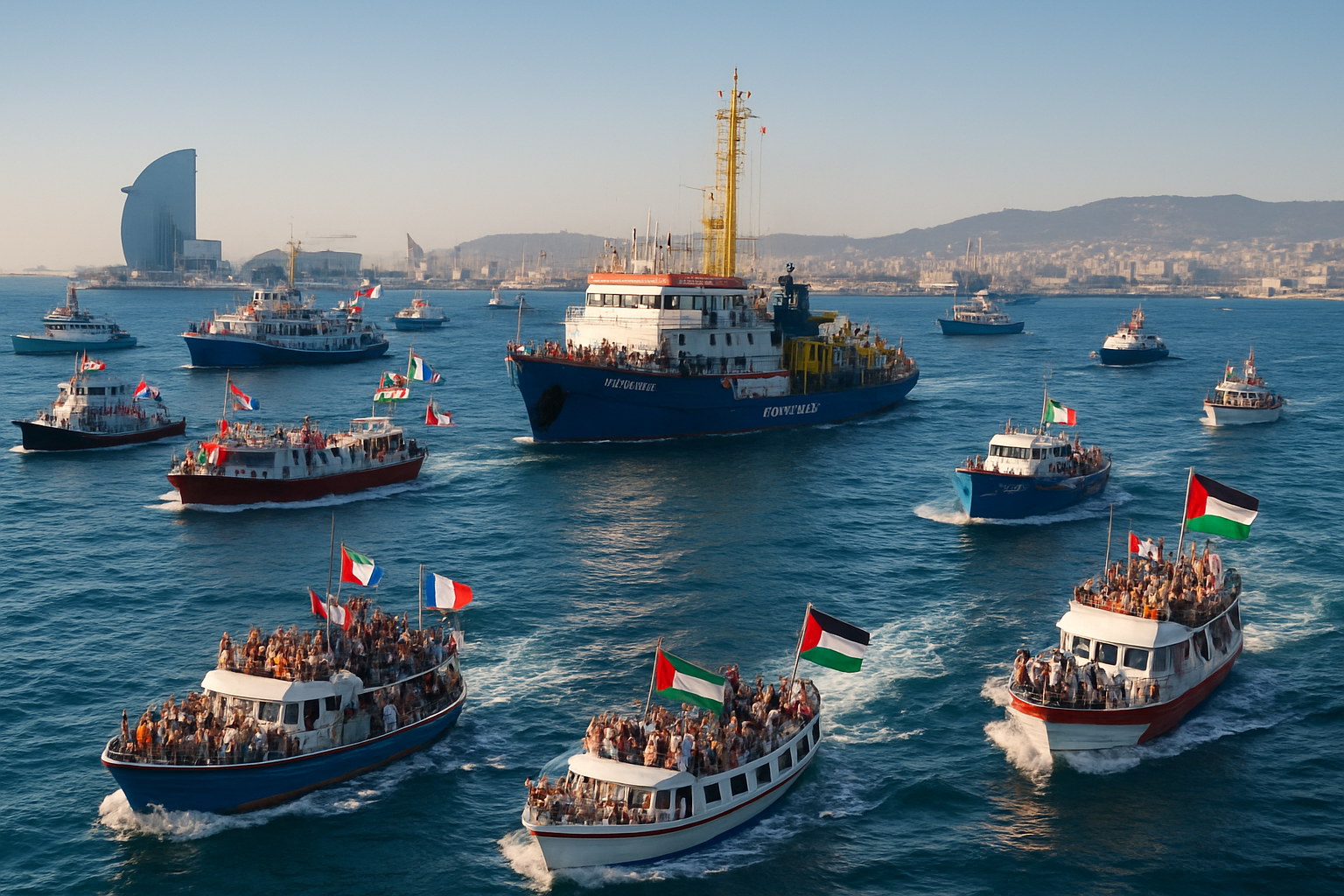
Over 1,000 activists from nearly 100 countries launched the largest Global Sumud Flotilla in history from Barcelona's port on Sunday, April 12, 2026, departing for Gaza in a renewed bid to deliver humanitarian aid and challenge Israel's maritime blockade of Palestinian territory.
The unprecedented maritime mission, greeted with cheers and applause from thousands of supporters gathered at Barcelona's port, represents the most significant civilian-led humanitarian intervention since the Gaza crisis escalated. French media reports describe activists from across Europe setting sail to "bring Israel's blockade of the territory back into the global spotlight," while Al Jazeera confirmed this as the "largest ever Global Sumud Flotilla."
The flotilla's departure comes at a critical moment in the Palestinian humanitarian crisis, with Gaza facing systematic infrastructure collapse and ongoing ceasefire violations that have killed over 680 Palestinians since the October 2025 truce. The mission significantly surpasses the October 2025 Global Sumud Flotilla of 40 boats, which was intercepted by Israeli military forces resulting in the arrest of climate activist Greta Thunberg and 450+ participants.
Historical Context and Growing International Pressure
The 2026 flotilla builds upon months of escalating international condemnation of Israeli policies. In February, 85 UN member states issued an unprecedented joint condemnation of Israel's West Bank expansion plans, with UN Secretary-General António Guterres expressing "grave concern" over measures threatening the two-state solution viability through "dangerous escalation."
"This is the largest civilian humanitarian mission to Gaza planned, testing international maritime law and diplomatic frameworks."
— International observers, February 2026 announcement
The mission was originally announced in February 2026 at the Nelson Mandela Foundation in Johannesburg, with plans for over 100 boats carrying up to 1,000 medics and humanitarian workers. Mandla Mandela, Nelson Mandela's grandson and one of the organizers who was previously detained during flotilla operations, has been instrumental in coordinating this largest-scale civilian humanitarian mission to Gaza.
Humanitarian Crisis in Gaza Intensifies
The flotilla departs against the backdrop of a deepening humanitarian catastrophe in Gaza. According to medical authorities, the Gaza Civil Defense has completely shut down due to fuel shortages, hampering emergency response capabilities. The Rafah crossing remains severely limited to just 27 Palestinians crossing daily versus a 200-person quota, with Hamas condemning "systematic harassment" by Israeli security forces.
Dr. Mohamed Abu Selmiya, director of Al-Shifa Hospital, has repeatedly questioned "Where is the ceasefire?" as over 1,600 systematic violations have been documented since the October 2025 truce. The humanitarian situation has deteriorated to the point where 20,000+ Palestinians await medical evacuation, with Health Ministry Director Zaher al-Wahidi reporting that 6-10 critically ill patients are dying daily.
The Lancet medical journal confirmed in March 2026 that actual Gaza casualties exceed 75,000, representing a 35% undercount from official figures and affecting 3-4% of the total population. This study revealed the true scope of the humanitarian crisis that the Global Sumud Flotilla seeks to address through direct action.
International Legal Framework and Maritime Rights
The flotilla operates within the complex framework of international maritime law and represents a direct challenge to Israel's naval blockade of Gaza. International legal experts have cited potential violations of UN Security Council resolutions and Geneva Conventions regarding occupied territories and civilian protection.
The Euro-Mediterranean Human Rights Observatory has accused Israel of exploiting international focus on the Iran conflict to intensify Gaza civilian starvation policies. This strategic timing has enabled what critics describe as systematic violations of international humanitarian law while global attention remains divided across multiple regional crises.
Eight Arab nations, including countries with normalized relations with Israel such as Saudi Arabia and the UAE, have issued joint condemnations calling the measures violations of international law "aimed at imposing unlawful Israeli sovereignty" and undermining the two-state solution.
Broader Regional Context and International Response
The flotilla launch occurs within the broader context of the most serious Middle Eastern conflict since the Cold War. The March 1, 2026 death of Iran's Supreme Leader Khamenei triggered a diplomatic collapse, while the November 2024 US-French Israel-Hezbollah ceasefire completely shattered in March 2026 when Hezbollah chose "Iranian solidarity over Lebanese sovereignty."
Lebanon faces its own humanitarian catastrophe with 1.2 million displaced (25% of the population) and emergency shelters overwhelmed, forcing thousands to sleep on Beirut streets. The systematic targeting of medical personnel continues with 26 paramedics killed and 51 wounded since March 2026, raising serious Geneva Conventions violations concerns.
French President Emmanuel Macron has offered to host direct Israel-Lebanon talks in Paris, marking the first negotiations since the ceasefire collapse. UN Secretary-General António Guterres has called the situation "the greatest test of multilateral cooperation in the modern era."
Previous Flotilla Operations and Escalating Response
The Global Sumud Flotilla movement has evolved significantly since its inception. The October 2025 operation, while smaller in scale with 40 boats, demonstrated both the international solidarity commitment and the risks involved. The arrest of high-profile activists like Greta Thunberg brought global media attention to the blockade issue and Palestinian humanitarian needs.
Previous intercepts by Israeli military forces have followed a pattern of arrests and boat seizures, but the scale of the 2026 mission presents unprecedented challenges for enforcement. With over 100 boats from nearly 100 countries, the logistical complexity of interception while maintaining international law compliance becomes significantly more difficult.
The international coordination involves multiple countries' activists and represents growing frustration with traditional diplomatic channels and conventional humanitarian access routes. As traditional aid delivery mechanisms face restrictions and systematic barriers, civilian-led maritime missions have emerged as alternative solidarity expressions.
Strategic Implications and Global Governance
The 2026 Global Sumud Flotilla represents more than a humanitarian mission; it constitutes a template-setting moment for international civilian intervention in territorial disputes and humanitarian crises. The success or failure of this mission will influence approaches to territorial sovereignty, international law enforcement, and conflict resolution mechanisms for decades.
The timing coincides with what experts describe as a "window narrowing for effective climate action" and international cooperation. With 18 consecutive months of global temperatures exceeding 1.5°C above pre-industrial levels, the humanitarian crisis in Gaza intersects with broader challenges facing international governance systems.
"The largest scale civilian humanitarian mission to Gaza planned, testing international maritime law and diplomatic frameworks represents growing frustration with diplomatic channels and traditional humanitarian access."
— International coordination analysis, February 2026
The flotilla occurs against the backdrop of what Pakistani officials describe as the "greatest test of multilateral cooperation in modern crisis management." Pakistan's successful mediation of the "Islamabad Accord" between the US and Iran demonstrates middle power capability to bridge major adversaries when traditional mechanisms fail.
Economic and Political Pressures
The humanitarian mission launches amid significant economic pressures affecting the broader region. Global oil prices have exceeded $100 per barrel for the first time since 2014, with Iran's Strait of Hormuz closure affecting 40% of global oil transit. The International Energy Agency has conducted its largest strategic reserve release in 50-year history, deploying 400 million barrels across 32 countries.
Aviation disruptions have reached COVID-scale proportions with 18,000+ flights cancelled worldwide, affecting international evacuation capabilities and humanitarian coordination. Australia reports 115,000 nationals trapped in the region, while Germany has 30,000 stranded tourists requiring evacuation support.
The economic implications extend beyond immediate humanitarian concerns to questions of sustainable international development and climate adaptation funding. The European Union has activated its ESTIA Cyprus evacuation protocol for the first time in bloc history, demonstrating the unprecedented nature of current regional challenges.
Looking Forward: Diplomatic Solutions and International Law
As the Global Sumud Flotilla progresses toward Gaza, the international community faces critical decisions about conflict resolution approaches and civilian protection mechanisms. The success of this mission may influence whether diplomatic intervention prevents broader regional warfare or military escalation continues affecting millions of civilians.
The flotilla represents what analysts describe as a "template-setting 21st-century precedent" for civilian intervention in territorial disputes. The coming weeks will determine whether international pressure achieves meaningful policy reversals or further deterioration makes Palestinian statehood technically unfeasible through systematic demographic and geographic alteration.
With over 400 EU diplomats demanding increased pressure on Israeli authorities and European petition signatures against EU-Israel partnerships exceeding 400,000, the political pressure for policy change continues mounting. The Global Sumud Flotilla serves as both humanitarian mission and political statement, challenging the international community to translate diplomatic rhetoric into concrete protective action for Palestinian civilians.
The mission's outcome will likely influence global precedents for territorial sovereignty disputes, international law enforcement credibility, and civilian protection mechanisms in an era of great power competition and climate volatility. As the boats sail toward Gaza waters, they carry not only humanitarian supplies but also the hopes of a global movement demanding accountability for systematic violations of international humanitarian law.