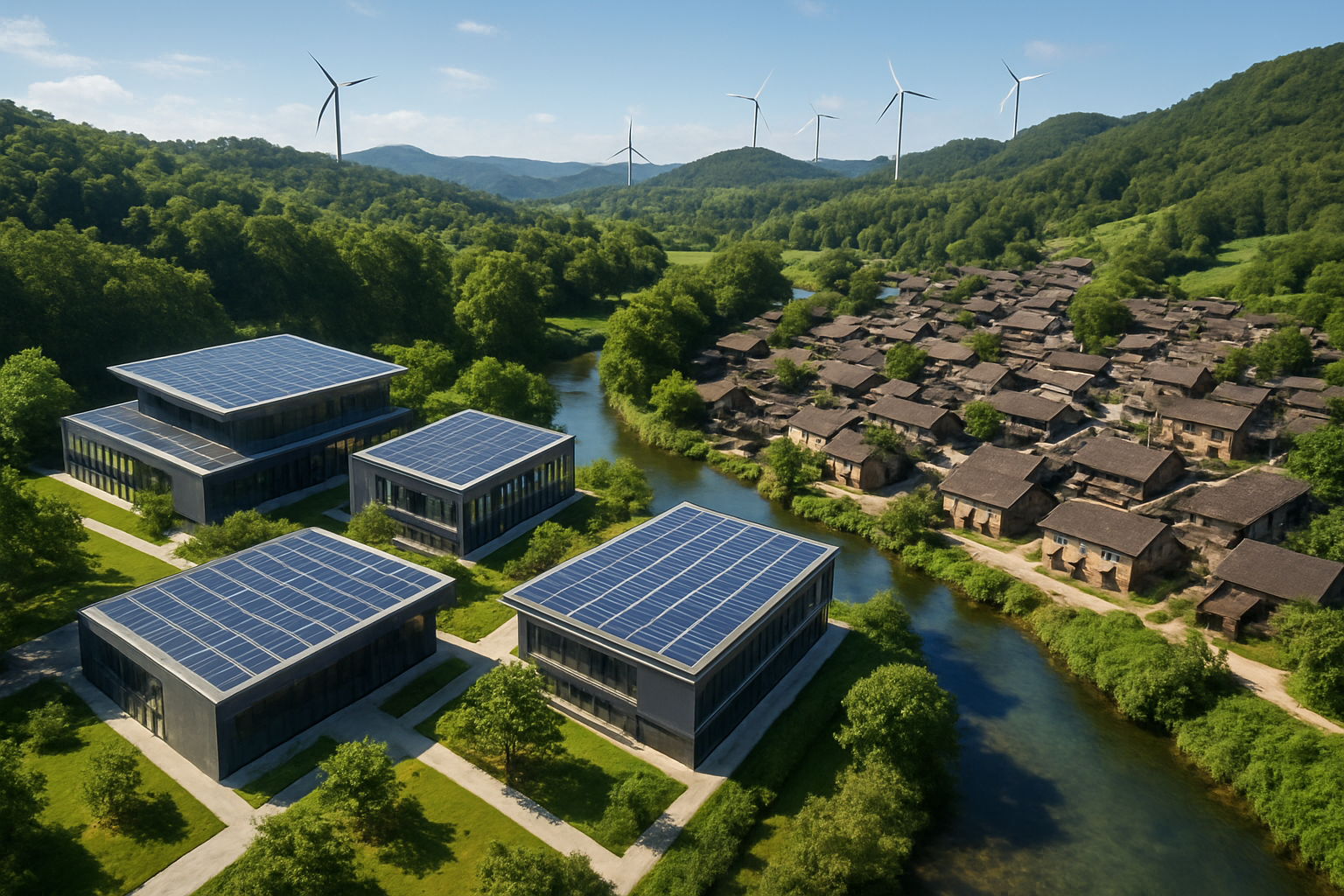
A powerful surge in sustainable development projects spanning three diverse regions demonstrates how nations are transforming environmental challenges into innovative solutions, as Cyprus, Monaco, and Saint Vincent and the Grenadines lead groundbreaking initiatives during the 19th consecutive month of global temperatures exceeding 1.5°C above pre-industrial levels.
The coordinated environmental action comes as January 2026 was confirmed as the hottest month in recorded history, with sustained warming overriding natural climate variability including La Niña cooling effects. This unprecedented climate backdrop has catalyzed a fundamental shift from reactive crisis management to proactive ecosystem service management across multiple continents.
Cyprus Leads Corporate Sustainability Revolution
Lidl Cyprus has unveiled its third annual Sustainability Report for 2024, marking a transformative approach to responsible entrepreneurship under the central motto "Redefining Sustainability – Building our Common Home." The comprehensive initiative, presented as a joint publication with Lidl Hellas, represents the evolution of sustainability from corporate obligation to daily operational practice.
The retailer's ambitious framework encompasses five critical areas of environmental action: Climate Protection with a Net Zero target by 2050, Resource Conservation initiatives, comprehensive waste reduction programs, biodiversity protection measures, and community engagement strategies. This holistic approach positions Cyprus as a regional leader in sustainable retail practices, demonstrating how smaller nations can drive significant environmental change through corporate innovation.
"This year's edition showcases how sustainability is transformed into daily practice, generating value for the Cypriot economy, society and the environment."
— Lidl Cyprus Leadership Team
The joint Cyprus-Greece approach enables the exchange of best practices and maximizes positive environmental impact across both countries, creating a template for regional cooperation in corporate sustainability. This model demonstrates how environmental protection functions as an economic development strategy rather than a regulatory burden, attracting sustainable investment and enhancing international competitiveness.
Monaco Spearheads Ocean Conservation Partnership
The Prince Albert II of Monaco Foundation has announced a landmark partnership with the Commonwealth Secretariat to accelerate ocean conservation across Commonwealth nations in Asia and the Pacific. This strategic alliance, unveiled during Commonwealth Day in London, represents a sophisticated evolution in international environmental diplomacy where smaller nations take leadership roles in planetary-scale challenges.
The collaboration operates through the Commonwealth Blue Charter Project Incubator, providing grants of up to £50,000 to help Commonwealth countries develop early-stage ocean conservation projects. The Foundation's focused support on Asia and Pacific regions addresses areas already experiencing severe impacts from sea-level rise and marine ecosystem degradation.
This partnership advances the goals of the Apia Commonwealth Ocean Declaration, unanimously adopted at the Commonwealth Heads of Government Meeting in Samoa in 2024. The declaration called for the restoration, protection, and sustainable use of the world's oceans, recognizing that one-third of the world's population depends directly on marine resources for their livelihoods.
The Monaco initiative demonstrates how international cooperation is evolving from traditional North-South aid models toward peer-to-peer knowledge sharing, where smaller nations become environmental solution providers. This approach leverages Monaco's unique position as a sustainable luxury destination to drive global marine conservation efforts.
Caribbean Pioneers Renewable Energy Microgrids
In a groundbreaking development for Caribbean energy independence, the Taiwan Technical Mission and St. Kitts Electricity Company (SKELEC) have successfully completed critical site assessments for innovative renewable energy microgrids. This collaboration marks the transition from conceptual design to physical construction of solar panels and battery storage systems on government buildings.
During the comprehensive survey, engineers evaluated structural integrity and shading patterns to optimize solar panel placement and battery storage configuration. The microgrid technology represents a revolutionary approach to energy resilience in small island developing states, providing backup power during extreme weather events and reducing dependence on imported fossil fuels.
The SKELEC microgrid project addresses multiple challenges simultaneously: energy security, climate adaptation, and economic sustainability. By deploying distributed energy systems, Caribbean nations can reduce their vulnerability to supply chain disruptions while building local technical capacity in renewable energy technologies.
This initiative reflects the broader trend of South-South cooperation in climate action, where developing nations share locally-adapted innovations that can be scaled across similar contexts. The success of the microgrid assessment provides a template for other small island states facing similar energy security challenges.
Technology-Tradition Integration: A New Conservation Paradigm
The success of these diverse initiatives demonstrates the critical importance of integrating cutting-edge technology with traditional ecological knowledge and community-based management. Cyprus combines advanced retail analytics with Mediterranean cultural sustainability practices, while Monaco leverages digital marine monitoring with traditional maritime conservation wisdom.
Similarly, the Caribbean microgrid project builds on traditional community resilience strategies enhanced by modern renewable energy technology. This synthesis represents a fundamental evolution in environmental protection methodology, moving beyond purely technological or traditional approaches toward comprehensive, culturally sensitive frameworks.
The sophisticated integration of satellite monitoring, environmental DNA sampling, and artificial intelligence with centuries of accumulated environmental knowledge creates robust conservation strategies that can adapt to rapidly changing conditions while maintaining cultural authenticity and community ownership.
Economic Development Through Environmental Leadership
All three initiatives demonstrate how environmental protection functions as an economic development engine rather than a regulatory burden. Cyprus's retail sustainability attracts eco-conscious consumers and positions the country for green technology investment, while Monaco's marine conservation enhances its reputation as a luxury sustainable destination.
The Caribbean renewable energy project creates specialized employment opportunities in installation, maintenance, and system management while reducing energy costs for communities. Countries implementing comprehensive environmental protection consistently demonstrate greater economic resilience and attract sustainable investment across multiple sectors.
Economic benefits extend beyond direct environmental sectors to include improved public health outcomes, enhanced agricultural productivity through ecosystem services, and reduced infrastructure costs through natural disaster prevention. This holistic approach to environmental economics is becoming increasingly recognized as essential for long-term prosperity.
International Cooperation: The Key to Success
The success of these initiatives highlights the imperative for unprecedented international cooperation in addressing transnational environmental challenges. Ocean currents transport pollution across continents, atmospheric systems carry climate effects globally, and species migrations connect ecosystems regardless of political boundaries, making unilateral conservation efforts insufficient.
The diversity of approaches across Cyprus, Monaco, and the Caribbean provides resilience against single-solution dependencies, offering multiple adaptation pathways for complex environmental challenges. Knowledge sharing between these regions creates global networks that can respond more effectively to environmental threats.
Success factors consistently include community ownership and engagement, transparent governance frameworks, economic incentives that make protection financially viable, and the integration of traditional ecological knowledge with modern conservation science.
Critical Action Window and Future Implications
March 2026 represents a critical juncture in global environmental protection, with the choice between reactive crisis management and proactive ecosystem service management potentially determining whether conservation efforts can keep pace with accelerating environmental change during this decisive climate action decade.
The environmental action window is rapidly narrowing as ecological systems approach critical thresholds that could trigger irreversible changes affecting global food security, climate stability, and human settlements. However, the tools, knowledge, and cooperation frameworks demonstrated by these three initiatives show that comprehensive environmental protection is achievable with proper planning and commitment.
Success depends on sustained international cooperation, enhanced multi-sector coordination, and increased financial commitments that recognize environmental protection as essential infrastructure for human prosperity and planetary sustainability. The convergence of innovation, cooperation, and political commitment demonstrated in March 2026 offers hope for maintaining planetary habitability during this unprecedented period of environmental challenge.
Templates for Global Scaling
The Cyprus retail sustainability model, Monaco's international marine partnership, and the Caribbean renewable microgrid provide practical templates for scaling environmental protection globally. These initiatives demonstrate that effective conservation requires sophisticated combinations of scientific knowledge, community engagement, technological innovation, and international cooperation adapted to local contexts.
The success stories emerging from these diverse geographical and cultural contexts prove that the fundamental challenge is not identifying environmental solutions, but implementing them at sufficient speed and scale. The window for effective environmental action may be narrowing, but the convergence of innovation, cooperation, and commitment demonstrated by these three nations provides both inspiration and practical guidance for the massive coordination required to address planetary-scale environmental challenges.
As we move forward in this critical climate action decade, the lessons learned from Cyprus, Monaco, and Saint Vincent and the Grenadines offer hope that humanity can develop the adaptive capacity necessary to protect essential environmental systems while building sustainable prosperity for all nations.