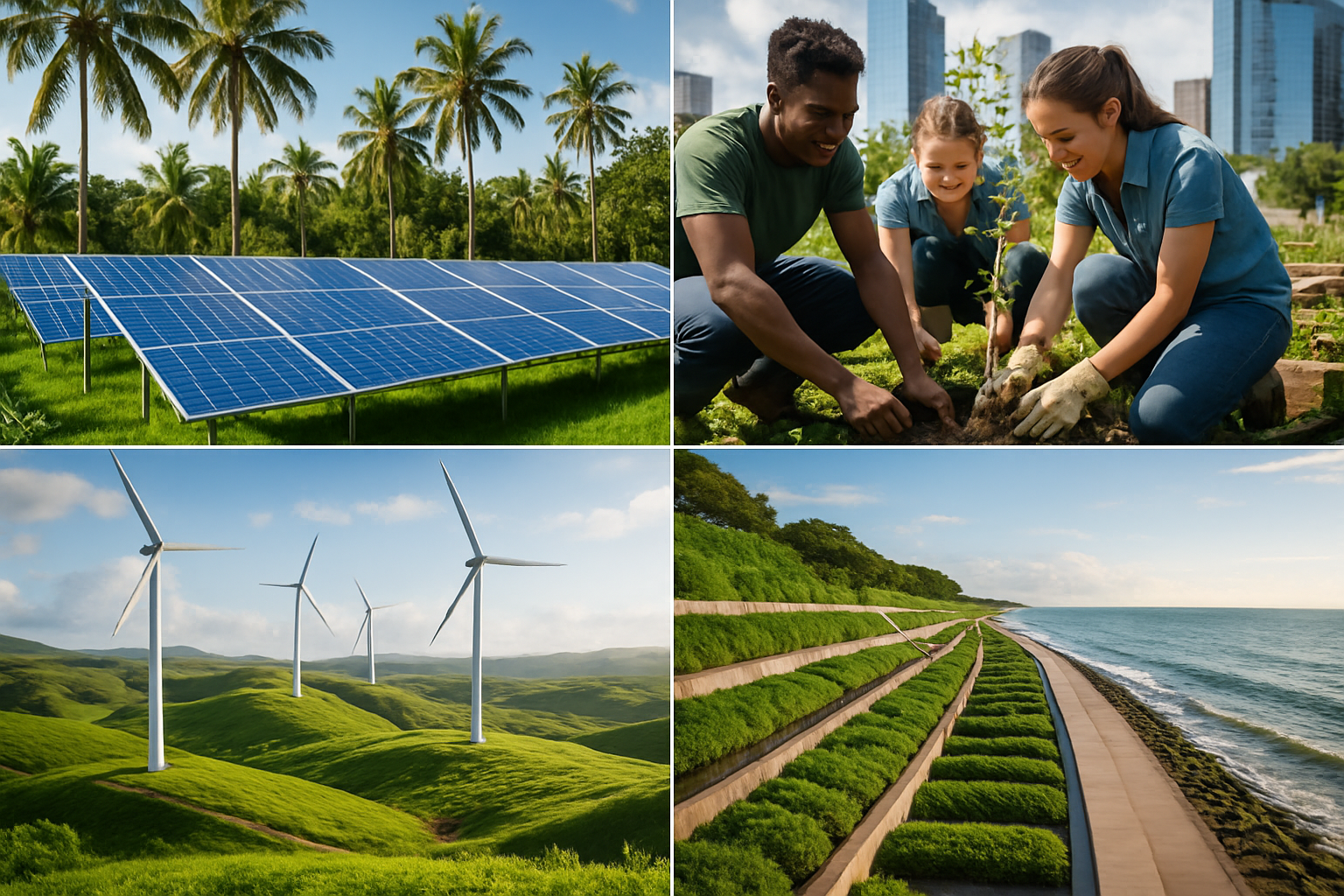
A comprehensive investigation reveals unprecedented sustainable development momentum across three nations as the Dominican Republic launches environmental education programs, Liberia strengthens biodiversity finance frameworks, and the United States witnesses innovative solar farming initiatives - all amid Earth's 18th consecutive month of temperatures exceeding 1.5°C above pre-industrial levels.
Dominican Republic: "Boca Chica Verde" - Youth Environmental Leadership Revolution
The Mayor's Office of Boca Chica has launched the transformative "Boca Chica Verde" program, representing a sophisticated inter-institutional initiative designed to strengthen environmental education and youth leadership in the municipality. Coordinated by the Municipal Environmental Management Department (UGAM) and local Education Department, the program benefits from strategic support from the Ministry of Agriculture, the 10-05 Educational District, and the Deep Green Foundation.
This groundbreaking initiative demonstrates the Dominican Republic's evolution from reactive environmental management to proactive ecosystem service development. The program emphasizes community participation, technological integration, and environmental education as fundamental components of sustainable development, creating a template for Caribbean nations facing similar climate adaptation challenges.
Liberia: Biodiversity Finance Architecture Advancement
In Kakata, Margibi County, Liberia validated key reports to strengthen biodiversity finance during a significant gathering at the Kakata City Hall. Government institutions, development partners, and environmental stakeholders convened to discuss critical frameworks for ecosystem service financing, representing a fundamental shift in how African nations approach conservation economics.
The validation process reflects Liberia's strategic positioning as a leader in biodiversity finance innovation, combining traditional conservation approaches with modern financial mechanisms. This initiative aligns with broader African environmental leadership trends, where nations like Namibia and Uganda are positioning themselves as global climate solution providers rather than aid recipients.
"The convergence of environmental protection and economic development creates unprecedented opportunities for sustainable prosperity in developing nations."
— Environmental Finance Specialist, analyzing Liberia's biodiversity initiatives
United States: California Solar Farm Revolution Amid Water Scarcity
California farmers are backing a giant solar farm initiative as state water access limitations force agricultural land to remain fallow. The San Luis Canal region farmers face increasing water scarcity due to new state regulations, creating an opportunity to develop unused farmland into renewable energy generation sites.
This innovative approach demonstrates how climate adaptation challenges can drive technological solutions. As reported by NPR, many farmers in the San Joaquin Valley region have had to fallow significant acreage, but rather than viewing this as purely economic loss, communities are exploring solar development as alternative land use generating sustainable income while contributing to clean energy goals.
The initiative represents a sophisticated understanding of climate-agriculture-energy nexus, where traditional farming constraints become catalysts for renewable energy expansion. California's approach provides templates for other agriculturally dependent regions facing similar climate pressures worldwide.
Global Climate Context: Unprecedented Environmental Urgency
These sustainable development initiatives emerge during Earth's most environmentally challenging period. January 2026 marked the hottest month in recorded history, extending an unprecedented streak of 18 consecutive months with temperatures exceeding 1.5°C above pre-industrial levels. This persistent warming demonstrates human-induced climate change fundamentally altering atmospheric systems beyond natural recovery mechanisms.
The temperature elevation creates cascading environmental effects: agricultural systems face unprecedented pressure, coastal regions experience intensified weather patterns, and biodiversity habitats undergo rapid transformation. Against this backdrop, the coordinated sustainable development responses across three continents demonstrate humanity's adaptive capacity and innovative potential.
Technology-Tradition Integration: The New Conservation Paradigm
Successful environmental initiatives increasingly demonstrate sophisticated synthesis of cutting-edge technology with traditional ecological knowledge and community-based management. The Dominican Republic's environmental education program combines scientific understanding with local cultural knowledge systems. Liberia's biodiversity finance framework integrates modern economic instruments with traditional conservation practices. California's solar farming initiative builds on agricultural expertise while embracing renewable energy technology.
This approach represents the maturation of environmental protection strategies, recognizing that purely technological solutions insufficient without community engagement and traditional wisdom. The most effective conservation programs emerge from respectful collaboration between scientific innovation and indigenous stewardship knowledge.
Economic Development Through Environmental Protection
Modern sustainable development demonstrates that environmental protection functions as an economic development strategy rather than a regulatory burden. The Dominican Republic's youth education program creates employment in environmental services and eco-tourism while building climate resilience. Liberia's biodiversity finance initiatives attract international sustainable development investment while preserving essential ecosystems. California's solar farming provides alternative income streams for agricultural communities while contributing to renewable energy goals.
Countries implementing comprehensive environmental protection consistently demonstrate greater economic resilience and attract sustainable investment. The economic multiplier effects include reduced disaster recovery costs, enhanced international reputation, and positioning for clean technology market opportunities.
International Cooperation and South-South Partnership Evolution
The February 2026 sustainable development surge reflects evolving international cooperation patterns, with increasing South-South collaboration replacing traditional North-South aid relationships. Developing nations are emerging as environmental solution providers, leveraging indigenous knowledge, renewable resources, and innovative governance approaches.
This shift recognizes that environmental challenges require diverse, locally-adapted solutions that can be shared across similar geographic and cultural contexts. The Dominican Republic's community-based environmental education, Liberia's biodiversity finance innovation, and California's agricultural-energy integration offer templates adaptable across diverse global contexts while respecting local autonomy and cultural specificity.
Implementation Challenges and Success Factors
Despite promising developments, sustainable development initiatives face systematic challenges. Funding sustainability remains critical for developing nations where immediate economic pressures can override long-term environmental considerations. Technical capacity building requires sustained investment in education, training, and institutional development. Climate change disrupts project timelines, requiring adaptive management approaches capable of responding to rapidly changing environmental conditions.
Success factors consistently include community ownership and engagement, transparent governance frameworks, economic incentives that make environmental protection financially viable, and integration of traditional ecological knowledge with modern environmental science. The diversity of approaches provides resilience against single-solution dependencies, offering multiple pathways for addressing environmental challenges through local innovation supported by international cooperation.
Strategic Significance for Global Environmental Action
The February 2026 sustainable development surge represents a critical juncture in global environmental protection. The coordination across environmental education, biodiversity finance, and renewable energy development demonstrates the sophisticated, multi-sector approach required for effective environmental action during accelerating climate change.
These initiatives provide templates for scaling environmental protection efforts globally through a comprehensive framework that addresses environmental challenges at the required speed and scale. The window for effective climate action continues narrowing, but the tools, knowledge, and international cooperation frameworks demonstrated across these three nations offer hope for comprehensive environmental protection.
Future Implications and Scaling Potential
The success of these diverse sustainable development approaches may prove decisive for global environmental protection in the coming decade. The Dominican Republic's environmental education model can inspire Caribbean and Latin American nations. Liberia's biodiversity finance framework offers templates for African nations seeking to monetize ecosystem services sustainably. California's agricultural-energy integration provides pathways for climate adaptation in water-stressed agricultural regions worldwide.
Success depends on sustained international cooperation, enhanced coordination across sectors and scales, and increased financial commitments recognizing environmental protection as essential infrastructure for human prosperity and planetary sustainability. The coordinated response emerging in February 2026 may determine whether conservation efforts can keep pace with accelerating environmental change during this critical decade of climate action.