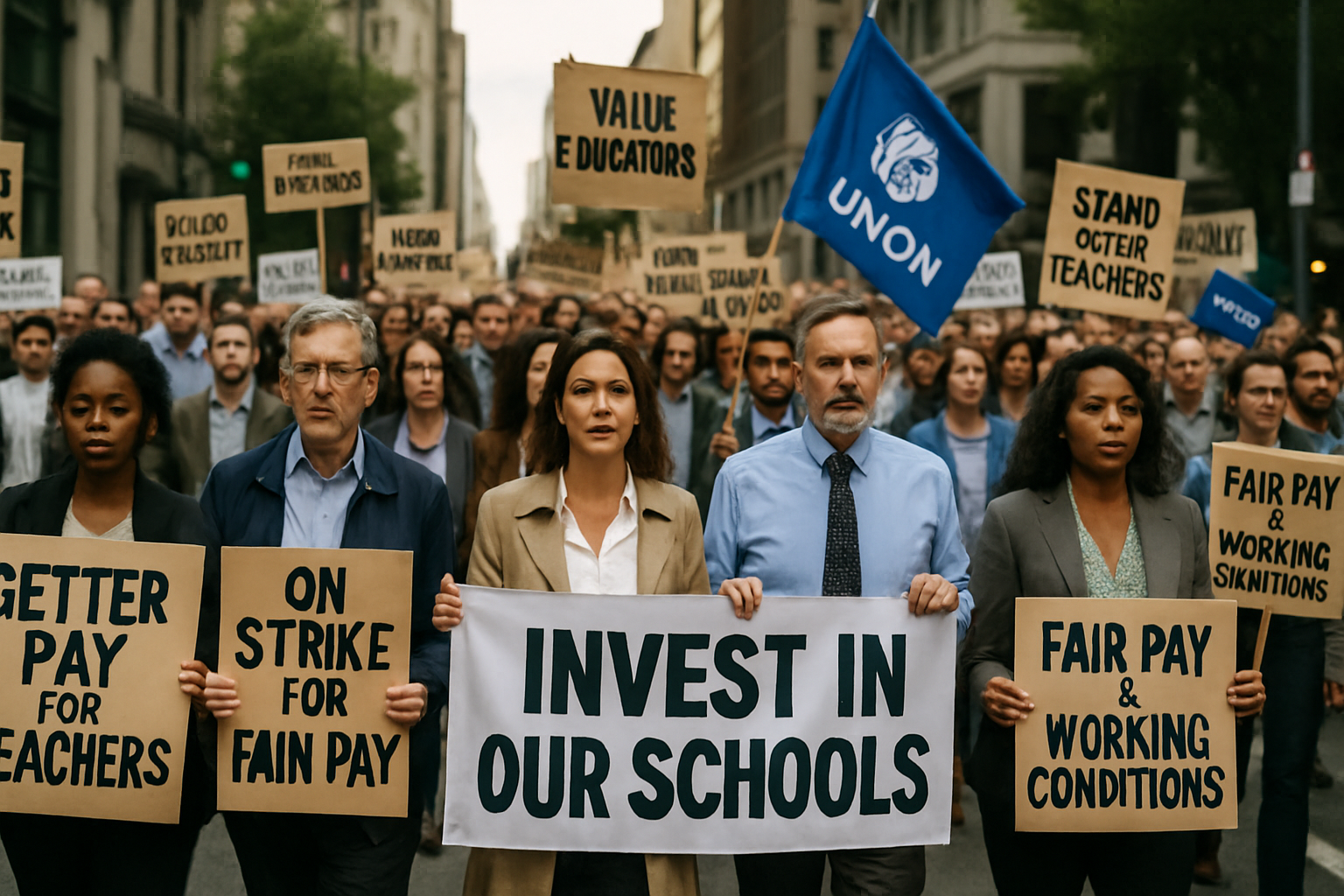
A coordinated wave of teachers' strikes across Australia and Kenya has exposed the deepening global crisis facing education systems, with over 40,000 Victorian teachers marching through Melbourne streets while Kenyan educators threaten to paralyze national examinations over persistent pay disputes and deteriorating working conditions.
The simultaneous industrial action across two continents reflects a broader pattern of educational workforce unrest that has emerged as a defining challenge of 2026, occurring within what experts term the "Educational Technology Renaissance" yet highlighting fundamental issues that technology cannot resolve.
Victoria's Historic Education Walkout
Approximately 40,000 Victorian teachers walked off the job on March 24, 2026, in one of the largest education strikes in recent Australian history. The mass action, organized by multiple education unions, brought the state's government school system to a virtual standstill, affecting hundreds of thousands of students across metropolitan Melbourne and regional Victoria.
Premier Jacinta Allan had made eleventh-hour appeals for teachers to abandon the strike action, warning of significant disruption to families and students. However, union representatives argued that the government's pay offers failed to address the reality of rising living costs and expanding job responsibilities that educators face in the post-pandemic era.
The Victorian strike builds on earlier industrial action, including the unprecedented strike by ABC staff - the first in 20 years - after 60% of employees rejected an enterprise agreement offering a 10% pay rise over three years plus a $1,000 bonus. The Community and Public Sector Union (CPSU) led the action with 75% employee participation, demonstrating widespread dissatisfaction across Australia's public sector.
Kenya's Examination System Under Threat
Simultaneously, Kenya faces the prospect of educational paralysis as teachers threaten to boycott national examinations over unresolved pay disputes. The Teachers Service Commission (TSC) is struggling to meet demands for hiring 44,000 teacher interns on a permanent basis, creating a volatile situation that could disrupt the academic year for millions of students.
The Kenyan crisis reflects deeper systemic issues within the country's education sector, including previous revelations of widespread fraud involving "ghost learners" that siphoned Ksh 1.1 billion annually from the system. MPs have alleged that TSC teacher appointment letters were issued outside official mandates and distributed at State House as political rewards, undermining merit-based appointments and professional standards.
These grievances come amid broader concerns about educational integrity, with investigations uncovering "numerous unauthenticated learner records, including missing or invalid Unique Personal Identifiers (UPIs)" that suggest systematic compromise of student data management and verification processes.
Global Context of Educational Workforce Crisis
The Australian and Kenyan strikes occur within a documented pattern of educational workforce crisis spanning multiple continents throughout 2026. From Lithuania's education union legal actions over ethics teacher dismissals to Uganda's Professional Humanities Teachers' Union threatening renewed strikes over salary harmonization delays, educators worldwide are demanding recognition of their professional worth.
Research from memory archives reveals this crisis coincides with the "2026 Educational Technology Renaissance" - a global phenomenon emphasizing thoughtful digital integration with traditional educational values. However, the current strikes demonstrate that technological advancement cannot address fundamental issues of professional compensation, working conditions, and institutional respect for educators.
Austria's unpaid overtime crisis, where workers lost €2.5 billion in uncompensated hours, exemplifies the broader workplace rights challenges affecting educational professionals. The Ugandan Professional Humanities Teachers' Union highlighted disparities between science teacher salary enhancements and arts teachers' stagnant compensation during budget planning, creating a two-tiered system within education.
Economic and Social Impact
The economic implications of these strikes extend far beyond immediate disruption. In Australia, the Victorian action affects families forced to arrange alternative childcare, while businesses lose productivity as employees manage unexpected school closures. The educational disruption also threatens academic continuity during crucial assessment periods.
Kenya's potential examination boycott could derail university entrance procedures and workforce development programs, affecting the country's human capital formation at a critical juncture. The broader educational fraud scandals have already undermined public confidence in the system's integrity, requiring comprehensive reforms to restore credibility.
Economic modeling suggests that countries implementing comprehensive prevention-focused educational approaches demonstrate superior outcomes through reduced crisis intervention costs, decreased unemployment, and improved workforce productivity. The current strikes highlight the cost of neglecting systematic investment in educational professionals.
International Cooperation and Solutions
Despite the challenges, successful models exist for addressing educational workforce issues. Malaysia has achieved 97.82% teacher placement rates with innovative AI-integrated educational programs, while Singapore's WonderBot 2.0 and Canadian AI teaching assistants demonstrate technology enhancing rather than replacing human educational relationships.
International cooperation through bilateral partnerships and peer-to-peer networks has proven more effective than traditional multilateral approaches in addressing educational challenges. The success of Bangladesh-Malaysia educational partnerships and Commonwealth Youth Awards programs demonstrates the potential for coordinated responses that respect local contexts while maintaining evidence-based standards.
However, the global semiconductor crisis, with memory chip prices surging sixfold, has created infrastructure bottlenecks affecting technology-dependent educational programs until 2027, forcing systems toward more sustainable approaches that prioritize human development over expensive equipment deployment.
Prevention-First Educational Economics
Educational experts advocate for prevention-first approaches that demonstrate superior economic outcomes compared to crisis-response models. Countries implementing comprehensive prevention programs report improved community resilience, reduced long-term social service demands, and enhanced international competitiveness through strategic human capital development.
The current strikes represent a critical test of whether democratic institutions can maintain educational systems that serve human development rather than merely managing periodic crises. Success requires sustained political commitment beyond electoral cycles, comprehensive stakeholder engagement, and recognition of education as strategic infrastructure for 21st-century prosperity.
Critical Juncture for Global Education
March 2026 represents a critical juncture for global educational policy, with the success or failure of current reform initiatives determining educational trajectories for the coming decade. The window for effective coordinated action is narrowing as technological change accelerates and global challenges intensify.
The simultaneous strikes in Australia and Kenya demonstrate that educational transformation requires thoughtful integration of technological tools with enduring educational principles rather than wholesale replacement of human relationships. Success depends on maintaining human creativity, critical thinking, and cultural knowledge while preparing students for an interconnected global economy requiring both technical competence and cultural authenticity.
As educators continue their struggle for professional recognition and adequate compensation, the international community faces an urgent challenge: ensuring that educational systems serve human flourishing rather than becoming sources of institutional conflict and social instability. The choices made in response to these strikes will shape educational policy and professional standards for decades to come.