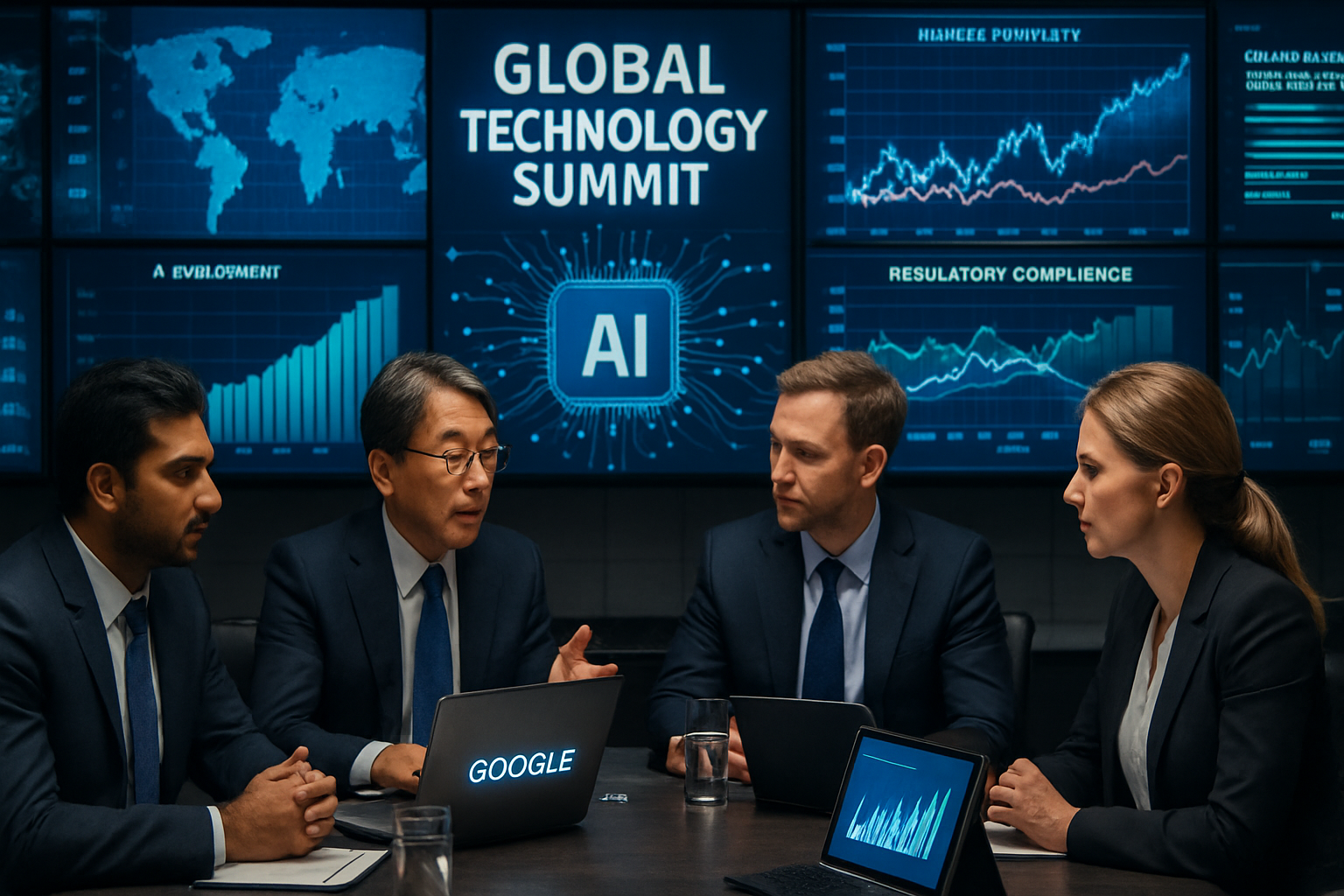
The global technology sector is experiencing a watershed moment in February 2026, as artificial intelligence capabilities surge ahead while regulatory frameworks tighten worldwide, creating both unprecedented opportunities and existential challenges for established tech giants and emerging players alike.
Google's Strategic AI Positioning
Google's Chief Technologist for AI Infrastructure has highlighted the company's integrated approach to artificial intelligence development as its primary competitive advantage over rivals including OpenAI and Nvidia. This co-design strategy, spanning from custom chips to software architecture, has enabled faster innovation cycles and superior performance in the company's new Gemini 3 model.
The tech giant is pursuing ambitious infrastructure projects that extend beyond terrestrial boundaries, including space-based AI data centers designed to enhance computational capabilities. This vertical integration approach represents a fundamental departure from traditional technology partnerships, positioning Google as a comprehensive AI ecosystem rather than merely a software provider.
"Our real secret weapon is the integrated approach from custom chips to software that allows for faster innovation cycles."
— Google Chief Technologist for AI Infrastructure
This strategic positioning comes as the technology sector faces unprecedented infrastructure constraints, with memory chip prices surging sixfold due to explosive AI demand, affecting major manufacturers including Samsung, SK Hynix, and Micron. The shortage is expected to persist until 2027 when new fabrication facilities come online.
Indian IT Sector Under Pressure
The Indian information technology sector has experienced severe market turbulence, with approximately ₹5.7 lakh crore ($67 billion) in market value wiped out within eight trading sessions. The Nifty IT index declined roughly 19% over this short period, reflecting investor concerns about artificial intelligence's impact on traditional IT services.
However, JPMorgan analysts have offered a contrasting perspective, describing Indian IT professionals as the "plumbers of the tech world" who shouldn't worry about AI displacement. The investment bank explains that new areas of work are emerging that require human expertise in AI implementation, maintenance, and integration with existing systems.
Major Indian IT companies including Infosys, Wipro, HCL Tech, and Persistent Systems have seen stock declines of approximately 6% as markets grapple with the implications of AI automation on traditional outsourcing models. The sector's response involves rapid upskilling initiatives and pivot strategies toward AI-assisted services rather than AI-replaced functions.
Japan-US Investment Acceleration
Japan and the United States have agreed to expedite selection processes for the first round of investment projects under a substantial $550 billion infrastructure package. This acceleration represents a significant strengthening of bilateral economic cooperation, particularly in strategic technology sectors.
The framework encompasses diverse investment areas including advanced manufacturing, semiconductor production, renewable energy infrastructure, and critical minerals processing. The expedited timeline reflects both nations' urgency in securing supply chain resilience amid global economic uncertainties and technological competition.
Japan's participation in this investment surge coincides with the country achieving breakthrough developments in deep-sea mining technology, extracting rare earth elements from depths of 6,000 meters with concentrations twenty times higher than terrestrial deposits. These discoveries strengthen the alliance's strategic materials independence efforts.
European Regulatory Intensification
The European Union has launched a comprehensive investigation into Google's online advertising practices, with regulators expressing concerns that the technology giant may be artificially inflating advertising auction prices to the detriment of advertisers. The European Commission has specifically highlighted Google Search advertising auctions as problematic.
This investigation represents another potential multi-billion euro antitrust challenge for Google, which has already faced substantial EU penalties in recent years. The scrutiny occurs within a broader context of European digital sovereignty initiatives, as the continent seeks to establish regulatory independence from American technology platforms.

The timing is particularly significant as European officials have warned that regulatory fragmentation and external pressure from both Chinese technological expansion and American bilateral trade agreements threaten the EU's competitiveness. This has prompted emergency summits focused on eliminating internal barriers and protecting "Made in Europe" products.
Global Market Implications
The confluence of these developments occurs against the backdrop of the "SaaSpocalypse" – a market phenomenon where artificial intelligence demonstrations have triggered hundreds of billions in losses across traditional software companies. German analysts have described this as an "apocalypse for software houses," with stock declines reaching 20% as AI systems demonstrate capability to replace rather than complement existing software solutions.
The technology sector's infrastructure crisis extends beyond memory shortages to include massive energy demands from AI data centers. The World Bank projects that AI systems could require 4.2-6.6 billion cubic meters of water annually by 2027 for cooling purposes alone – equivalent to four to six times Denmark's entire national water consumption.
Despite these challenges, major technology companies continue unprecedented infrastructure investments. Alphabet has committed $185 billion to AI infrastructure for 2026, while Amazon has announced over $1 trillion in AI development plans. These investments represent the largest single-year technology expenditures in corporate history.
Regulatory Coordination Challenges
The global nature of technology platforms creates complex jurisdictional challenges for regulators. Spain has implemented world-first criminal executive liability provisions for platform violations, France has conducted cybercrime raids on AI platforms, and the United Nations has established an Independent International Scientific Panel on AI with 40 experts.
This regulatory intensification occurs simultaneously with technological breakthroughs that challenge traditional competitive assumptions. Chinese AI company DeepSeek's recent advances have demonstrated that artificial intelligence leadership may become multipolar rather than concentrated in Silicon Valley, potentially reshaping global technology governance approaches.
Industry Transformation Timeline
The convergence of these developments suggests that 2026 represents a critical inflection point for the global technology industry. Companies must navigate infrastructure constraints, regulatory compliance, competitive pressures, and fundamental shifts in business models simultaneously.
Success factors increasingly include operational flexibility, strategic positioning across multiple jurisdictions, sustainable business models that balance innovation with regulatory compliance, and the ability to maintain growth while addressing legitimate concerns about market concentration and consumer protection.
The technology sector's evolution from experimental capabilities to essential infrastructure requirements creates both opportunities for companies that adapt effectively and existential challenges for those that fail to evolve. The decisions made throughout 2026 will likely determine industry structure for the remainder of the decade.
Future Strategic Considerations
Looking ahead, the technology industry faces several critical challenges requiring coordinated responses. Infrastructure bottlenecks demand innovative solutions and alternative supply chains. Regulatory frameworks need alignment across jurisdictions to prevent fragmentation while preserving innovation incentives.
The successful integration of artificial intelligence into existing business models requires balancing automation benefits with employment considerations, privacy protection with functionality improvements, and global standardization with local regulatory requirements.
As the industry moves beyond experimental applications toward essential infrastructure, the stakes for getting these balances right have never been higher. The transformation currently underway will determine whether technological advancement serves broad human welfare or creates systematic disruptions requiring dramatic corrections.