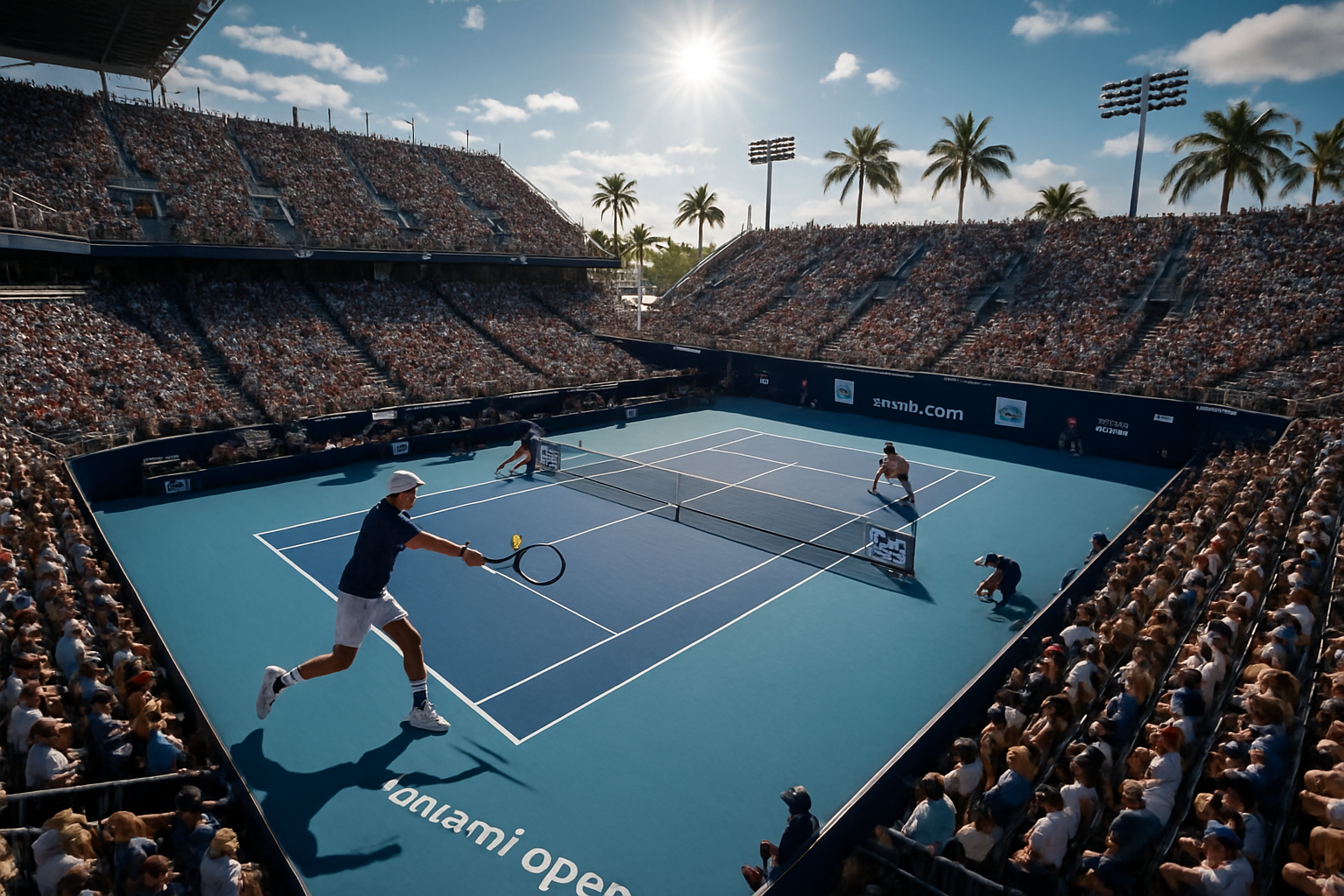
Individual sports are experiencing a remarkable surge of excellence and global expansion as the Miami Open approaches its championship weekend, with breakthrough performances spanning from professional tennis courts to challenging golf courses and Challenger tournaments across multiple continents.
The convergence of elite competition at the Miami Open, emerging tennis talent from unexpected regions, and international sporting achievements demonstrates how individual sports continue to democratize and expand their global footprint in 2026.
Sinner's Historic Masters 1000 Dominance
Italy's Jannik Sinner has established himself as the most formidable force in men's tennis, advancing to the Miami Open final against Czech Republic's Jiří Lehečka with an unprecedented display of consistency. The world number one has now won an astounding 32 consecutive sets in Masters 1000 tournaments, a feat that underscores his complete tactical evolution from powerful baseline player to strategic champion.
Sinner's semifinal victory over Alexander Zverev showcased the German's acknowledgment of the Italian's superiority: "He has played incredible tennis. I served very well at the end, I couldn't have done better." This admission from a former world number two reflects the broader recognition of Sinner's current dominance across the professional tour.
"It has been tough. I served very well at the end, I couldn't have done better."
— Alexander Zverev, on facing Jannik Sinner
The Miami Open final represents more than just another Masters 1000 title opportunity for Sinner. His 32-set winning streak in these premier events demonstrates a level of consistency rarely seen in modern tennis, where the depth of competition has never been greater. The Italian's tactical improvement alongside his natural power has created a playing style that adapts effectively to different opponents and conditions.
Women's Tennis: Sabalenka's Championship Defense
World number one Aryna Sabalenka enters the Miami Open women's final with the opportunity to achieve tennis immortality by completing the "Sunshine Double" - winning both Indian Wells and Miami in the same year. This rare feat has been accomplished by only four women in tennis history: Steffi Graf (1994, 1996), Kim Clijsters (2005), and Victoria Azarenka (2016).
Sabalenka's path to the final included a commanding 6-4, 6-3 victory over Elena Rybakina, serving as revenge for her loss to the Kazakhstani in the Australian Open final earlier this year. The Belarusian's tactical improvement beyond her trademark power game was evident as she capitalized on Rybakina's 23 unforced errors while maintaining her aggressive style.
Facing her in Sunday's final will be American Coco Gauff, who demolished Karolina Muchova 6-1, 6-1 to reach her sixth WTA 1000 final. The matchup presents compelling narratives: Sabalenka seeking elite historical achievement versus Gauff pursuing her breakthrough WTA 1000 title on home soil in Florida.
Global Tennis Expansion: Bolivia's Challenger Success
Beyond the Miami Open's high-profile courts, individual sports are demonstrating remarkable global expansion. Bolivia has achieved unprecedented success at the Challenger tournament in São Paulo, Brazil, with Hugo Dellien and Juan Carlos Prado both advancing to the semifinals - creating the possibility of an all-Bolivian final.
Dellien, the tournament's sixth seed, secured his semifinal position with a hard-fought 6-4, 7-6(4) victory over Chile's Marcelo Barrios. The match, lasting two hours and 14 minutes on the central court of São Paulo Jockey Club, showcased the competitive depth emerging from South American tennis development programs.
This Bolivian breakthrough at the professional level reflects broader trends in tennis globalization, where systematic investment in coaching, infrastructure, and sports science is enabling athletes from diverse backgrounds to compete at the highest levels. The potential for an all-Bolivian final would represent a historic achievement for the nation's tennis program.
Challenger Circuit Development
The success of Bolivian players at the São Paulo Challenger exemplifies how the global tennis ecosystem continues to provide pathways for emerging talent. Challenger tournaments serve as crucial stepping stones between national competition and the ATP Tour, offering ranking points and prize money essential for career development.
These mid-tier tournaments have become increasingly competitive as more nations invest in tennis infrastructure and coaching education. The result is a more democratic professional tennis landscape where players from smaller tennis nations can achieve breakthrough results through systematic preparation and international exposure.
Individual Sports Excellence Beyond Tennis
While tennis garners significant attention, other individual sports are experiencing similar global expansion and competitive excellence. New Zealand's Lydia Ko demonstrated resilience at the Ford Championship, maintaining contention despite losing the lead to a resurgent Nelly Korda during the second round.
Ko's career-best scoring performance, despite experiencing some wobbles, illustrates the mental fortitude required in individual sports where athletes cannot rely on teammates for support. Her ability to remain competitive against world-class opposition reflects the systematic development programs that New Zealand has implemented across multiple individual sports.
"I was surprised by my career-best score after wobbling in the second round."
— Lydia Ko, on her Ford Championship performance

The Democratization of Individual Sports
The current surge in individual sports reflects broader democratization trends that have accelerated following the Milano-Cortina 2026 Winter Olympics. Nations previously limited in international representation are now producing world-class competitors across multiple disciplines through strategic investment in coaching, infrastructure, and sports science.
This democratization is evident not only in tennis, where players from Bolivia are reaching Challenger semifinals, but across individual sports where traditional powerhouses face increasing competition from emerging nations. The result is a more competitive and globally representative sporting landscape.
Technology and Training Evolution
Modern individual sports increasingly utilize advanced analytics, AI integration, and performance optimization tools that were pioneered during recent major international competitions. These innovations are creating environments that enable previously unimaginable athletic achievements while making elite training methods more accessible globally.
The integration of technology with traditional coaching wisdom is producing superior outcomes compared to purely technological or traditional approaches. This balance allows athletes from diverse backgrounds to access elite development resources while maintaining cultural authenticity in their training approaches.
Economic Impact and Professional Opportunities
The global expansion of individual sports creates significant economic opportunities beyond prize money and endorsements. Tennis facilities, coaching education programs, and sports tourism generate substantial revenue while building sustainable pathways for athletic development.
The Miami Open exemplifies this economic model, where premier tournaments serve as showcases for global talent while generating revenue that supports broader tennis development programs. This creates positive feedback loops where successful tournaments fund grassroots development, which produces the next generation of competitive players.
Media and Broadcasting Innovation
Individual sports are benefiting from broadcasting innovations that enhance spectator engagement across global audiences. Advanced camera work, real-time statistics, and enhanced coverage capabilities demonstrated at recent major events are setting new standards for sports presentation.
These improvements make individual sports more accessible to new audiences while providing detailed analysis that helps fans appreciate the technical sophistication required for elite performance. The result is growing global interest in sports that were previously limited to specific geographic regions.
Future Implications for Global Competition
The current surge in individual sports excellence suggests a fundamental shift toward more competitive and globally representative athletic competition. Traditional hierarchies are being challenged as nations implement strategic development programs that produce world-class athletes across previously dominated disciplines.
This trend has implications for major international competitions, where increased depth of talent creates more unpredictable and exciting competitions. The days of predetermined outcomes based on national affiliation are giving way to merit-based competition where preparation, strategy, and execution determine results.
Sustainability and Long-term Development
Sustainable development in individual sports requires balancing competitive success with long-term athlete welfare and community benefit. Successful programs demonstrate that athletic excellence and social responsibility can coexist when properly implemented through comprehensive support systems.
The Miami Open finals weekend represents not just the culmination of elite competition, but a celebration of how individual sports continue to evolve, expand globally, and create opportunities for athletes from diverse backgrounds to achieve excellence on the world stage.
Championship Weekend Anticipation
As the Miami Open approaches its championship conclusion, the tournament embodies the broader trends transforming individual sports globally. From Sinner's pursuit of Masters 1000 history to Sabalenka's quest for the Sunshine Double, and from Bolivian Challenger breakthroughs to New Zealand golf excellence, individual sports are experiencing unprecedented growth and competitive depth.
The convergence of elite performance, global expansion, and technological innovation creates an exciting future for individual sports, where athletic excellence transcends traditional boundaries and creates inspiring examples of what can be achieved through dedication, strategic development, and international cooperation.