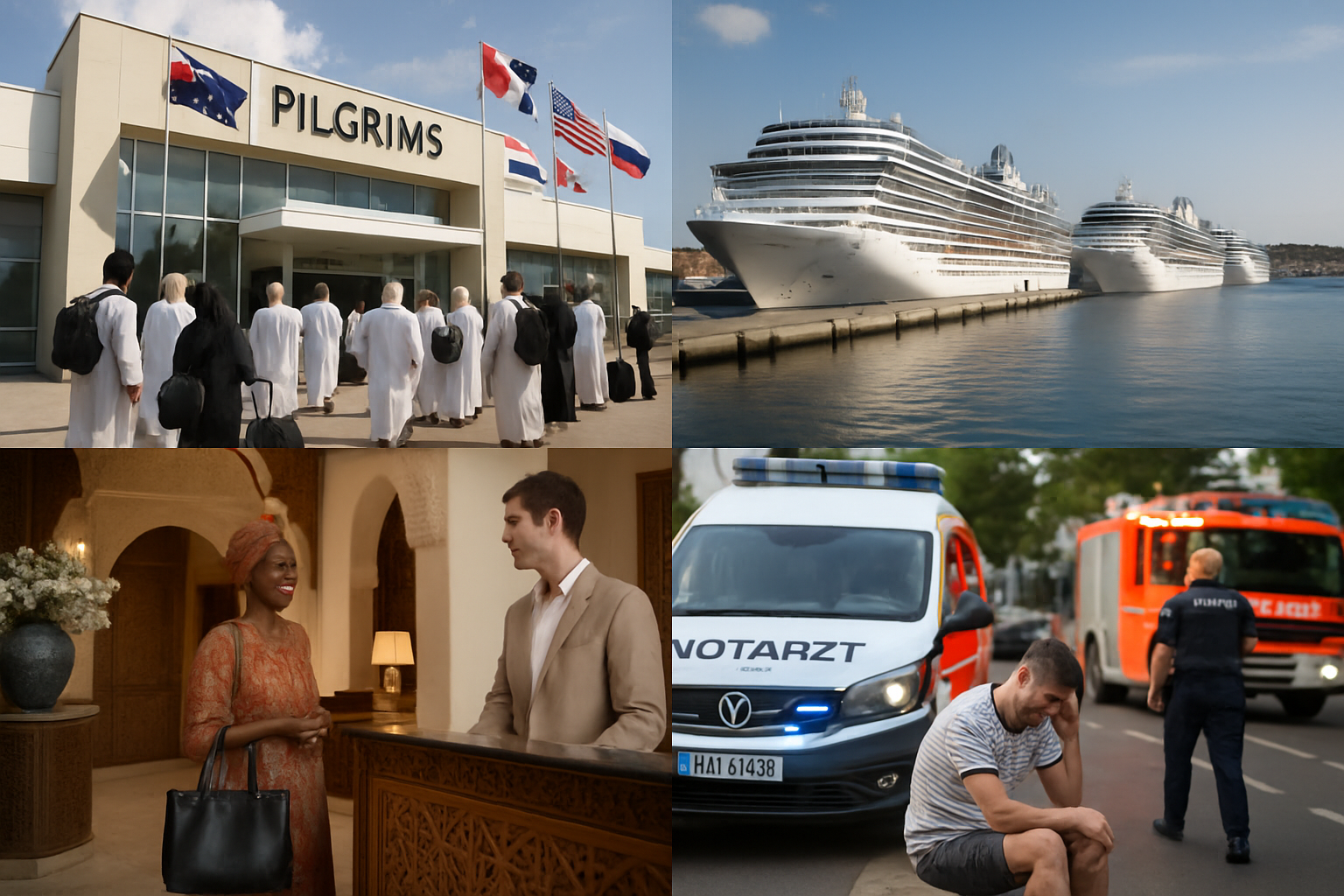
The global tourism industry confronts a paradox of unprecedented growth and sobering safety reminders as international developments span from tragic incidents to transformative infrastructure investments, reshaping travel patterns across multiple continents.
A German tourist's death following a snake bite at a hotel in Hurghada, Egypt, has highlighted ongoing safety concerns in popular tourist destinations, while simultaneously, three Islamic nations coordinate the largest religious travel operation in modern history as Hajj preparations reach peak intensity across Afghanistan, Pakistan, and Saudi Arabia.
Tragic Safety Incident Underscores Tourism Vulnerabilities
The fatal snake bite incident in Hurghada represents the latest in a concerning pattern of travel safety challenges that have characterized 2026 as one of the most dangerous years for international tourism since the COVID-19 pandemic. The incident occurred at a hotel facility, raising questions about safety protocols and wildlife management in resort environments.
This tragedy adds to an alarming catalogue of over 210 significant transportation incidents documented across 50+ countries since February 2026, including the La Gomera bus crash that killed one British tourist and hospitalized 27 others during an excursion in the Canary Islands. The convergence of aging infrastructure, extreme weather conditions, and surging tourist demand has created operational challenges that extend far beyond infrastructure design parameters.
"We are witnessing a fundamental transformation in risk management requirements for the tourism sector. The traditional safety assumptions are no longer adequate for current operational complexities."
— Tourism Safety Expert, European Travel Research Institute
Historic Islamic Pilgrimage Coordination Demonstrates Industry Capabilities
In stark contrast to individual safety incidents, the coordination of Hajj preparations across Afghanistan, Pakistan, and Saudi Arabia exemplifies the tourism industry's remarkable capacity for complex multinational operations. This represents one of the largest coordinated religious travel operations in modern history, affecting millions of pilgrims.
Afghanistan achieved a milestone with 30,000 pilgrims transported via 96 flights from four air zones using Ariana Afghan Airlines and Kam Air, with 15,000 traveling directly to Medina and 15,000 to Jeddah. Pakistan's operation proves even more extensive, with Pakistan International Airlines managing 55,000+ pilgrims through 191 flights beginning April 19, including the inaugural PK-747 from Sialkot to Medina.
Saudi Arabia's Tourism Minister Ahmed Al-Khateeb has inspected readiness across hospitality facilities and temporary accommodations in Makkah, while the Hajj and Umrah Minister reviewed border crossing preparations at Al-Haditha and Jadidat Arar. The General Directorate of Passports confirmed all international entry points—air, land, and sea—are prepared with the latest technologies and human resources deployed.
Educational Opportunities Expand Global Access
Beyond religious tourism, educational opportunities are expanding international access through programs like Saint Vincent and the Grenadines' promotion of Japan's MEXT Scholarship Programme. The Embassy of Japan announced applications for the 2027 Ministry of Education, Culture, Sports, Science and Technology scholarship, funded by the Government of Japan to support outstanding international students.
This initiative represents the broader trend toward educational tourism and international cooperation, creating pathways for cultural exchange that extend beyond traditional vacation travel. The scholarship program demonstrates how tourism and education sectors increasingly intersect to create meaningful international experiences.
Unprecedented Infrastructure Investment Reshapes Industry
These developments occur within an unprecedented $570+ billion global tourism infrastructure surge that extends far beyond traditional hospitality accommodations. Croatia leads European innovation with 62 tourist medical clinics for the 2026 season—the continent's most extensive seasonal healthcare network—while technology integration advances through sophisticated visitor management systems.
The Rome Trevi Fountain managed access system generates €6 million annually through €2 entry fees, providing a sustainable template for balancing economic objectives with cultural preservation. Venice has expanded its entry fee system from 29 days in the 2024 pilot to 60 days in 2026, demonstrating the evolution of dynamic pricing for visitor flow management.
Climate Adaptation Becomes Essential Competitiveness Factor
January 2026 marked the 18th consecutive month of global temperatures exceeding 1.5°C above pre-industrial levels, making climate resilience an essential factor in destination competitiveness. This sustained warming has fundamentally altered operational conditions, requiring proactive infrastructure adaptation rather than reactive responses to extreme weather events.
Generation Z travelers, representing 50% of those taking multiple trips exceeding five days annually, are driving transformation by demanding AI-integrated travel planning combined with authentic cultural experiences and environmental sustainability. This demographic shift encourages destinations to balance technological innovation with cultural preservation and environmental responsibility.
Regional Cooperation Replaces Individual Competition
The industry demonstrates remarkable evolution from individual destination competition toward regional cooperation through coordinated marketing initiatives, shared infrastructure development, and multi-destination experiences. Caribbean cruise coordination, European infrastructure collaboration, and Asia-Pacific market integration create comprehensive travel experiences that benefit entire regions while maintaining distinct cultural identities.
This transformation represents a fundamental shift toward quality-focused strategies over volume-based approaches, with Cyprus achieving record performance in 2025 through 4.5 million visitors generating €3.6 billion revenue via market diversification and strategic infrastructure investment.
Economic Multiplier Effects Extend Beyond Hospitality
Tourism development in 2026 demonstrates comprehensive economic multiplier effects extending beyond traditional hospitality sectors. Infrastructure improvements, cultural industry support, artisan networks, transportation enhancements, and year-round employment creation show how modern tourism functions as a comprehensive community development catalyst.
Countries implementing comprehensive tourism infrastructure demonstrate greater economic resilience and sustainable investment attraction through sophisticated destination management that combines marketing excellence with operational efficiency and community benefits.
Success Factors for Modern Tourism Development
Successful tourism development in 2026 consistently requires several key factors: cultural authenticity preservation enhanced by technology, strategic infrastructure investment, meaningful community involvement in tourism planning, international cooperation frameworks, and adaptive management responding to changing consumer preferences and environmental conditions.
The industry faces critical choices between maintaining global connectivity versus developing regionalized, security-conscious travel patterns. The template being established in 2026 will likely determine the fundamental nature of international mobility in an increasingly interconnected yet volatile world.
Future Implications for Global Travel
April 2026 represents a watershed moment establishing sustainable tourism standards that will influence the sector for decades ahead. The convergence of safety challenges, technological innovation, climate adaptation requirements, and changing consumer preferences creates both opportunities and imperatives for comprehensive transformation.
The tourism industry's choice between sustainable community-focused development and traditional volume-based approaches will determine sector evolution in an interconnected world where authenticity, safety, environmental responsibility, and community benefits increasingly define competitiveness.
As the industry navigates these complex challenges—from individual safety incidents to massive coordinated operations—the developments of 2026 establish precedents for tourism crisis management and destination competitiveness in an era of unprecedented global interconnectedness and environmental change.