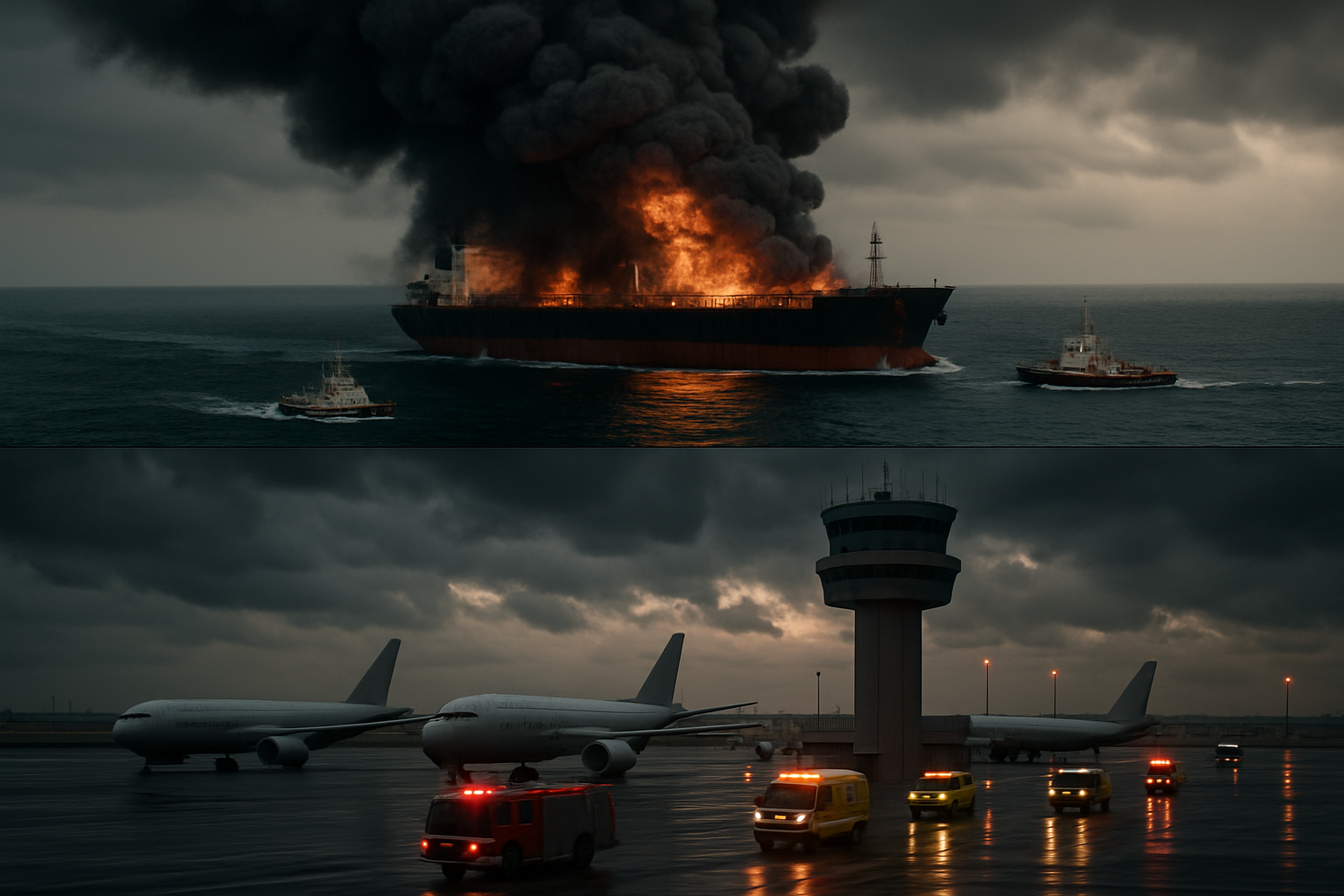
A convergence of maritime attacks, aviation emergencies, and security threats has created the most comprehensive global transport crisis in decades, disrupting shipping lanes and flight operations across multiple continents.
From the Strait of Hormuz to European airports, transport safety concerns are mounting as multiple incidents affect both maritime and aviation sectors simultaneously. The crisis involves dangerous shipping conditions, aircraft emergencies, security breaches, and infrastructure vulnerabilities that threaten the backbone of global commerce and travel.
Maritime Emergency in Critical Waterways
The Thailand-flagged cargo ship Mayuree Naree has become emblematic of the maritime crisis, with the vessel engulfed in smoke following attacks in the Strait of Hormuz. Three Thai sailors remain missing after the incident, highlighting the human cost of the deteriorating maritime security situation.
According to Cuban media reports, oil prices have surged past $100 per barrel amid new attacks in the strategic waterway, which handles approximately 40% of global seaborne oil transit. The 21-mile-wide chokepoint has become increasingly dangerous for commercial vessels, with multiple ships targeted in recent weeks.
Major shipping companies including Maersk and MSC have suspended operations through Persian Gulf routes, leaving over 150 oil and LNG tankers stranded with billions of dollars in cargo. The disruption affects not just energy supplies but also consumer goods and industrial materials that rely on Gulf shipping networks.
Aviation Safety Incidents Multiply
European airports are experiencing unprecedented security challenges, with Berlin's BER airport forced to halt operations twice in one evening due to reports of unidentified flying objects. The incidents required a complete shutdown of flight operations for approximately one hour, affecting thousands of passengers.
In Finland, maritime safety authorities have launched an investigation into a truck cargo fire aboard the passenger ferry Silja Serenade. The incident, involving smoking truck cargo, demonstrates how safety concerns are affecting multiple transport modes simultaneously.
The aviation sector is also grappling with broader operational challenges as airlines implement emergency protocols including enhanced fuel loading to avoid refueling in affected zones, complex rerouting around multiple closed airspaces, and dramatically increased operational costs.
Supply Chain Vulnerabilities Exposed
The current transport crisis has exposed critical vulnerabilities in global supply chain architecture. The Persian Gulf serves as a critical trade hub beyond energy, affecting the movement of consumer goods and industrial materials worldwide. Single chokepoint dependencies, particularly the narrow Strait of Hormuz, demonstrate how modern logistics systems remain vulnerable to disruption.
Manufacturing sectors dependent on Gulf shipping networks, including automotive, electronics, and textiles industries, are experiencing severe disruptions. China has suspended refined fuel export contracts, while Singapore reports 30% increases in logistics costs.
These disruptions are forcing businesses to reconsider supply chain strategies that have prioritized efficiency over resilience. Companies are accelerating discussions about route diversification and alternative transportation networks, though such transitions require significant time and investment to implement.
International Response and Emergency Measures
Governments worldwide are implementing emergency response protocols to address the transport crisis. Japan is considering deploying national oil stockpiles for the first time since the 2011 Fukushima disaster, given the country's 95% dependence on Middle Eastern oil supplies, with 70% transiting through the now-dangerous Strait of Hormuz.
The International Energy Agency has announced the largest emergency oil reserve release in its 50-year history, coordinating the release of 400 million barrels from 32 member countries. This response doubles the previous record set during the 2022 Ukraine crisis.
European authorities are coordinating emergency measures including state aid for energy-intensive industries and enhanced security protocols at airports and ports. The crisis has prompted the first-ever activation of Cyprus's ESTIA evacuation plan, designed to coordinate EU nationals and third-country citizens during international emergencies.
Technology and Safety Innovations
The crisis is accelerating the adoption of advanced safety and monitoring technologies across both maritime and aviation sectors. Enhanced satellite tracking capabilities, AI-powered navigation systems, and real-time analytics are being deployed to improve detection and response to threats.
In the maritime sector, companies are implementing comprehensive security protocols including automated cargo handling systems, predictive maintenance technologies, and digital monitoring networks. The aviation industry is similarly investing in enhanced surveillance systems and improved emergency response capabilities.
However, coordination across jurisdictions remains challenging, highlighting the need for international cooperation in implementing safety standards and information sharing protocols.
Economic Impact on Global Commerce
The transport crisis is generating significant economic ripple effects across global markets. Financial markets have experienced severe volatility, with Pakistan's KSE-100 posting its largest single-day decline in history at -8.97%, while South Korea's KOSPI fell 12% with circuit breakers activated.
Consumer impacts are immediate and widespread. Sweden is predicting electricity price increases of 10-20 öre and gasoline price rises of 1-2 kronor, with southern regions most exposed due to continental European market integration. Ireland is seeing heating oil price increases of 40% in a single week, approaching €2 per liter.
Airlines are implementing emergency fuel surcharges as jet fuel prices surge from $85-90 per barrel to $150-200, representing increases of up to 122%. Major carriers including Qantas Airways, SAS, and Air New Zealand have announced significant fare increases to offset the "abrupt spike" in operational costs.
Long-term Implications for Transport Safety
This crisis represents a watershed moment for global transport safety planning. The events of March 2026 are forcing a fundamental reconsideration of risk assessment procedures, route planning strategies, and international cooperation frameworks.
The aviation industry is accelerating route diversification investments to reduce over-reliance on Middle Eastern hubs for Europe-Asia connectivity. Enhanced contingency planning and alternative routing strategies are becoming standard operating procedures rather than emergency measures.
Maritime safety improvements require sustained commitment to addressing ocean-based operational risks through robust monitoring systems, enhanced international coordination, and comprehensive safety protocols. The current crisis has demonstrated that maritime and aviation safety are increasingly interconnected with geopolitical stability.
Looking Forward: Building Resilient Transport Networks
Recovery from the current crisis will require both immediate emergency responses and long-term structural changes to transport networks. Unlike weather-related disruptions with predictable timelines, the current situation depends on diplomatic and security resolutions that remain uncertain.
The international community faces critical decisions about immediate supply needs versus long-term transport architecture restructuring. Energy and transport security planning must evolve to reduce dependence on volatile geopolitical regions and single-point failure risks.
Success in managing this crisis could provide a framework for future transport emergency responses and international cooperation mechanisms. However, failure to address underlying vulnerabilities may establish dangerous precedents that could reshape global transport networks for decades to come.
The template-setting nature of this crisis extends beyond immediate operational challenges to fundamental questions about how transport networks can maintain safety and reliability in an increasingly interconnected yet unstable world. The lessons learned from March 2026 will likely influence transport safety planning and international cooperation frameworks well into the future.