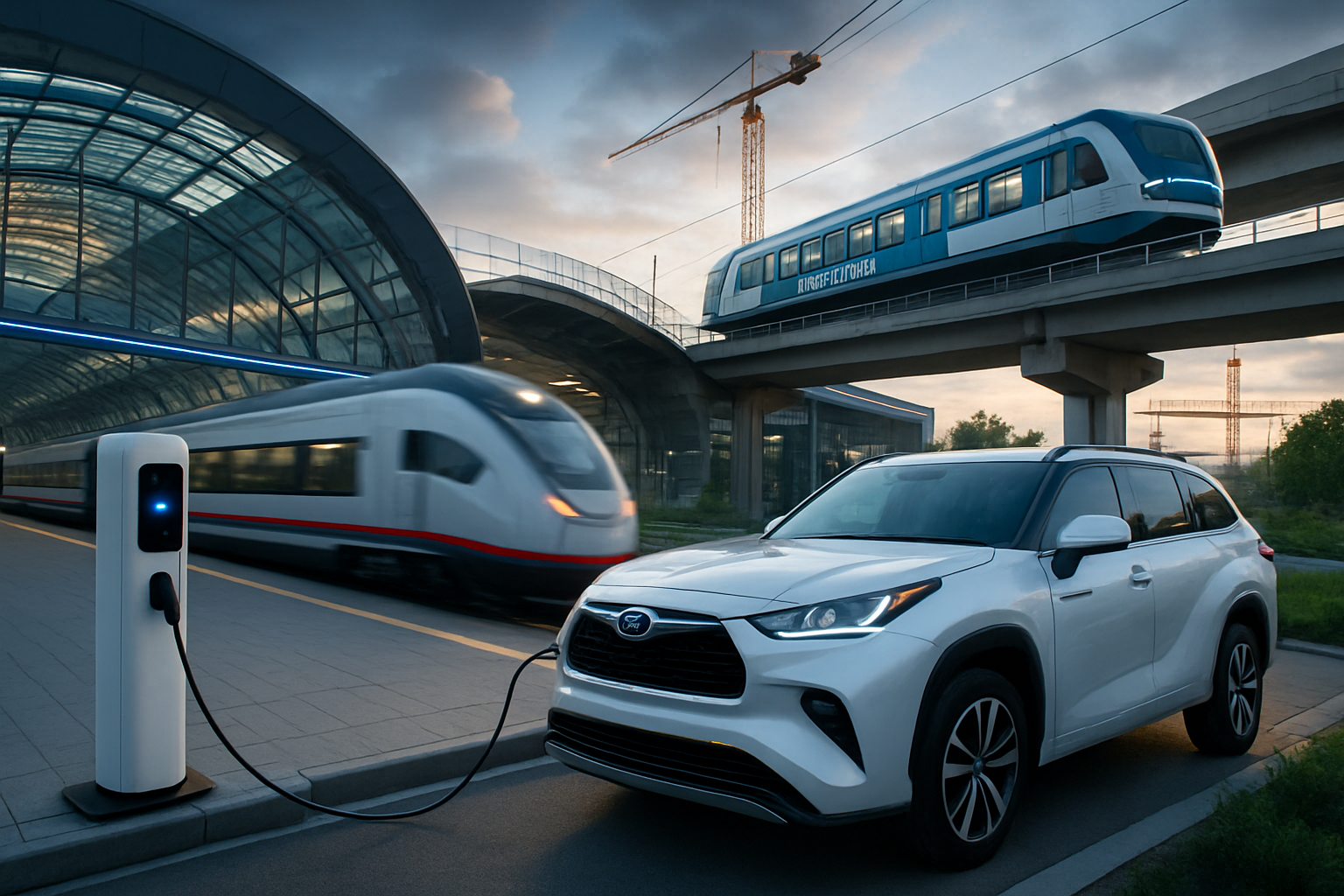
A comprehensive transportation revolution is sweeping across the globe as nations accelerate their shift toward sustainable mobility solutions, with major announcements in electric vehicle manufacturing, high-speed rail development, and hydrogen-powered transit systems marking February 2026 as a pivotal month for the industry.
From Toyota's historic launch of its first American-manufactured electric vehicle to ambitious cross-border railway projects spanning continents, the transportation sector is experiencing unprecedented transformation driven by climate commitments, technological breakthroughs, and massive infrastructure investments exceeding $570 billion globally.
Toyota's Electric Revolution Reaches American Shores
Toyota Motor Corporation achieved a significant milestone with the announcement of the 2027 Highlander as a fully electric vehicle, marking the Japanese automaker's dramatic transformation of its 25-year-old family SUV nameplate. The vehicle will be manufactured at Toyota's Princeton facility in the United States, positioning it to compete directly with the Kia EV9 and Hyundai Ioniq 9 in the rapidly expanding three-row electric SUV segment.
This development represents Toyota's strategic pivot from its historically conservative approach to electric vehicles toward aggressive electrification of core family vehicles. The timing aligns with new CEO Kenta Kon's mandate to accelerate decision-making processes during the industry's transformation period, effective April 1, 2026.
The Highlander EV announcement comes amid ongoing supply chain challenges in critical materials, where China maintains 60% of production and 90% of refining capacity for lithium, cobalt, and rare earth elements essential for electric vehicle batteries. Toyota's emphasis on domestic North American production reflects a broader industry strategy toward regional manufacturing and supply chain localization.
Middle East Railways Herald New Era of Regional Integration
In a groundbreaking development for Gulf cooperation, the Saudi Arabian Cabinet approved a historic agreement with Qatar to establish an electric high-speed railway connecting the two nations. The ambitious project will span 785 kilometers, linking Riyadh and Doha with trains capable of exceeding 300 kilometers per hour.
The railway will include key stations in Dammam and Al-Ahsa, with projected travel times between the two capitals reduced to approximately two hours. This infrastructure project represents a new era of Gulf cooperation and regional integration, facilitating both economic development and cultural exchange.
"This railway project will fundamentally transform transportation between our nations and serve as a model for regional connectivity across the Gulf,"
— Saudi Transport Official, speaking on condition of anonymity
The project builds upon Saudi Arabia's broader transportation modernization efforts, including recent agreements for 20 new Talgo high-speed trains for the Haramain Railway, with deliveries scheduled between 2028 and 2031. These developments collectively aim to expand the kingdom's railway capacity to serve over 30 million passengers annually.
European Innovation: Hydrogen Trains and Metro Expansion
Europe continues to lead in sustainable transportation innovation, with Romania announcing discussions with Hyundai Rotem for local production of hydrogen-powered trains. Transport Minister Ciprian Serban outlined "Project Dacia," a comprehensive proposal aimed at localizing rolling stock production and developing hydrogen train technology within Romanian borders.
The collaboration would establish Romania as a European hub for railway production and innovation, with significant export potential. Hyundai Rotem, already recognized for unveiling its first hydrogen-powered tram in 2023, brings proven expertise in developing sustainable rail solutions for urban and intercity applications.
Meanwhile, Ireland is witnessing proposals for enhanced regional connectivity through the "Metro North-West" rail link concept. The initiative, presented by advocacy group Into The West, envisions utilizing existing Derry-Coleraine-Portrush rail networks while expanding coverage to include additional stops in Manorcunningham and at the City of Derry Airport.
This proposal aligns with 2024's All-Island Rail Strategy, which included plans for a Letterkenny-Derry rail link, demonstrating continued momentum for improved connectivity across the Irish island.
Technology Integration and Smart Infrastructure
The current transportation revolution extends beyond traditional vehicles and railways to encompass sophisticated technology integration and smart infrastructure development. Modern projects increasingly incorporate real-time analytics, automated operations, renewable energy systems, and climate resilience features.
Electric vehicle infrastructure continues expanding globally, with Indonesia's PT PLN committing to establish 5,000 electric vehicle charging stations nationwide. This massive infrastructure investment supports Southeast Asia's largest economy in developing a comprehensive EV ecosystem, building upon successful government incentive programs.
The convergence of transportation electrification with smart grid technology is creating opportunities for integrated transportation-energy ecosystems. Emerging bidirectional charging technology, including BMW's DC systems, allows electric vehicles to function as home backup power sources, transforming vehicles into distributed energy storage solutions.
Global Investment Surge Drives Infrastructure Transformation
The transportation sector's transformation is supported by unprecedented global infrastructure investment, with projects spanning multiple continents and transportation modes. From Vietnam's $120 billion expressway development program to Kenya's accelerated highway completion projects, nations worldwide are prioritizing transportation infrastructure as a foundation for economic development.
This investment surge reflects recognition that modern transportation networks require sophisticated integration of sustainability principles, smart technology, and climate adaptation measures. Projects now incorporate environmental compliance, renewable energy integration, and resilience planning from the design phase.
The financing mechanisms for these projects demonstrate innovative approaches, combining public sector leadership with private sector expertise. Standard partnerships, international cooperation agreements, and multilateral development funding are enabling projects previously considered financially unfeasible.
Environmental and Economic Implications
The transportation revolution carries significant environmental and economic implications extending far beyond the immediate benefits of reduced emissions. The shift toward electric vehicles, hydrogen trains, and high-speed rail represents a fundamental transformation in how societies approach mobility and energy consumption.
Climate adaptation has become central to transportation planning, with projects increasingly designed to withstand extreme weather events and changing environmental conditions. Recent European winter storms and flooding events have highlighted the importance of building resilient transportation networks capable of maintaining service during severe weather.
Economic multiplier effects from transportation infrastructure investment include enhanced regional integration, improved market access, tourism development, and job creation spanning high-tech manufacturing, engineering, and construction sectors.
Challenges and Future Outlook
Despite significant progress, the transportation revolution faces substantial challenges including supply chain constraints, workforce development needs, and coordination requirements across multiple jurisdictions and industries. The memory chip shortage affecting vehicle control systems and the critical materials crisis for battery production represent ongoing obstacles requiring innovative solutions.
International cooperation has become essential for addressing these challenges, with coordination mechanisms including the US-EU-Japan Critical Minerals Partnership and various regional integration initiatives demonstrating the global nature of transportation transformation.
Success in the transportation revolution requires sustained investment, technological innovation, international cooperation, and adaptive policy frameworks capable of responding to rapidly evolving conditions. The convergence of climate urgency, technological capability, and political will creates an unprecedented opportunity for fundamental transportation system transformation.
As February 2026 demonstrates remarkable momentum across electric vehicle manufacturing, railway development, and sustainable transportation initiatives, the global transportation revolution appears poised to accelerate throughout the remainder of the decade, reshaping how billions of people move through the world while contributing to climate goals and economic development objectives.