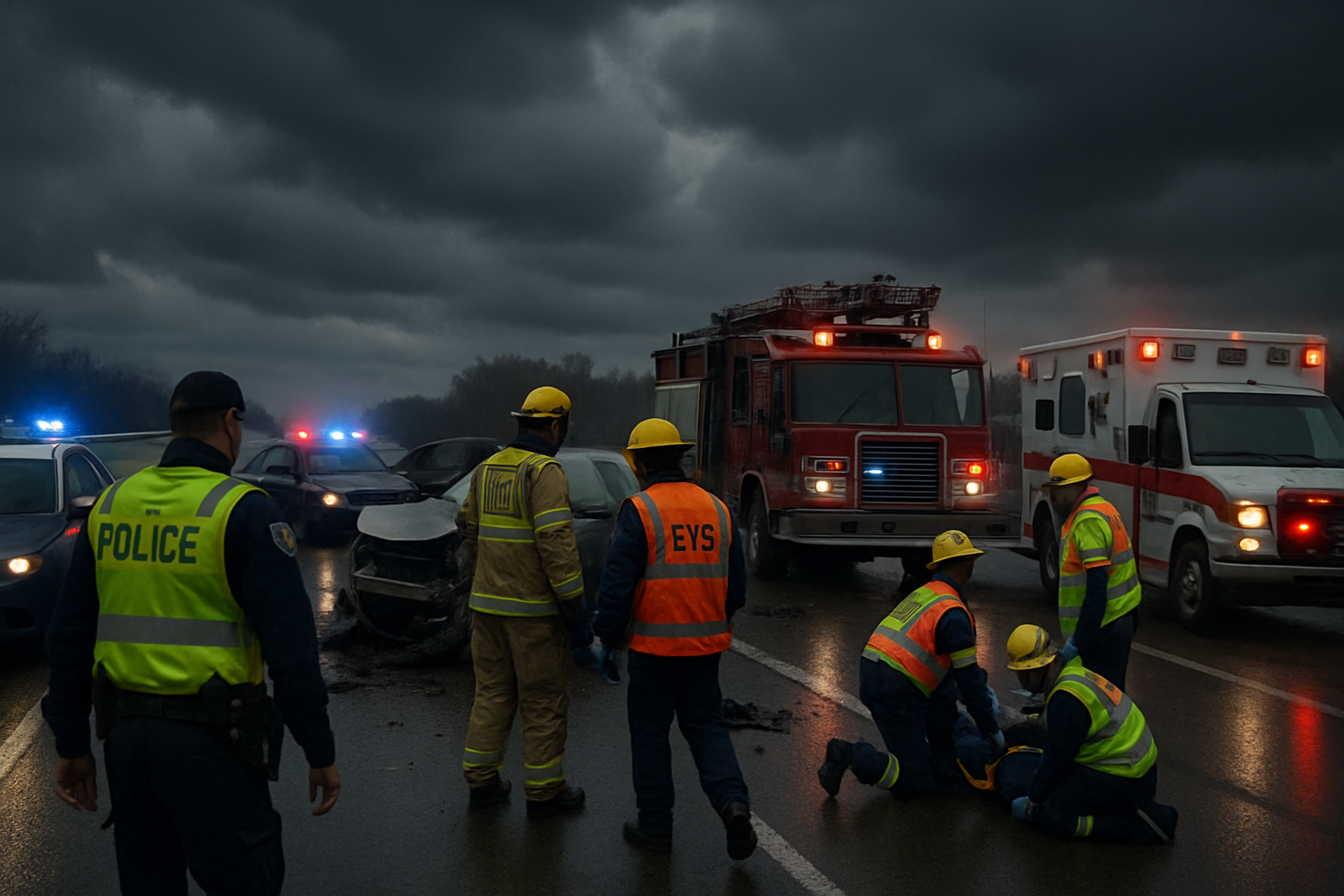
A wave of devastating transportation accidents across multiple continents has claimed numerous lives and injured dozens more, highlighting critical vulnerabilities in global transportation networks and raising urgent questions about infrastructure safety standards worldwide.
The latest incidents, spanning from North Africa to Northern Europe, represent a troubling pattern of transportation failures that experts say reflect deeper systemic issues including aging infrastructure, inadequate safety protocols, and the mounting challenges posed by extreme weather conditions.
Algeria Records Multiple Fatal Collisions
Algeria suffered two separate deadly traffic accidents on March 9, 2026, underscoring the country's ongoing struggle with road safety. In Khenchela province, a violent collision between a commercial vehicle and a passenger car on Bekkar road in Ain Toula municipality claimed two lives and left three others with varying degrees of injury, according to the General Directorate of Civil Protection.
Earlier the same day, six people were injured in another collision in Batna province when a taxi collided with a tourist vehicle in the Mechta Ouled Hassana area of Ouled Si Suleiman municipality. Two of the victims were reported in critical condition and required urgent medical attention.
"These incidents highlight the persistent challenges facing Algeria's road network, particularly in rural and mountainous regions where infrastructure development has lagged behind traffic volume increases."
— Transportation Safety Expert
The accidents add to Algeria's mounting road safety crisis, which has seen hundreds of casualties in recent months. February 2026 alone recorded 16 deaths and 367 injuries across multiple provinces within a 48-hour period, according to Civil Protection statistics.
Caribbean Highway Tragedy Claims Four Lives
The Dominican Republic witnessed one of the most severe accidents of the weekend when a head-on collision on the crucial Duarte Highway left four people dead and a minor injured. The crash occurred in the section between Bonao and Santo Domingo, disrupting one of the country's primary transportation arteries.
According to preliminary reports from the General Directorate of Traffic Safety and Land Transportation, a Lexus SUV traveling from Santo Domingo toward the Cibao region lost control, crossed into the opposite lane, and struck a vehicle carrying five passengers. The collision took place near the Falconbridge entrance, creating significant traffic disruptions on the vital commercial route.
The incident underscores the vulnerability of the Caribbean nation's highway infrastructure, which serves as a critical link for both domestic commerce and tourism. The Duarte Highway functions as a major economic corridor, making safety improvements a pressing national priority.
European Networks Face Unprecedented Challenges
Northern Europe has not been spared from the transportation crisis. Latvia reported a tragic traffic accident on the Riga bypass (A4) near the Ērgļi road (P4) junction that completely blocked traffic, while the Netherlands continues to grapple with rail service disruptions following a work train derailment near Vught.
The Dutch rail incident has suspended service between Den Bosch and both Tilburg and Boxtel since early Saturday morning, affecting thousands of commuters and highlighting the fragility of modern rail networks. The derailment of a work train, typically used for maintenance operations, raises questions about safety protocols during infrastructure maintenance work.
These European incidents occur against the backdrop of an unusually challenging winter that has tested transportation infrastructure across the continent. Earlier this year, extreme weather conditions forced the closure of major airports, paralyzed rail networks, and created hazardous driving conditions from Scandinavia to the Mediterranean.
Historical Context and Emerging Patterns
The March 2026 accidents continue a troubling pattern that has emerged throughout the year. Transportation safety experts point to several interconnected factors contributing to the crisis:
- Aging infrastructure struggling to meet modern traffic demands
- Inadequate investment in road maintenance and safety systems
- Extreme weather events stressing transportation networks beyond design limits
- Insufficient emergency response capabilities in remote areas
- Gaps in international safety standard coordination
The global transportation safety crisis has been building throughout 2026, with significant incidents recorded across multiple continents. Earlier this year, Armenia's decade-long statistics revealed 3,261 road traffic fatalities, while Egypt witnessed a devastating multi-vehicle crash that killed 18 fishermen near Port Said.
Economic and Social Impact
Beyond the immediate human toll, these transportation accidents carry substantial economic consequences. Each traffic death is estimated to cost society hundreds of thousands in lost productivity, medical expenses, and legal proceedings. The social impact extends far beyond the immediate victims, affecting thousands of family members, friends, and community members.
In Algeria alone, where transportation accidents have become alarmingly frequent, the economic burden likely runs into billions of dollars annually when considering both direct costs and indirect economic impacts on families and communities.
The disruption to critical transportation arteries, such as the Dominican Republic's Duarte Highway and the Netherlands' rail network, creates ripple effects throughout regional economies, affecting everything from daily commuting patterns to international freight movements.
International Response and Solutions
Transportation safety experts worldwide are calling for coordinated international action to address the crisis. Successful models from countries like Sweden, which has implemented a "Vision Zero" approach to eliminate traffic deaths, demonstrate that significant improvements are possible through sustained political commitment and comprehensive safety system reforms.
The Netherlands has pioneered the "Safe System Approach," which designs infrastructure to account for human error rather than expecting perfect driver behavior. Australia's speed management initiatives have shown remarkable success in reducing urban traffic fatalities.
"We need a fundamental shift from reactive crisis management to proactive safety system design. The technology exists to prevent many of these tragedies - what's lacking is the political will and international cooperation to implement comprehensive solutions."
— Dr. Sarah Mitchell, International Transportation Safety Institute
Advanced Driver Assistance Systems (ADAS), autonomous emergency braking, and intelligent transportation systems offer promising technological solutions for preventing human error-related accidents. However, implementing these technologies requires substantial infrastructure investment and international coordination.
Climate Change and Infrastructure Adaptation
The transportation safety crisis is occurring against the backdrop of unprecedented climate volatility. January 2026 marked the 18th consecutive month of global temperatures exceeding 1.5°C above pre-industrial levels, creating operating conditions that exceed historical infrastructure design parameters.
Extreme weather events have repeatedly tested transportation networks beyond their intended capacity, from the devastating European winter storms that claimed over 30 lives to severe flooding that disrupted major highways and rail lines. Traditional infrastructure designs, based on historical weather patterns, are proving inadequate for current climate conditions.
Climate adaptation has evolved from an optional consideration to a fundamental requirement for transportation infrastructure projects. Modern designs must incorporate enhanced drainage systems, weather-resistant materials, and backup power systems to maintain safety and functionality during extreme weather events.
The Path Forward
Addressing the global transportation safety crisis requires coordinated action across multiple fronts. Key priorities identified by international experts include:
- Infrastructure Investment: Comprehensive upgrades to roads, lighting, signage, and emergency response capabilities
- Regulatory Enhancement: Strengthened legal frameworks with consistent enforcement across jurisdictions
- Technology Integration: Rapid deployment of safety technologies including collision avoidance systems and intelligent traffic management
- International Cooperation: Enhanced sharing of safety data, best practices, and coordinated emergency response protocols
- Climate Adaptation: Integration of climate resilience into all transportation infrastructure planning
The semiconductor shortage that has affected many industries, with prices surging sixfold until 2027, poses additional challenges for implementing advanced safety systems. However, this constraint is accelerating innovation in efficient design and edge computing alternatives that may prove more resilient in the long term.
Emergency Response Coordination
The recent incidents have highlighted both strengths and limitations in emergency response capabilities. While local authorities have generally mobilized quickly, remote locations and challenging conditions continue to impede recovery efforts. The Democratic Republic of Congo's vast distances and limited communication infrastructure exemplify these challenges.
International cooperation frameworks, such as the EU Civil Protection Mechanism, have demonstrated their value during major emergencies but require enhancement to handle simultaneous disasters across multiple regions effectively.
Success stories from Estonia, which has adapted traditional winter transportation methods with modern safety monitoring, provide templates for climate adaptation that other regions can emulate. The integration of traditional knowledge with contemporary safety protocols offers promising approaches for diverse geographic contexts.
Looking Ahead
The March 2026 transportation accidents represent a critical moment that demands transformative rather than reactive responses. The choice between continuing with crisis management approaches versus implementing comprehensive safety system reforms will have implications for millions of lives and trillions of dollars in economic activity.
As global transportation volumes continue to grow and operational environments become increasingly challenging due to climate change, the window for implementing effective preventive measures is narrowing. The human cost of inaction—measured in preventable deaths, injuries, and economic losses—makes the case for urgent, coordinated international action unmistakably clear.
The transportation safety crisis of 2026 may ultimately be remembered as a watershed moment that catalyzed fundamental improvements in how societies approach infrastructure safety, international cooperation, and climate adaptation. Whether this potential is realized will depend on the political will and sustained commitment of governments, international organizations, and civil society worldwide.