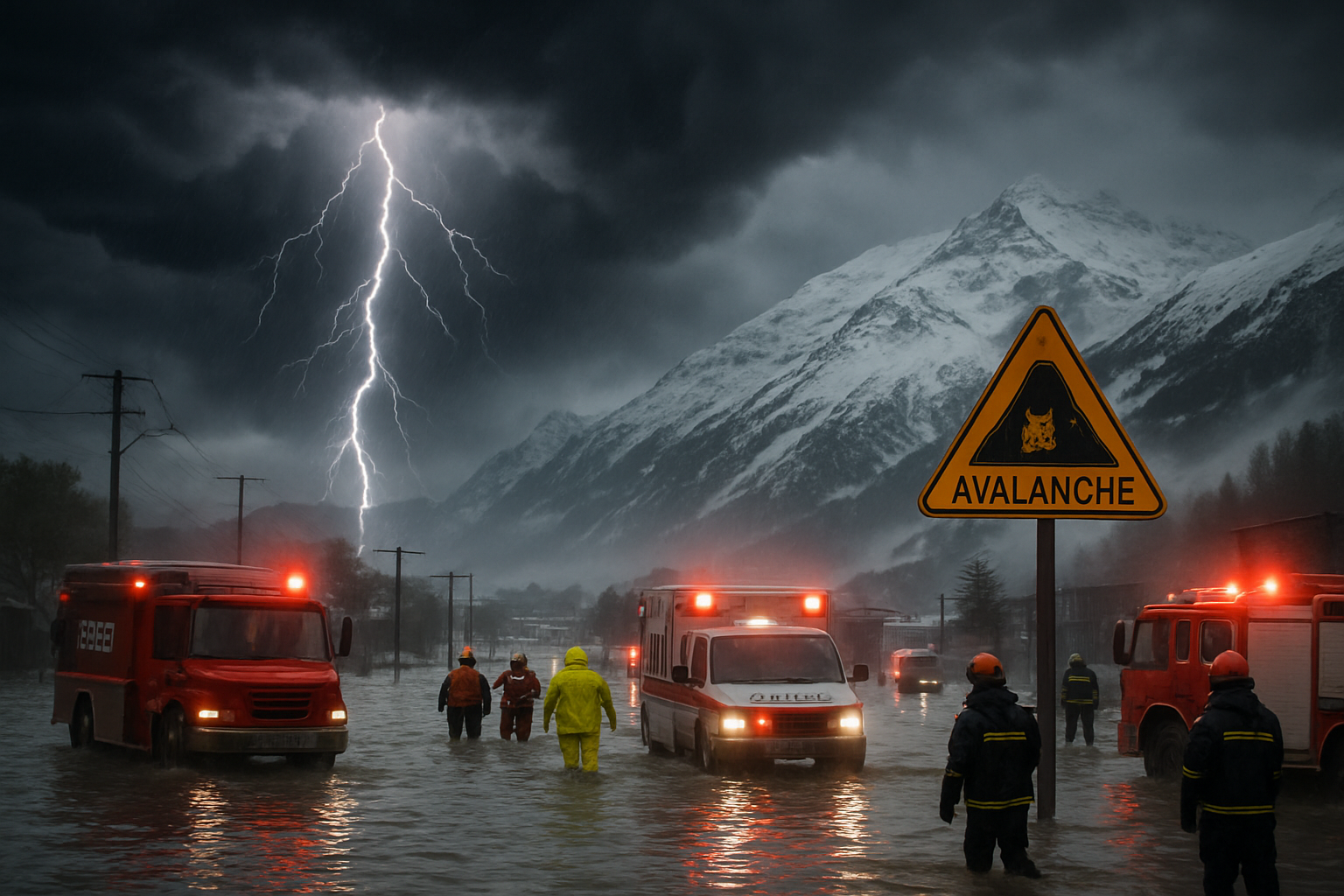
A cascading global weather crisis has emerged across multiple continents as six nations simultaneously battle severe weather emergencies, marking the 20th consecutive month that global temperatures have exceeded 1.5°C above pre-industrial levels.
Algeria's meteorological services issued urgent warnings Thursday for a powerful atmospheric disturbance set to strike northern regions beginning Sunday. The weather system threatens to bring extremely heavy rainfall exceeding 60mm, dense snowfall above 1,100 meters, and dangerous winds surpassing 100 km/h. Dust storms pose additional respiratory hazards as the cold air mass advances across the country.
The meteorological models indicate this disturbance will persist through at least Tuesday, affecting not only Algeria's northern territories but extending to the northern Sahara, oases, and southwestern regions. Thunderstorms with rainfall exceeding 50mm are forecast for multiple provinces, creating potentially dangerous flooding conditions.
Nordic Region Faces Seismic and Wind Emergencies
Finland recorded seismic activity in Kouvola Thursday evening, with the Institute of Seismology's automatic monitoring systems detecting tremors that residents described as shaking entire buildings. Local witnesses reported feeling significant ground movement, with one resident stating "the whole house shook."
Meanwhile, Iceland experienced a magnitude 3.7 earthquake near Torfajökull glacier, approximately three kilometers west of Landmannalaugar, just before noon. The seismic event adds to growing concerns about geological instability across the Nordic region during this period of extreme weather volatility.
Norway faces its own crisis as meteorological services issued storm warnings for dangerous wind conditions across southern regions. Multiple reports have emerged of falling trees and structural damage, with Oslo authorities urging residents to avoid parks due to wind-related hazards. The severe weather has left 8,000 households without power, while the roof of Lambertseter church is reportedly in danger of being blown off.
South African Weather Service Issues Critical Warnings
The South African Weather Service has escalated its response by issuing a yellow Level 4 warning for disruptive rainfall that could trigger localized flooding across the Lowveld regions of Mpumalanga and Limpopo. Simultaneously, extreme heatwave conditions are threatening the Western Cape, Northern Cape, and portions of the Eastern Cape, creating a dangerous dual-threat scenario.
This weather pattern represents the complex and increasingly unpredictable nature of global climate systems, where extreme cold and heat events occur simultaneously across different regions of the same country.
Historical Context: Unprecedented Global Pattern
The current crisis occurs against the backdrop of extraordinary climate records. January 2026 marked the 20th consecutive month that global temperatures exceeded the critical 1.5°C threshold above pre-industrial levels, representing the longest sustained extreme warming period in recorded human history.
"This represents a fundamental shift from natural climate variability to human-induced climate change that is now overriding natural cooling mechanisms, including La Niña effects."
— World Meteorological Organization Climate Analysis
The simultaneity of these weather emergencies across such diverse geographical regions underscores the interconnected nature of global climate systems and the cascading effects of sustained warming.
Infrastructure Under Unprecedented Strain
Emergency services across the affected nations are operating at or beyond capacity limits, with traditional mutual aid mechanisms strained by the simultaneous nature of these disasters. Transportation networks, power grids, and communication systems designed for historical climate patterns are being pushed beyond their operational parameters.
In Norway, emergency services report unprecedented call volumes for assistance with wind-related damage, while Finnish seismological monitoring systems are working to assess the full extent of ground movement in affected areas. Algeria's emergency preparedness systems are mobilizing ahead of the incoming weather disturbance, with particular concern for mountainous regions expecting heavy snowfall.
The power outages affecting thousands of Norwegian households highlight how extreme weather events increasingly cascade through interconnected infrastructure systems, creating compound emergencies that strain response capabilities.
Economic and Social Impact
The economic implications of these simultaneous weather emergencies are mounting rapidly. Agricultural sectors across the affected regions face immediate threats from extreme weather, while tourism industries grapple with safety concerns and operational disruptions.
The psychological toll on communities repeatedly facing extreme weather events has led to increased demand for mental health services, as families and businesses struggle with the uncertainty of increasingly volatile climate conditions.
Recovery timelines for infrastructure damage have shifted from traditional patterns of weeks to months or even years, fundamentally changing how governments and communities approach disaster preparedness and response.
International Response and Cooperation
The global nature of these simultaneous emergencies is testing international cooperation frameworks that were designed for sequential rather than concurrent disasters. Traditional aid mechanisms assume that some regions remain stable enough to assist others during emergencies, but the current pattern of simultaneous global weather events challenges this assumption.
Previous recent crises, including the devastating February 2026 European storm succession that claimed over 30 lives and required 26,500 emergency personnel in Portugal alone, demonstrate the urgent need for enhanced international coordination capabilities designed for permanent climate volatility.
Climate Science Implications
Scientists emphasize that current conditions provide a preview of routine circumstances expected in the 2030s without significant climate adaptation investment. The "climate volatility paradox" demonstrates how global warming enables both unprecedented heat records and devastating regional extreme weather through disrupted atmospheric circulation patterns.
The World Meteorological Organization has indicated a 50-60% probability of El Niño development between July and September 2026, which could drive global temperatures into unprecedented territory during an already exceptional warming streak.
Adaptation Imperatives
The March 2026 weather crisis represents a watershed moment for global climate preparedness, forcing a choice between reactive crisis management and transformative infrastructure adaptation approaches. The concept of "building back better" has evolved from an optional enhancement to an essential survival strategy for communities facing repeated extreme weather.
Infrastructure systems require fundamental reassessment for a "new normal" of extreme weather volatility, as traditional seasonal patterns are no longer reliable planning frameworks. Enhanced early warning systems, climate-resistant construction, and community resilience networks are becoming critical components of adaptation strategies.
Looking Forward: Urgent Action Required
The window for effective climate action continues to narrow as ecological systems approach critical thresholds with potentially irreversible changes affecting global food security, climate stability, and human settlements. The tools, knowledge, and cooperation mechanisms exist for comprehensive environmental protection, but success depends on unprecedented speed and coordination in sustained international cooperation.
Additional weather systems are developing across multiple ocean basins, with authorities maintaining high alert levels globally. The persistence of crisis conditions over recent months may be establishing a "new normal" of extreme weather frequency that challenges traditional emergency response frameworks on a permanent basis.
Emergency management systems require transformation to address permanent climate volatility rather than treating extreme weather as exceptional events. Enhanced capabilities for climate-resilient infrastructure, new international cooperation frameworks for simultaneous global disasters, and adaptive management approaches are essential for protecting human societies during this critical climate decade.
The choices made in the coming months will be decisive for global climate resilience strategies, affecting emergency response approaches and climate adaptation efforts that will define human societies' ability to thrive in an unprecedented environmental change era.