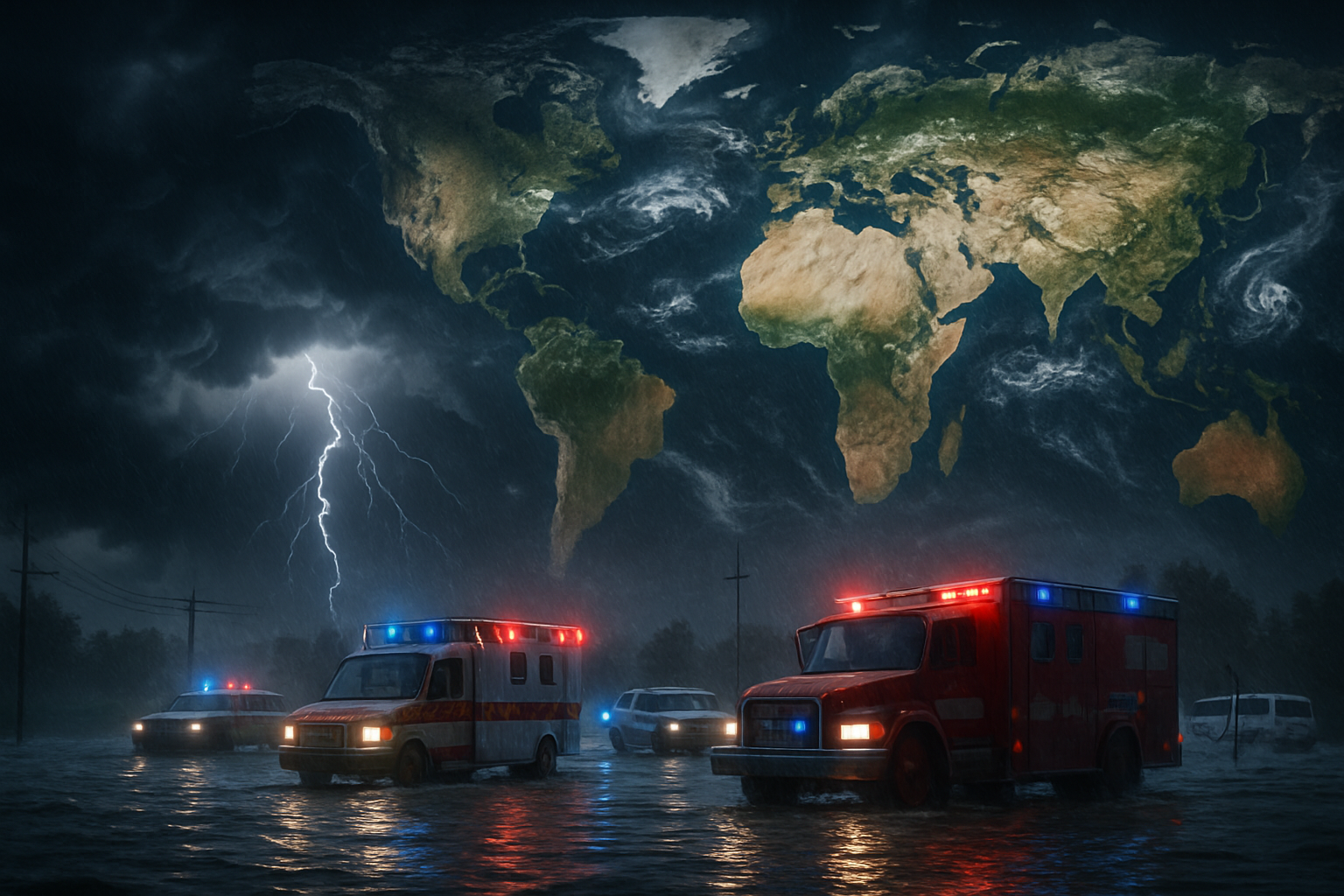
A convergence of severe weather disasters across four continents has triggered emergency declarations and overwhelmed response systems worldwide, highlighting the unprecedented strain on global infrastructure during what appears to be the 24th consecutive month of temperatures exceeding 1.5°C above pre-industrial levels.
Wellington, New Zealand declared a state of emergency Monday following torrential rains that triggered severe flooding and landslides throughout the capital region. The extreme weather has left at least one person missing, according to Radio New Zealand, while footage shows vehicles submerged, trees uprooted, and houses struck by landslides.
The crisis extends far beyond New Zealand's borders. In Algeria, meteorological services have issued urgent warnings for dangerous winds exceeding 100 km/h striking multiple provinces, accompanied by dust storms creating respiratory hazards across the southern regions. The Saharan nation faces a triple threat of thunderstorms, mountain snowfall, and severe wind conditions that threaten widespread infrastructure damage.
24-Month Climate Emergency Milestone
The simultaneous weather disasters occur during what climate scientists describe as the longest sustained period of extreme warming in recorded human history. January 2026 remains the hottest month ever documented, marking nearly two full years of global temperatures consistently exceeding critical climate thresholds.
"We are asking people to take this seriously, follow safety advice, and act early if they are in low-lying or flood-prone areas, which are those that have experienced multiple flooding events in recent years."
— Carrie McKenzie, Wellington Civil Defense Emergency Management
The World Meteorological Organization has indicated a 50-60% probability of El Niño conditions developing by July-September 2026, which could drive temperatures into unprecedented territory by combining baseline warming with natural climate cycle amplification.
Wellington Under Water
New Zealand's capital received a record-breaking 77 millimeters of rain in less than an hour Monday, overwhelming urban drainage systems designed for historical weather patterns. The MetService upgraded warnings to red alert status for Wellington and the Wairarapa region through Tuesday night, with forecasters warning of "dangerous river conditions, significant flooding, and slips."
At the two-storey Duckworth Lewis guesthouse in Wellington, approximately 35-40 residents awoke to meter-high floodwaters on the ground floor. In the Hutt Valley, superette owner Jay Gandhi deployed sandbags in a desperate attempt to protect his store from rising waters.
Global Emergency Response Breakdown
The simultaneous nature of these disasters is exposing critical weaknesses in emergency response systems designed for sequential rather than concurrent multi-continental crises. Traditional mutual aid mechanisms, which historically allowed stable regions to assist areas facing isolated emergencies, are proving inadequate when multiple continents face disasters simultaneously.
Emergency services are operating at or beyond capacity limits globally. Transportation networks, power grids, and communication systems designed for historical climate patterns are repeatedly failing as extreme weather exceeds their operational parameters.
Algeria's Triple Weather Threat
In North Africa, Algeria's meteorological services have issued comprehensive warnings for a dangerous atmospheric disturbance affecting northern regions through Tuesday. The system threatens to bring heavy rainfall exceeding 60mm, dense snowfall above 1,100 meters elevation, and winds surpassing 100 km/h.
The atmospheric instability extends across the northern Sahara, oases, and southwestern areas with unprecedented March intensity. Civil protection services have already conducted multiple rescues as dust storms create respiratory hazards for vulnerable populations.
Compound Disasters Paradigm
Emergency management experts are identifying a fundamental shift from isolated regional disasters to what they term "compound disasters" – multiple emergency types occurring concurrently across vast geographic areas, fundamentally challenging traditional resource allocation and mutual aid mechanisms.
The Australian Fire Emergency Services Authority (AFAC) notes that emergency services are experiencing a paradigmatic shift from managing isolated regional disasters to handling multiple simultaneous incidents requiring different specialties, straining response capabilities designed for historical patterns.
Infrastructure Beyond Design Limits
Recovery timelines have fundamentally shifted from weeks to months or years, representing a permanent change in disaster response approaches. The concept of "building back better" with climate-resilient infrastructure has evolved from an optional enhancement to an essential survival strategy for communities facing permanent climate volatility.
Traditional seasonal patterns that guided infrastructure design, agricultural planning, and emergency preparedness for centuries are no longer reliable frameworks. Current conditions provide a preview of what may become routine in the 2030s without comprehensive climate adaptation investment.
Economic and Social Devastation
The mounting economic impact spans agricultural operations facing billions in losses as extreme weather destroys crops and disrupts supply chains during critical growing seasons. Tourism industries are experiencing extended cancellations and infrastructure damage during peak revenue periods.
Mental health services report increased demand for support related to climate anxiety and repeated trauma, as families face the prospect of losing generational properties multiple times within a decade. Vulnerable populations, including the elderly and those with respiratory conditions, are disproportionately affected by the frequency and intensity of extreme weather events.
International Cooperation at Breaking Point
Environmental challenges transcend political boundaries, as atmospheric systems and ocean currents transport climate effects globally, making unilateral adaptation insufficient for comprehensive resilience. The simultaneity of disasters is testing cooperation mechanisms developed under the assumption that stable regions could assist others during isolated emergencies.
The European Union's Civil Protection Mechanism has been repeatedly activated, with Sweden-Denmark receiving €246 million in assistance representing the largest coordinated European weather response on record. However, this response has proven insufficient for the scale and simultaneity of current challenges.
Critical Climate Action Window
Climate experts describe April 2026 as a critical watershed moment for global climate preparedness, forcing a choice between reactive crisis management and transformative infrastructure adaptation. The window for effective climate action is narrowing as ecological systems approach critical thresholds that could trigger irreversible changes to global food security, climate stability, and human settlements.
Environmental protection must be recognized as essential infrastructure for human prosperity and planetary sustainability, rather than merely a regulatory burden. The tools, knowledge, and cooperation frameworks exist for comprehensive environmental protection, but success depends on unprecedented speed of coordination and sustained international cooperation with political commitment.
A Defining Moment
The convergence of extreme weather, infrastructure vulnerabilities, and emergency response limitations underscores the urgent need for coordinated international action. Additional weather systems are developing in the Atlantic and Pacific regions, with authorities maintaining high alert status globally.
The persistence of crisis conditions may establish a "new normal" characterized by extreme weather frequency and intensity that permanently challenges traditional emergency response frameworks. The question is no longer whether transformative climate action is needed, but whether humanity can organize and implement solutions rapidly enough to maintain planetary habitability during Earth's most environmentally challenging period in recorded history.