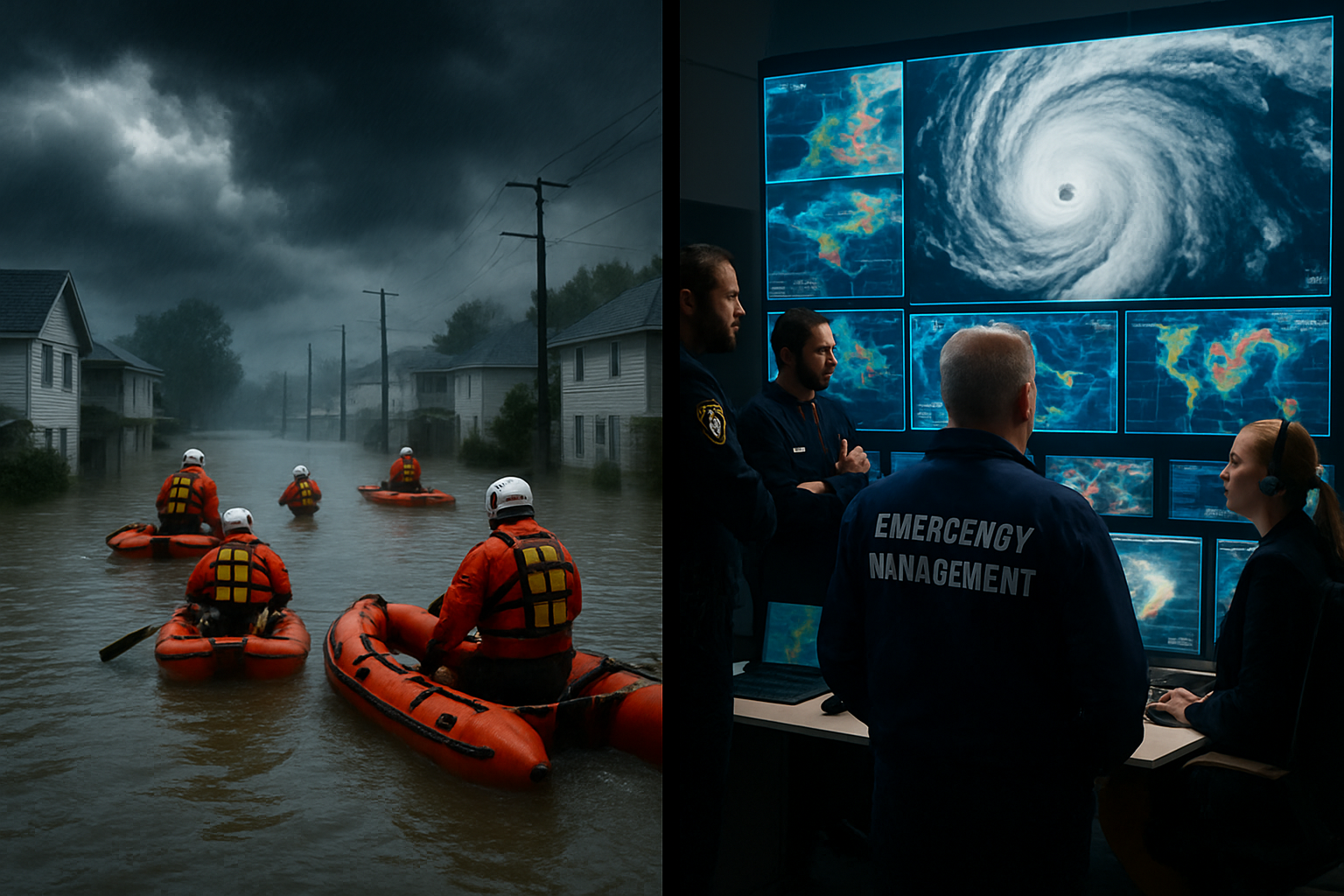
Emergency officials across multiple continents are grappling with simultaneous extreme weather events as severe flooding forces evacuations in Canada's Manitoba province while powerful thunderstorms threaten millions across five South African provinces.
The convergence of these weather emergencies represents the latest escalation in what climate scientists are calling an unprecedented period of global atmospheric instability, occurring during what may become the 24th consecutive month of temperatures exceeding 1.5°C above pre-industrial levels.
Manitoba Flooding Crisis Intensifies
Parts of Manitoba and Ontario have declared states of emergency as spring flooding reaches critical levels not witnessed since 2022. The Peguis First Nation and Fisher River Cree Nation are anticipating water levels that previously forced the evacuation of 1,000 residents, according to local emergency management officials.
In Gatineau, Quebec, emergency officials report 41 roads are now closed with 164 homes at immediate risk as rising water levels threaten to overwhelm the community's flood defenses. The situation has become particularly acute in areas where flood barriers designed for historical weather patterns are proving inadequate against current precipitation intensities.
"We're seeing water levels that challenge our traditional flood management systems. The frequency and intensity of these events is testing our emergency response capabilities like never before."
— Manitoba Emergency Management Official
Community members in Peguis First Nation have been working around the clock to transport sandbags and prepare evacuation routes, with emergency coordinators noting that this represents the 12th major flood event since 2000 for the region.
South African Thunderstorm Emergency
Simultaneously, the South African Weather Service has issued comprehensive warnings for severe thunderstorms, hail, excessive lightning, and heavy rainfall across Gauteng, Mpumalanga, Limpopo, North West, and the Free State provinces. The warnings indicate potential flooding conditions that could affect millions of residents across the country's most densely populated regions.
Weather officials report that the storm systems are characterized by unusual intensity and duration, with atmospheric conditions creating dangerous combinations of multiple weather threats occurring simultaneously rather than in sequence. The warnings encompass both urban flooding risks in major metropolitan areas and agricultural disruption across key farming regions.
Global Context of Extreme Weather Patterns
These simultaneous emergencies occur against the backdrop of what climate scientists describe as the longest sustained period of extreme global warming in recorded history. January 2026 remains the hottest month ever documented, extending a streak of consecutive months exceeding critical climate thresholds.
According to meteorological analysis accessed through historical weather data, the current crisis builds upon a pattern of increasing extreme weather simultaneity that has challenged traditional emergency response mechanisms designed for sequential rather than concurrent disasters.
The World Meteorological Organization has indicated a 50-60% probability of El Niño development between July and September 2026, which could drive unprecedented global temperatures by combining baseline warming with natural cycle amplification.
Emergency Response Systems Under Strain
Emergency management experts are identifying a fundamental shift from isolated regional disasters to what they term "compound disasters" – multiple emergency types occurring concurrently across vast geographic areas, challenging traditional resource allocation and mutual aid mechanisms.
In Canada, the coordination between Quebec and Ontario emergency services has become essential due to the cross-border nature of the Ottawa River watershed flooding. Traditional flood defenses, designed based on historical precipitation patterns, are proving insufficient against current rainfall intensities and rapid temperature fluctuations.
South African emergency services are similarly adapting to manage multiple weather threats simultaneously, with coordination required across five provinces to address thunderstorm impacts while maintaining readiness for potential secondary effects including power outages and transportation disruptions.
Infrastructure Adaptation Challenges
The current crisis highlights critical vulnerabilities in infrastructure systems designed for historical rather than current climate conditions. Recovery timelines are increasingly shifting from weeks to months or years, representing a fundamental change in disaster response approaches.
Transportation networks, power grids, and communication systems across affected regions are operating beyond their design parameters, with cascading failures compounding primary weather impacts. This has led to what emergency officials describe as a permanent shift toward "building back better" climate-resilient infrastructure as an essential survival strategy rather than an optional enhancement.
"We're not just dealing with individual weather events anymore. We're managing interconnected crises that challenge every aspect of our emergency response systems."
— International Emergency Management Specialist
Economic and Social Impact
The agricultural sectors in both affected regions are mounting significant losses as extreme weather destroys crops and disrupts supply chains during critical growing seasons. Tourism industries face extended cancellations and infrastructure damage, while families confront the possibility of losing generational properties to repeated extreme weather events.
Mental health services are experiencing increased demand as climate anxiety and repeated trauma from extreme weather events affect vulnerable populations, including elderly residents and those with pre-existing health conditions. The frequency and intensity of these events are creating sustained psychological impacts that extend far beyond the immediate physical damage.
International Cooperation and Future Preparedness
Environmental challenges increasingly transcend political boundaries, with atmospheric and ocean systems transporting weather effects globally regardless of borders. The simultaneity of current disasters is testing international cooperation mechanisms that were developed assuming stable regions could assist others during isolated emergencies.
Recent examples include the EU Civil Protection mechanism's repeated activation, including €246 million in assistance for Sweden and Denmark – representing the largest coordinated European weather response on record, yet insufficient for the scale and simultaneity of current global challenges.
Technology-tradition integration is emerging as a successful response strategy, combining advanced meteorological forecasting and satellite monitoring with Indigenous knowledge systems and community-based management approaches. This hybrid methodology is providing more effective early warning systems and evacuation protocols.
Climate Action Window Narrowing
Climate scientists emphasize that the current conditions provide a preview of what may become routine circumstances in the 2030s without comprehensive climate adaptation investment. The choice between reactive crisis management and transformative infrastructure adaptation is becoming increasingly critical as ecological systems approach thresholds that could trigger irreversible changes to global food security, climate stability, and human settlements.
Additional weather systems are developing in Atlantic and Pacific regions, with authorities maintaining high alert status globally. The persistence of these crisis conditions may establish a "new normal" of extreme weather frequency and intensity that permanently challenges traditional emergency response frameworks.
The convergence of extreme weather, infrastructure vulnerabilities, and emergency response limitations underscores the urgent need for coordinated international action. Tools, knowledge, and cooperation frameworks exist for comprehensive environmental protection, but success depends on unprecedented speed and coordination through sustained international cooperation and political commitment to environmental protection as essential infrastructure for human prosperity and planetary sustainability.