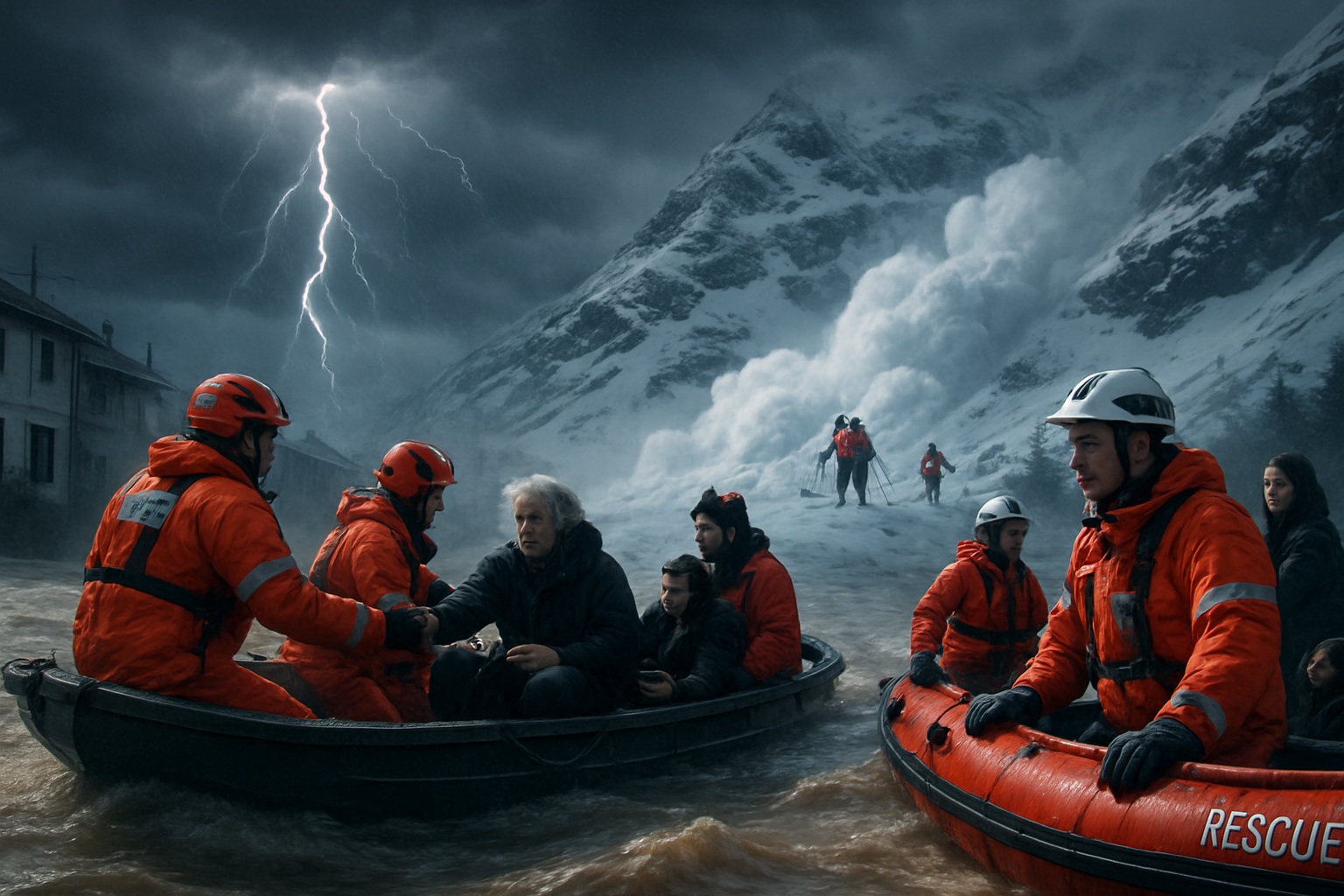
Emergency services across multiple continents are struggling to respond to simultaneous weather disasters as the planet experiences its 22nd consecutive month of temperatures exceeding 1.5°C above pre-industrial levels—the longest sustained period of extreme warming in recorded human history.
From devastating snowstorms and avalanche risks in Northern Europe to severe flooding in North Africa and ongoing cleanup efforts in New Zealand, the current crisis exposes critical weaknesses in global emergency response systems designed for sequential, not concurrent disasters.
Algeria Faces Triple Weather Threat
Algeria's Civil Protection Directorate reported multiple rescue operations as the country battles a dangerous combination of extreme weather conditions. Heavy snowfall, thunderstorms, and powerful winds exceeding 100 km/h have created hazardous conditions across multiple provinces, forcing authorities to conduct emergency rescues of trapped civilians.
The severity of the conditions prompted civil protection teams to evacuate 10 people trapped by snow and weather-related incidents, highlighting the increasingly unpredictable nature of Mediterranean weather patterns. Dust storms accompanying the extreme winds have created additional respiratory hazards for vulnerable populations.
New Zealand's Prolonged Recovery
In New Zealand's Far North, communities are still grappling with the aftermath of the devastating March 26 deluge that particularly impacted the settlement of Whirinaki. The flooding event left many areas isolated and inundated, with infrastructure damage requiring months of repair work.
Local authorities report that traditional flood defenses proved inadequate against the intensity of rainfall experienced, echoing a global pattern where infrastructure designed for historical climate patterns fails under current extreme weather conditions.
Nordic Countries Under Pressure
Norway has experienced a tragic incident with a man in his 60s losing his life after falling into a river in Klepp, Jæren. The incident underscores the heightened dangers posed by extreme weather events, even in regions traditionally well-equipped to handle challenging conditions.
Finland's meteorological services have issued danger warnings for the Päijät-Häme region, though the immediate threat has since passed. The frequency of such alerts across Nordic countries reflects the increasing volatility of weather patterns in regions that have historically experienced more predictable seasonal variations.
Global Emergency Response Breaking Point
Emergency management experts are increasingly concerned about the shift from isolated regional disasters to what they term "compound disasters"—multiple emergency types occurring simultaneously across vast geographic areas. This fundamental change challenges traditional resource allocation and mutual aid mechanisms that have historically allowed stable regions to assist others during crises.
"We're seeing a complete breakdown of the traditional mutual aid systems that emergency services have relied on for decades. When multiple continents face disasters simultaneously, there's simply nowhere to draw additional resources from."
— Emergency Management Specialist
The European Union's Civil Protection Mechanism has been activated repeatedly in recent months, with the Sweden-Denmark €246 million assistance package representing the largest coordinated European weather response on record. However, experts warn that even these unprecedented measures are insufficient given the scale and simultaneity of current challenges.
Climate Science Context
The current crisis unfolds against the backdrop of January 2026 being confirmed as the hottest month in recorded history, extending an unprecedented warming streak. Human-induced climate change is now completely overriding natural cooling mechanisms, including La Niña effects that would traditionally moderate global temperatures.
The World Meteorological Organization has indicated a 50-60% probability of El Niño development by July-September 2026, which could drive global temperatures to unprecedented levels by combining baseline warming with natural cycle amplification.
This "climate volatility paradox" means that sustained global warming enables both heat records and devastating regional extremes through disrupted atmospheric circulation and polar vortex patterns.
Infrastructure Failures and Economic Impact
Transportation networks, power grids, and communication systems designed for historical climate patterns are repeatedly failing as extreme weather exceeds their operational parameters. The cascading effects of these infrastructure failures compound the primary impacts of severe weather events.
Economic devastation is mounting across multiple sectors, with agricultural operations facing billions in losses from destroyed crops and disrupted supply chains. Tourism industries are experiencing extended cancellations and infrastructure damage during what should be peak revenue periods. Recovery timelines have fundamentally shifted from weeks to months or even years, representing a dramatic change in disaster response planning.
Mental Health and Community Impact
Mental health services report increased demand as communities face repeated extreme weather trauma. Families are potentially losing generational properties multiple times within a single decade, creating unprecedented psychological and social stress.
However, the crisis has also demonstrated remarkable community resilience, with volunteer networks, neighbor assistance, and local organizations providing crucial coordination when official systems become overwhelmed.
The Path Forward: Adaptation vs. Crisis Management
Experts emphasize that the current crisis represents a watershed moment in global climate preparedness. The choice between reactive crisis management and transformative infrastructure adaptation is becoming increasingly critical as the window for effective climate action narrows.
"Building back better" with climate-resilient infrastructure has evolved from an optional enhancement to an essential survival strategy. Traditional seasonal patterns that have guided infrastructure design, agricultural planning, and emergency preparedness for centuries are no longer reliable frameworks.
International Cooperation Under Strain
Environmental challenges transcend political boundaries, as atmospheric systems and ocean currents transport climate effects globally regardless of borders. The simultaneity of disasters is testing cooperation mechanisms that were developed assuming stable regions could assist others during isolated emergencies.
Success in managing this new reality requires unprecedented international cooperation, enhanced multi-sector coordination, and sustained financial commitments that recognize environmental protection as essential infrastructure rather than optional policy.
Looking Ahead: A New Normal
Current conditions provide a preview of what may become routine in the 2030s without significant climate adaptation investment. Additional weather systems are developing in the Atlantic and Pacific regions, with authorities maintaining high alert levels globally.
The persistence of crisis conditions may establish a "new normal" characterized by extreme weather frequency and intensity that permanently challenges traditional emergency response frameworks. The question facing humanity is no longer whether transformative climate action is needed, but whether we can organize and implement solutions rapidly enough to maintain planetary habitability during Earth's most environmentally challenging period in recorded history.
As the crisis continues to unfold, the convergence of extreme weather events, infrastructure vulnerabilities, and emergency response limitations underscores the urgent need for coordinated international action. The tools, knowledge, and cooperation frameworks exist for comprehensive environmental protection, but success depends on unprecedented speed, coordination, and sustained international cooperation with political commitment to environmental protection as essential infrastructure for human prosperity and planetary sustainability.