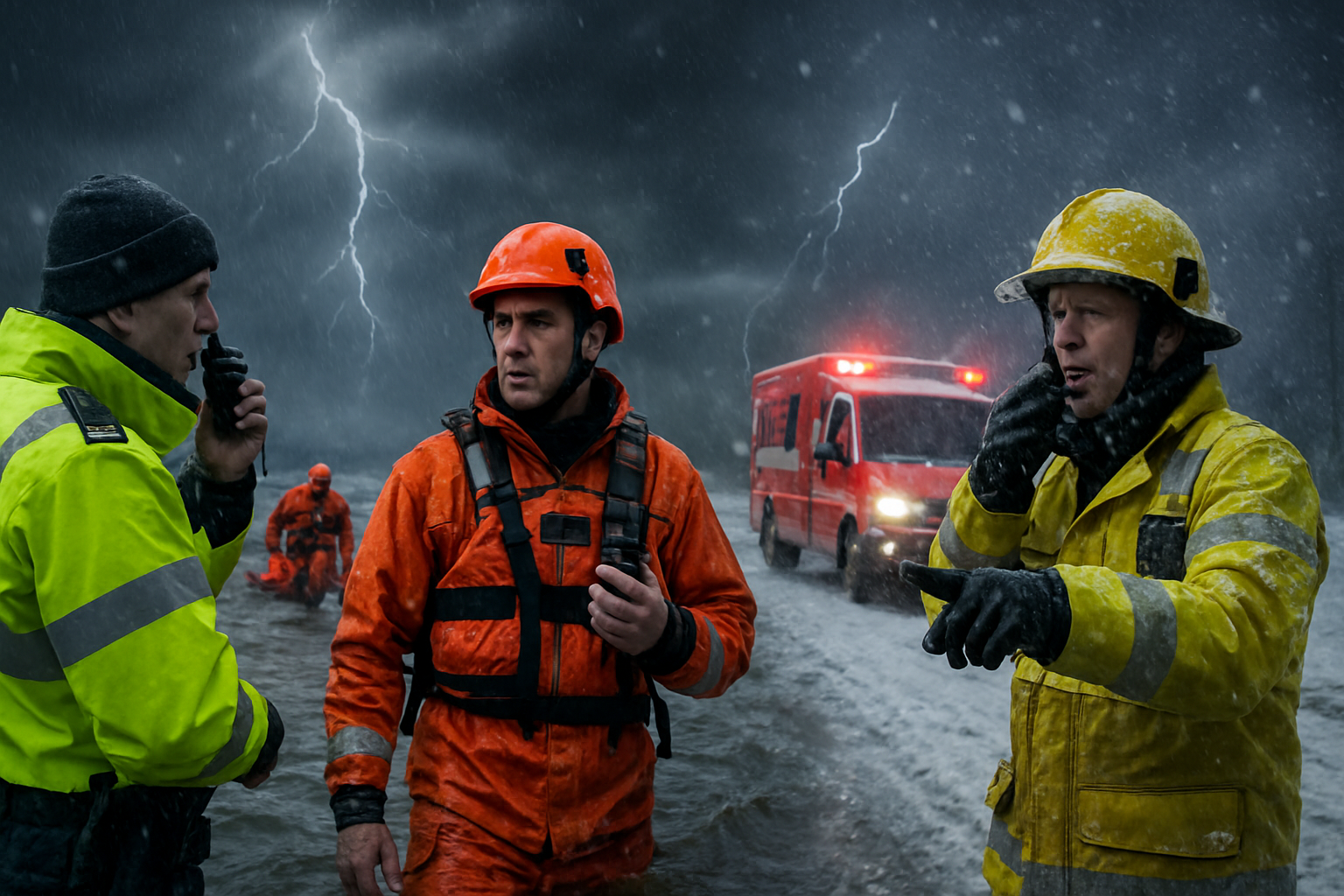
Emergency services across ten countries are battling simultaneous extreme weather disasters on February 26, 2026, as a magnitude 4.4 earthquake strikes Romania, deadly rockslides devastate Haiti, and freezing rain paralyzes Estonia's transportation networks—marking the latest escalation in a month of unprecedented global weather catastrophes.
The convergence of disasters spanning four continents has exposed critical vulnerabilities in international emergency response systems, with traditional mutual aid mechanisms strained by the sheer scale and simultaneity of crises affecting millions of people worldwide.
Seismic Activity Compounds Weather Emergencies
Romania's National Institute for Earth Physics reported a magnitude 4.4 earthquake at 7:21 PM local time in Vrancea County, the country's most seismologically active region. The deep tremor, occurring at 120 kilometers depth, was felt across neighboring Bulgaria, particularly in the border city of Silistra, demonstrating the cross-border nature of natural disasters.
The earthquake struck as Romania continues recovering from what officials called "the most severe winter episode of 2026," which left 58 vehicles with 106 people stranded and caused power outages affecting 23 localities across three counties. The timing compounds infrastructure stress as emergency services remain deployed managing ongoing weather-related interventions.
"Deep earthquakes in the Vrancea zone are characteristic of this region and often felt at great distances due to their geological properties,"
— Romanian National Institute for Earth Physics
Haiti Rockslide Disaster Claims Multiple Casualties
At least five people were injured in a devastating rockslide that struck the hillside neighborhood of Mòn Basiko in Cap-Haïtien on February 25. The disaster damaged three homes and highlighted the vulnerability of communities in mountainous terrain during periods of intense rainfall and geological instability.
The incident represents Haiti's latest environmental challenge as the Caribbean nation continues struggling with inadequate infrastructure and limited emergency response capabilities. Local authorities are assessing the full extent of damage while managing evacuation procedures for residents in high-risk areas.
Transportation Networks Collapse Under Extreme Conditions
Estonia's capital Tallinn switched its tram system to a "free timetable" as freezing rain created hazardous conditions across the Baltic nation. The unprecedented measure allows trams to operate without fixed schedules as operators navigate dangerous ice-covered tracks and overhead power lines.
The transportation crisis extends across Northern Europe, with similar dangerous conditions reported in Latvia and Finland. These disruptions come as the region experiences some of the coldest winter conditions in 25 years, straining power grids and emergency services beyond normal capacity limits.
Brazil's Ongoing Flood Catastrophe
Brazil's southeastern Minas Gerais state continues battling catastrophic flooding that has killed at least 53 people, with 15 still missing according to Italian news agency ANSA. The disaster, described as the worst in the region for decades, has overwhelmed local emergency services despite massive military deployment and civilian volunteer mobilization.
The flooding began February 23 in cities including Juiz de Fora and Ubá, triggered by what meteorologists called "the wettest February on record." Rescue operations face ongoing challenges from continued rainfall and dangerous landslide conditions across the mountainous terrain.
"We're seeing unprecedented rainfall patterns that our traditional flood defenses simply cannot handle,"
— Margarida Salomão, Mayor of Juiz de Fora
South American Weather Threats Intensify
Peru's authorities issued orange-level alerts as the Rímac River in Lurigancho-Chosica reached dangerous levels, threatening 12 critical points with potential overflows and landslides. The warnings come as intense rainfall continues battering the region, creating conditions for devastating huaicos (debris flows) that have historically caused significant casualties and infrastructure damage.
Colombia's maritime authority DIMAR has maintained special precautionary measures for February 26-27, identifying these as the days of highest risk for dangerous sea conditions and irregular rainfall patterns along the Caribbean coast. The warnings affect major ports and coastal communities already vulnerable to climate-related disasters.
Climate Context and Historical Significance
These simultaneous disasters occur during what climate scientists have identified as an unprecedented period of global weather volatility. January 2026 marked the 18th consecutive month of global temperatures exceeding 1.5°C above pre-industrial levels, with human-induced warming overriding natural cooling cycles including La Niña effects.
The current crisis builds on February 2026's devastating European storm succession—Kristin, Leonardo, Marta, Nils, and Pedro—which claimed over 30 lives across Portugal, Spain, and France, requiring the largest peacetime rescue operation in Portuguese history involving 26,500 personnel.
Infrastructure Vulnerabilities Exposed
The simultaneous nature of current emergencies has revealed critical weaknesses in infrastructure designed for historical rather than current climate conditions. Transportation networks, power grids, and communication systems across affected regions are operating beyond their design parameters, with cascading failures affecting millions of people.
Emergency services report reaching capacity limits globally, with traditional mutual aid mechanisms—which assume some regions remain unaffected and available to assist others—severely strained by the geographic breadth of simultaneous disasters.
International Response and Coordination Challenges
The European Union's Civil Protection Mechanism has been activated multiple times throughout February, with Sweden and Denmark providing €246 million in assistance—representing the largest coordinated European weather response on record. However, the simultaneous nature of global disasters prevents traditional resource sharing between regions.
Emergency management experts emphasize that current response strategies, based on historical weather patterns and traditional mutual aid assumptions, require fundamental restructuring for an era of permanent climate volatility.
Economic and Social Devastation
The economic toll spans multiple sectors, with agricultural losses reaching billions of dollars as extreme weather destroys crops and disrupts supply chains. Tourism industries face extended cancellations and infrastructure damage during peak seasons, while transportation disruptions create ripple effects throughout global commerce.
Recovery timelines have shifted from weeks to months or years in many affected areas, representing a fundamental change in disaster response and preparation approaches. The concept of "building back better" with climate-resilient infrastructure has evolved from optional to essential for community survival.
Adaptation Imperatives
Climate adaptation experts warn that February 2026 represents a watershed moment for global disaster preparedness. The choice between reactive crisis management and transformative infrastructure adaptation has become increasingly urgent as extreme weather events exceed the adaptive capacity of multiple regions simultaneously.
The European Scientific Advisory Council on Climate Change has warned that current infrastructure systems are critically unprepared for accelerating climate impacts, calling for urgent investment in protecting populations and infrastructure from floods, extreme heat, and severe weather.
"We're witnessing a fundamental shift from sequential regional disasters to simultaneous global emergencies. Our response systems must evolve accordingly,"
— International disaster response expert
Looking Forward
Additional Atlantic weather systems are developing, with authorities maintaining high alert levels across multiple continents. The persistence of crisis conditions over several weeks has established what many scientists term a "new normal" of extreme weather frequency that challenges traditional emergency response frameworks.
The window for effective climate action continues narrowing while the costs of both adaptation and inaction escalate rapidly. February 2026 may prove decisive for determining whether international response capabilities can adapt to manage the permanent climate volatility now characterizing our rapidly changing planet.
As communities worldwide confront generational challenges to their homes, businesses, and ways of life, the crisis demonstrates both the urgent need for enhanced international cooperation and the remarkable resilience of human communities when faced with environmental adversity.