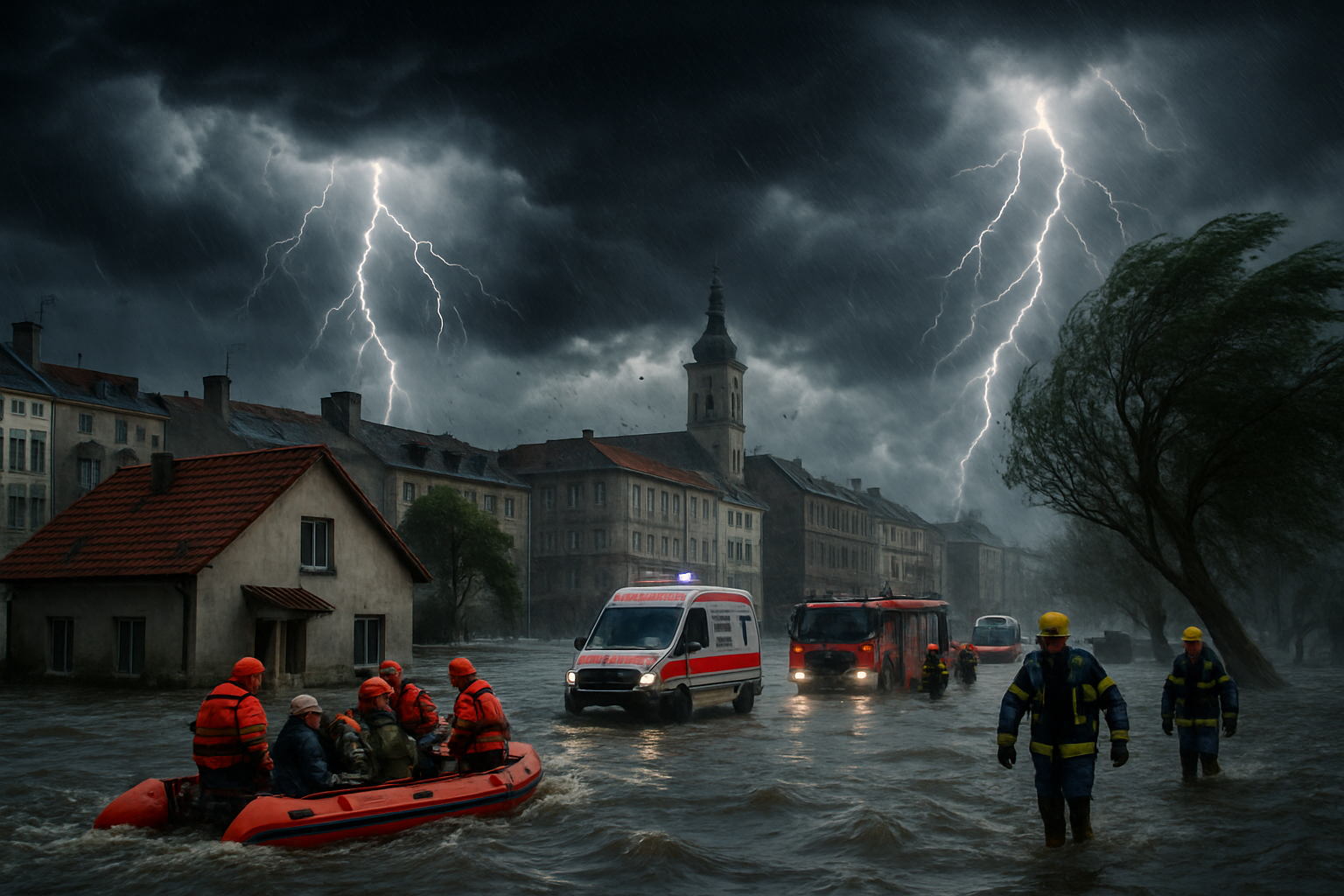
Storm Nils battered western Europe with hurricane-force winds exceeding 162 km/h, claiming at least two lives in France and leaving 450,000 households without power in what meteorologists are calling the fourth consecutive major Atlantic storm to strike the region in February 2026.
The storm claimed its first victim in France's Landes department on Thursday, followed by a second death in Tarn-et-Garonne according to government spokesperson Maud Bregeon. The casualties occurred as the storm unleashed its fury across southwestern France before moving toward Spain, creating what emergency services describe as "extraordinarily dangerous" conditions.
The deadly storm represents the latest chapter in an unprecedented global weather crisis that has simultaneously affected multiple continents, overwhelming emergency response systems from Europe to New Zealand, with tropical cyclones threatening southern Africa while severe flooding devastates communities across Ireland and Portugal.
Storm Nils: Fourth Atlantic Giant in Devastating Succession
Storm Nils follows the catastrophic sequence of Storms Kristin, Leonardo, and Marta that have battered the Iberian Peninsula throughout February 2026, creating what Portuguese authorities describe as their largest peacetime rescue operation in national history. The succession has required deployment of 26,500 emergency personnel, including 1,975 military staff and 30 naval vessels.
In Portugal, the crisis reached a critical infrastructure milestone when the A1 highway viaduct near Coimbra collapsed following catastrophic Mondego River flooding, severing the vital Lisbon-Porto transportation corridor. Infrastructure Minister Miguel Pinto Luz confirmed repairs will require "several weeks," forcing massive traffic diversions across the country.
French meteorological services issued red alerts across multiple departments, with Gironde and Lot-et-Garonne facing flood warnings, while Aude and Pyrénées-Orientales received alerts for violent winds. The Savoie region remains under avalanche warnings as the storm's influence extends into the French Alps.
New Zealand Declares State of Emergency
Simultaneously, New Zealand's North Island faces its own weather emergency, with Ōtorohanga District Council declaring a week-long state of emergency following severe thunderstorms and torrential rainfall that caused widespread flooding. The emergency declaration reflects the severity of conditions affecting the region.
Local emergency services report that Huipūtea Drive remains closed due to flooding under the Otewa Road overbridge, while orange heavy rain warnings persist across several North Island regions. The crisis has left numerous households without power overnight, compounding the challenges faced by residents.
The flooding has caused devastating damage to cultural institutions, with the Ōtorohanga Museum suffering significant losses to its precious taonga (treasured artifacts). Almost two dozen community volunteers mobilized to save what they could from the sodden museum, though the full extent of damage to irreplaceable cultural items remains unknown.
Ireland's Ongoing Flood Recovery
Ireland continues to grapple with extensive flood damage, with residents in Dublin's Clongriffin area describing scenes of destruction as torrential rain submerged vehicles and flooded properties. "How was this level of damage able to expand in such a short period of time? It's mind-blowing," one resident told The Irish Times, emphasizing how quickly the flooding overwhelmed the area.
The speed and severity of the flooding has left communities questioning their preparedness for such extreme weather events, with many residents reporting complete vehicle losses due to submersion in floodwaters.
Southern African Cyclone Threat Intensifies
In southern Africa, Zimbabwe's meteorological services continue monitoring Tropical Cyclone Gezani, which has intensified as it approaches the Mozambique coast. The weather system poses significant threats to the region, particularly after the devastating impact of recent cyclones that have already claimed dozens of lives across Madagascar.
Regional authorities have suspended maritime navigation in affected provinces as a precautionary measure, while emergency services prepare for potential landfall impacts. The cyclone represents another challenge for the southern African region, which has been battling consecutive severe weather events throughout the 2025-2026 cyclone season.
European Infrastructure Under Unprecedented Strain
Across Europe, transportation networks face collapse under the weight of consecutive storms. In Portugal, over 200 roads remain closed to traffic according to the GNR (National Republican Guard), with Coimbra district recording the highest number of interdicted routes. The railway system has suffered extensive damage, with the Castanheira-Alverca line remaining indefinitely suspended, affecting thousands of Lisbon commuters.
The economic toll continues mounting, with Vila Nova da Barquinha's mayor estimating damages from Storm Kristin alone at "hundreds of thousands of euros," calling the situation "an authentic tragedy." These local assessments hint at nationwide damage that could reach billions of euros across the agricultural and tourism sectors.
In the Oeste region, emergency services registered approximately 80 weather-related incidents in 24 hours, particularly affecting the municipalities of Alcobaça and Torres Vedras, demonstrating the geographic scope of the crisis.
Greece Faces Simultaneous Flooding Crisis
Greece experiences its own weather emergency as the Alfeios River in Elis overflowed its banks, flooding roads and threatening communities. The river's elevated water levels result from both heavy rainfall and the overflow of the Ladon dam, creating compounding flood risks across the region.
Greek emergency services report being overwhelmed by the scale of flooding, which has affected multiple regions including Chios and Crete, where landslides add to the emergency response challenges.
Global Climate Context: Unprecedented Warming Amid Extreme Weather
These simultaneous disasters occur against the backdrop of January 2026 being confirmed as the hottest month in recorded history, marking the 18th consecutive month of global temperatures exceeding 1.5°C above pre-industrial levels. This unprecedented warming trend demonstrates how climate change is overriding natural cooling cycles, enabling extreme regional weather events even during globally warm periods.
Climate scientists emphasize that the current pattern of simultaneous extreme weather events across multiple continents represents what they term a "new normal" of climate volatility. The convergence of warming global temperatures with extreme regional cold, flooding, and cyclonic activity illustrates the complex ways climate change manifests across different geographic regions.
International Response and Coordination
The European Union has activated its Civil Protection Mechanism in response to the crisis, with Sweden and Denmark providing a €246 million assistance package to affected countries. This represents one of the largest coordinated European weather emergency responses in recent history.
Emergency services across affected nations report operating at capacity limits, with traditional regional aid mechanisms strained by the simultaneity and scope of the disasters. The crisis tests international cooperation frameworks specifically designed for climate emergencies, highlighting the urgent need for enhanced coordination as extreme weather events become more frequent and intense.
Looking Ahead: Build Back Better
As recovery efforts begin across affected regions, authorities emphasize the importance of "building back better" with climate-resilient infrastructure designed for future rather than historical weather patterns. The collapsed A1 viaduct in Portugal, for example, is expected to become a European template for climate-adapted highway reconstruction.
Recovery timelines stretch from weeks to months across different regions, with some infrastructure projects requiring years for complete restoration. The crisis provides crucial lessons for climate adaptation strategies, emergency response capabilities, and international cooperation frameworks as extreme weather events continue to intensify.
Scientists warn that the frequency and intensity of such events will likely increase as global warming progresses, making the current crisis a preview of routine conditions expected in the 2030s without significant climate action and adaptation investment. The human cost extends far beyond statistics, with families losing generational homes, businesses facing extinction, and vulnerable populations requiring extended emergency support.
As additional Atlantic storm systems continue developing, the crisis may persist for weeks, representing what experts describe as a watershed moment requiring transformative rather than reactive approaches to climate adaptation and emergency response across the globe.