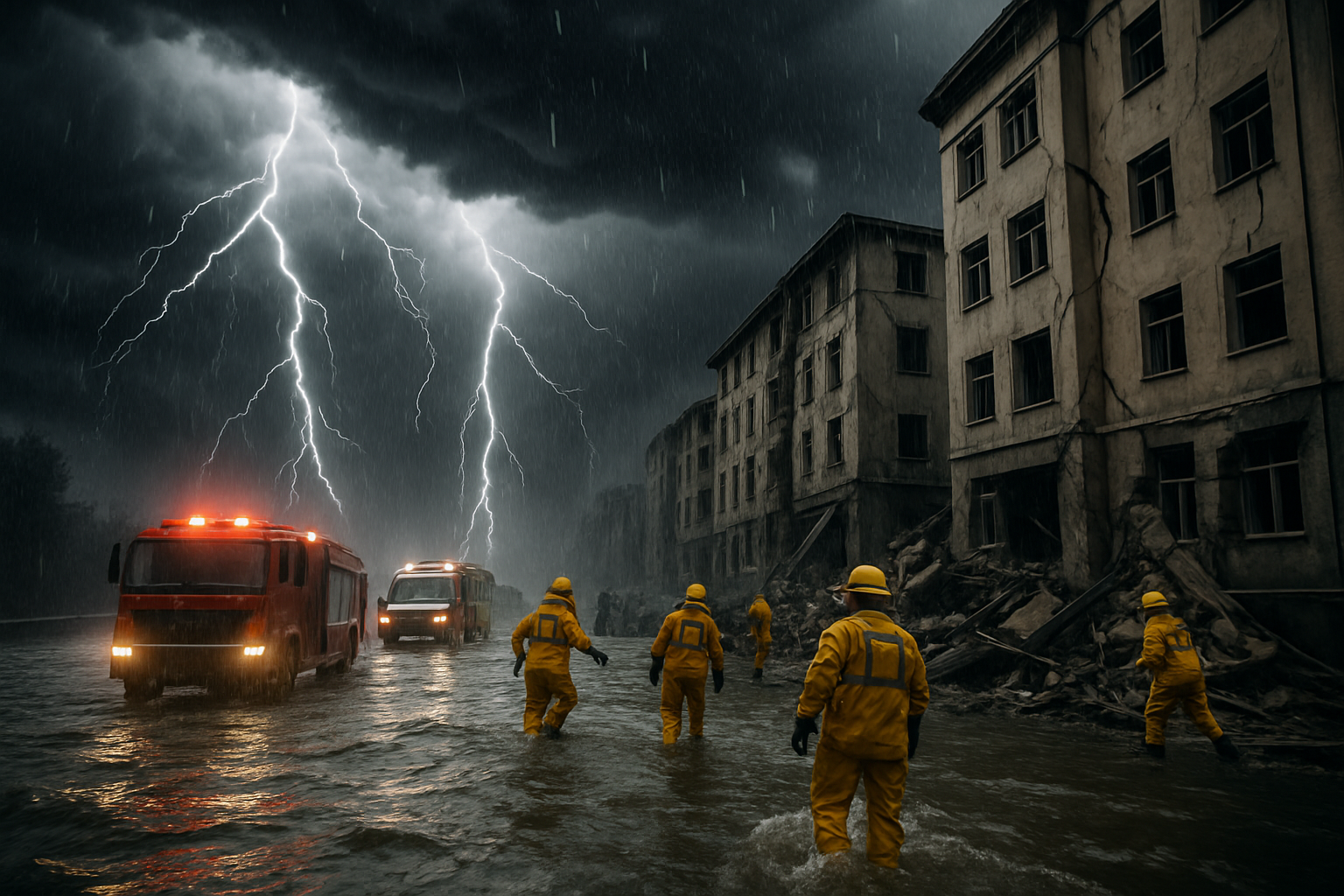
A catastrophic convergence of natural disasters has overwhelmed emergency services worldwide, as Japan's 7.4-magnitude earthquake triggers unprecedented megaquake warnings while extreme weather events simultaneously batter multiple continents during what scientists confirm as the 24th consecutive month of global temperatures exceeding 1.5°C above pre-industrial levels.
The seismic event struck off Japan's northeastern coast Monday, initially generating a three-meter tsunami warning that was later downgraded before being lifted entirely. However, the earthquake's significance extends far beyond its immediate impact, as Japanese authorities issued their first-ever "megaquake advisory" affecting 182 towns across seven prefectures, urging residents to confirm evacuation routes and emergency shelters.
Historic Seismic Alert System Activated
The megaquake advisory, while not a prediction, represents a new chapter in disaster preparedness as officials from Japan's Cabinet Office and Meteorological Agency warned of a "slightly heightened risk" of a more powerful earthquake in the coming week. The unprecedented alert system demonstrates Japan's evolution in seismic risk management following decades of devastating earthquakes.
"This is not a prediction but an acknowledgment of heightened seismic risk patterns we're observing."
— Japan Meteorological Agency Official
The advisory covers regions still recovering from previous disasters, highlighting the compound nature of contemporary emergency management where communities face multiple simultaneous threats before completing recovery from earlier events.
Global Weather Disasters Converge
While Japan grapples with seismic threats, extreme weather disasters have erupted across multiple continents, creating what emergency management experts term "compound disasters" – multiple emergency types occurring simultaneously across vast geographic areas, fundamentally challenging traditional resource allocation mechanisms.
In Algeria, meteorological services issued urgent warnings for a powerful atmospheric disturbance delivering heavy rainfall exceeding 60mm, dense snowfall above 1,100 meters, and dangerous winds surpassing 100 km/h. The system, accompanied by dust storms posing respiratory hazards, affected northern regions, the northern Sahara, oases, and southwestern areas through Tuesday.
Canada's New Brunswick declared flood stage conditions for Gagetown as Saint John River levels reached 4.26 meters Tuesday morning, with peaks expected to hit 4.4 meters Wednesday and Thursday. The flooding, captured in dramatic images from the Carleton Street River Lookout, forced trail closures and threatened infrastructure in the provincial capital region.
Record-Breaking Heat Amid Winter Weather
Creating a stark contrast to the severe weather elsewhere, Denmark recorded its warmest day of 2026 in North Jutland, while Ireland experienced an unusual warming trend with temperatures reaching 21°C Friday. Met Éireann forecasters attributed the pleasant conditions to high-pressure systems dominating the region – a meteorological pattern increasingly disrupted by climate volatility.
This temperature anomaly exemplifies what climate scientists call the "climate volatility paradox," where sustained global warming enables both record heat and devastating regional extremes through disrupted atmospheric circulation and polar vortex patterns.
Infrastructure Crisis Deepens
Portugal continues managing the aftermath of severe storms, with infrastructure authorities reporting 26 roads remain closed nationwide following the passage of recent storm systems. Despite resolving 92% of recorded closures, the remaining disruptions highlight ongoing vulnerabilities in transportation networks designed for historical rather than current climate conditions.
South Africa faces additional rainfall threats in Cape Town, where teams continue cleanup operations from weekend flooding while meteorological services predict more downpours. The persistent pattern of extreme weather events has strained municipal resources and tested urban drainage systems beyond their design capacity.
Emergency Response Systems at Breaking Point
The simultaneous nature of these disasters has exposed critical weaknesses in global emergency response systems originally designed for sequential rather than concurrent multi-continental crises. Traditional mutual aid mechanisms, where stable regions assist others during isolated emergencies, prove inadequate when multiple continents face disasters simultaneously.
Emergency services globally report operating at or beyond capacity limits, with transportation networks, power grids, and communication systems repeatedly failing as extreme weather exceeds operational parameters designed for historical climate patterns.
Climate Milestone Significance
January 2026 marked the 24th consecutive month of global temperatures exceeding the critical 1.5°C threshold above pre-industrial levels – the longest sustained extreme warming period in recorded human history. This unprecedented streak demonstrates how human-induced climate change has fundamentally overridden natural cooling mechanisms, including La Niña effects that historically moderated global temperatures.
The World Meteorological Organization reports a 50-60% probability of El Niño conditions developing July-September 2026, potentially driving temperatures into unprecedented territory by combining baseline warming with natural cycle amplification.
Economic and Social Devastation
The cascading impacts extend far beyond immediate emergency response, with agricultural sectors mounting billions in losses as extreme weather destroys crops and disrupts supply chains during critical growing seasons. Tourism industries face extended cancellations and infrastructure damage during peak revenue periods.
Recovery timelines have fundamentally shifted from weeks to months or years, representing a permanent change in disaster response approaches. Mental health services report increased demand for climate anxiety and repeated trauma support, as families face the possibility of losing generational properties multiple times within a decade.
Technology and Tradition Integration
Successful emergency responses increasingly rely on sophisticated synthesis of cutting-edge technology with traditional ecological knowledge and community-based management. Advanced monitoring capabilities using satellite imagery, environmental DNA sampling, and AI analysis provide rapid threat assessment, but require community engagement and local expertise for effectiveness.
Estonia operates continental Europe's largest battery storage system serving 90,000 households with 88% renewable electricity, while Finland implements "transformative adaptation" approaches for permanent climate volatility, demonstrating technological solutions integrated with traditional resilience strategies.
International Cooperation Under Strain
Environmental challenges transcending political boundaries place unprecedented pressure on international cooperation mechanisms. Traditional disaster response frameworks, designed for stable regions assisting others during isolated emergencies, struggle when simultaneous global events challenge basic assumptions about resource availability and mutual aid.
The European Union's Civil Protection Mechanism has been repeatedly activated, with Sweden and Denmark receiving €246 million in assistance representing the largest coordinated European weather response on record. However, experts note this response remains insufficient for the scale and simultaneity of current challenges.
Watershed Moment for Global Adaptation
April 2026 represents what climate scientists describe as a watershed moment in global climate preparedness, forcing a critical choice between reactive crisis management and transformative infrastructure adaptation. Current conditions provide a preview of routine circumstances expected in the 2030s without comprehensive climate adaptation investment.
The convergence of extreme weather events, infrastructure vulnerabilities, and emergency response limitations demands urgent coordinated international action. The window for effective climate action continues narrowing as ecological systems approach critical thresholds that could trigger irreversible changes in global food security, climate stability, and human settlement patterns.
"We're witnessing the emergence of a new normal characterized by extreme weather frequency and intensity that permanently challenges traditional frameworks."
— Emergency Management Expert
Building Resilience for the Future
"Building back better" with climate-resilient infrastructure has evolved from an optional enhancement to an essential survival strategy for communities facing permanent climate volatility. Traditional seasonal patterns that guided infrastructure design, agricultural planning, and emergency preparedness for centuries no longer provide reliable frameworks.
The tools, knowledge, and cooperation frameworks exist for comprehensive environmental protection, but success depends on unprecedented speed of coordination and sustained international cooperation. The fundamental question facing humanity is whether we can organize and implement solutions rapidly enough to maintain planetary habitability during Earth's most environmentally challenging period in recorded history.
As additional weather systems develop across Atlantic and Pacific regions, authorities maintain high alert status globally. The persistence of crisis conditions may establish this extreme weather frequency and intensity as the new baseline, permanently challenging traditional emergency response frameworks during what experts term the decisive climate action decade.