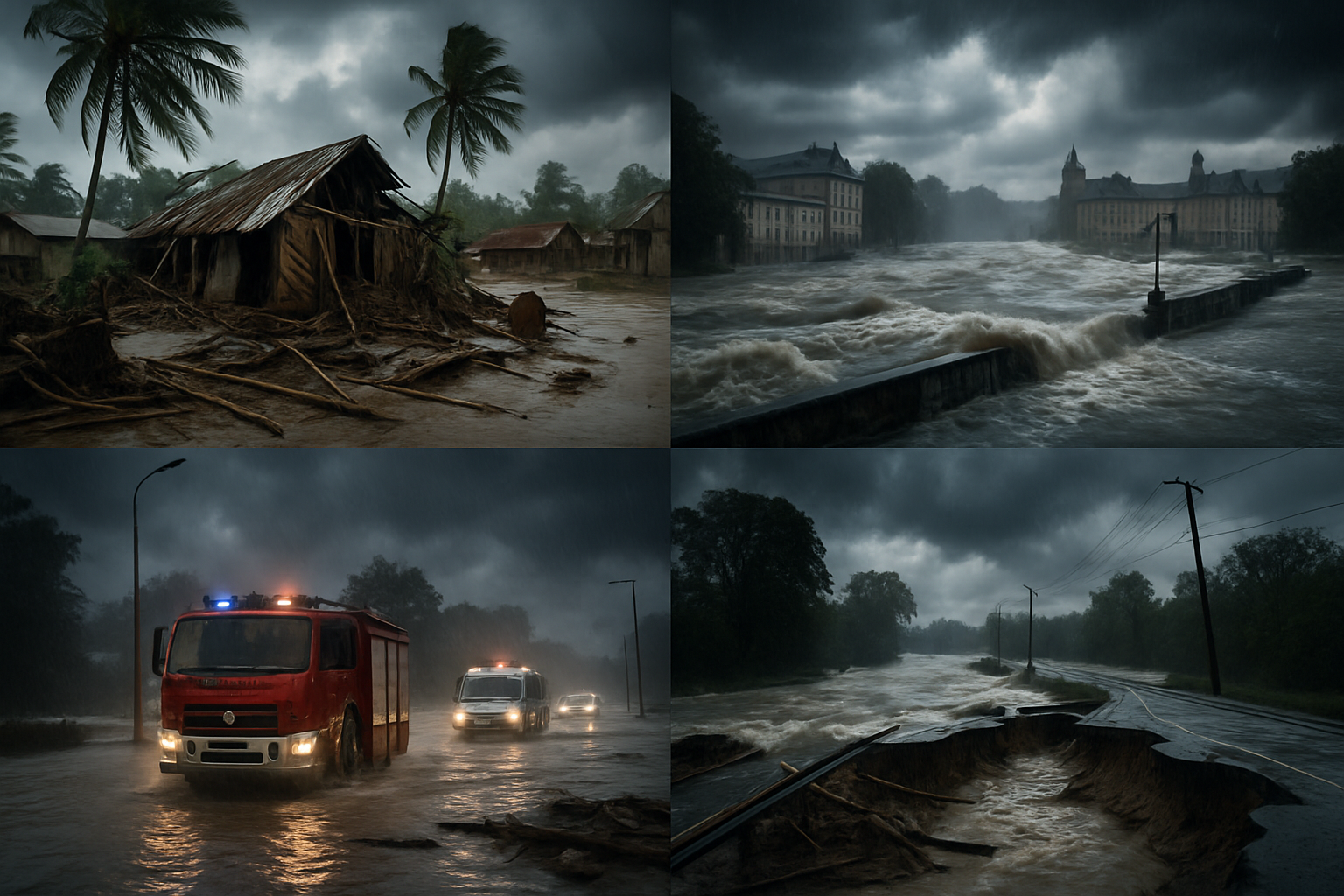
A devastating convergence of extreme weather events across multiple continents has claimed dozens of lives and exposed critical infrastructure vulnerabilities, with Cyclone Gezani striking Madagascar's main port while Europe battles the aftermath of consecutive Atlantic storms.
Tropical Cyclone Gezani made landfall in Madagascar with catastrophic force Tuesday evening, generating winds up to 270 km/h and killing at least 31 people while leaving widespread destruction across the island nation. The cyclone devastated Toamasina, Madagascar's second-largest city and primary commercial port, with authorities reporting "total chaos" as buildings collapsed and neighborhoods were plunged into darkness.
Madagascar Devastation Overwhelms Local Capacity
Madagascar's disaster management office confirmed that nearly 75% of Toamasina was destroyed by the cyclone's impact, with the death toll reaching 31 and at least 36 people injured. Several individuals remain missing as search and rescue operations continue amid the widespread debris and damaged infrastructure.
"What happened is a disaster, nearly 75% of the city of Toamasina was destroyed," Colonel Michael Randrianirina, the country's military leader who seized power in October, told AFP news agency. "The current situation exceeds Madagascar's capabilities alone."
The cyclone's landfall represents one of the most intense tropical systems recorded around Toamasina in the satellite era. Power grids failed completely, leaving the city of 325,000 residents without electricity, while communication networks were severely disrupted. Roads became impassable due to debris and flooding, hampering emergency response efforts.
This marks the second major cyclone to strike Madagascar in just 11 days, following Cyclone Fytia, which killed 12 people and displaced over 31,000 residents. The rapid succession of severe storms has prevented adequate recovery and preparation between events, overwhelming the island nation's limited emergency response capabilities.
European Flooding Crisis Continues
Simultaneously, Europe remains gripped by an unprecedented flooding emergency, with Portugal's death toll from severe weather rising to 16 as the Mondego River threatens to breach its banks in Coimbra. Portuguese authorities have deployed 1,975 military personnel and 30 naval vessels in what officials describe as the largest peacetime rescue operation in the country's history.
The crisis represents the culmination of three consecutive Atlantic storms - Kristin, Leonardo, and Marta - that have battered the Iberian Peninsula over the past two weeks. Civil Protection agencies have recorded over 1,800 weather-related incidents since February 1, with emergency services stretched to operational limits.
Critical infrastructure across Portugal remains severely compromised, with 167,000 residents still without power and major transportation networks disrupted. The Castanheira-Alverca railway line remains suspended, affecting Lisbon commuters, while the Douro River has reached critical 1997 flood levels in Porto.
"The current situation exceeds Madagascar's capabilities alone."
— Colonel Michael Randrianirina, Madagascar's Military Leader
In Portugal, Interior Minister Maria Lucia Amaral resigned Tuesday evening amid mounting criticism of the government's emergency response coordination. The resignation came as emergency services struggle to cope with the scale of the disaster, highlighting the political costs of inadequate crisis management in the climate change era.
Global Climate Context Drives Extreme Weather
These simultaneous disasters unfold against the backdrop of January 2026 being confirmed as the hottest month in recorded history, marking the 18th consecutive month to exceed 1.5°C above pre-industrial levels. This unprecedented warming trend demonstrates how climate change is overriding natural weather variability, including La Niña cooling effects that would typically moderate global temperatures.
The global warming pattern enables both extreme regional cold events and record heat simultaneously through disrupted atmospheric circulation patterns. This climate volatility creates conditions for intense tropical cyclones in the Indian Ocean while generating severe Atlantic storm systems that repeatedly target Europe.
Emergency services across multiple continents report reaching capacity limits as traditional regional aid mechanisms become ineffective when disasters strike simultaneously across vast geographical areas. The coordination challenges reveal critical gaps in international emergency response frameworks designed for isolated regional events rather than global-scale climate emergencies.
International Response and Coordination
The European Union has activated its Civil Protection Mechanism to coordinate assistance for affected member states, while Sweden and Denmark have announced a €246 million emergency aid package. However, the simultaneous nature of global disasters limits the availability of specialized resources that would typically be shared between regions.
Madagascar's isolation has complicated international assistance delivery, with the destruction of port infrastructure in Toamasina severely limiting the ability to bring in heavy rescue equipment and humanitarian supplies. The cyclone's impact on the port city threatens the entire island's supply chain, as Toamasina serves as Madagascar's primary gateway for international trade.
Economic implications extend far beyond immediate disaster response costs. Madagascar's vanilla industry, which supplies approximately 80% of global vanilla, faces severe disruption from cyclone damage to agricultural areas. Portugal's tourism and agricultural sectors, meanwhile, are experiencing billions in losses from the extended flooding crisis.
Infrastructure Vulnerabilities Exposed
The cascading failures across multiple systems highlight critical infrastructure vulnerabilities in the face of intensifying extreme weather. Transportation networks, power grids, and communication systems designed for historical weather patterns prove inadequate for the new climate reality of more frequent and intense storms.
In Portugal, the flooding has exceeded historical records, with some areas experiencing worse conditions than the catastrophic 1963 floods. The Alcácer do Sal region reported flooding levels surpassing those devastating benchmarks, demonstrating how current infrastructure cannot withstand the increased intensity of weather events.
Recovery timelines for both Madagascar and Portugal extend well beyond immediate emergency response, with full infrastructure restoration expected to require months or years. This extended recovery period creates long-term economic disruption and social displacement that compounds the immediate humanitarian crisis.
Climate Adaptation Urgency
The February 2026 weather disasters represent a watershed moment demonstrating the inadequacy of reactive crisis management approaches. Scientists emphasize that current emergency response systems require fundamental transformation to address the increasing frequency and intensity of simultaneous extreme weather events.
"Build back better" adaptation strategies must replace traditional recovery approaches, incorporating climate resilience into infrastructure design and emergency response capabilities. This includes enhanced early warning systems, climate-adaptive building standards, and expanded international coordination mechanisms for multi-continental disaster response.
The crisis provides critical lessons for future emergency planning, particularly the need for sustained international cooperation frameworks that can function effectively when traditional regional aid systems become overwhelmed. Enhanced climate monitoring, improved emergency communications, and expanded emergency service capacity represent essential investments for climate adaptation.
As recovery efforts continue across Madagascar, Portugal, and other affected regions, the February 2026 disasters will likely be remembered as a turning point that exposed the urgent need for fundamental changes in how humanity prepares for and responds to an increasingly volatile climate system.