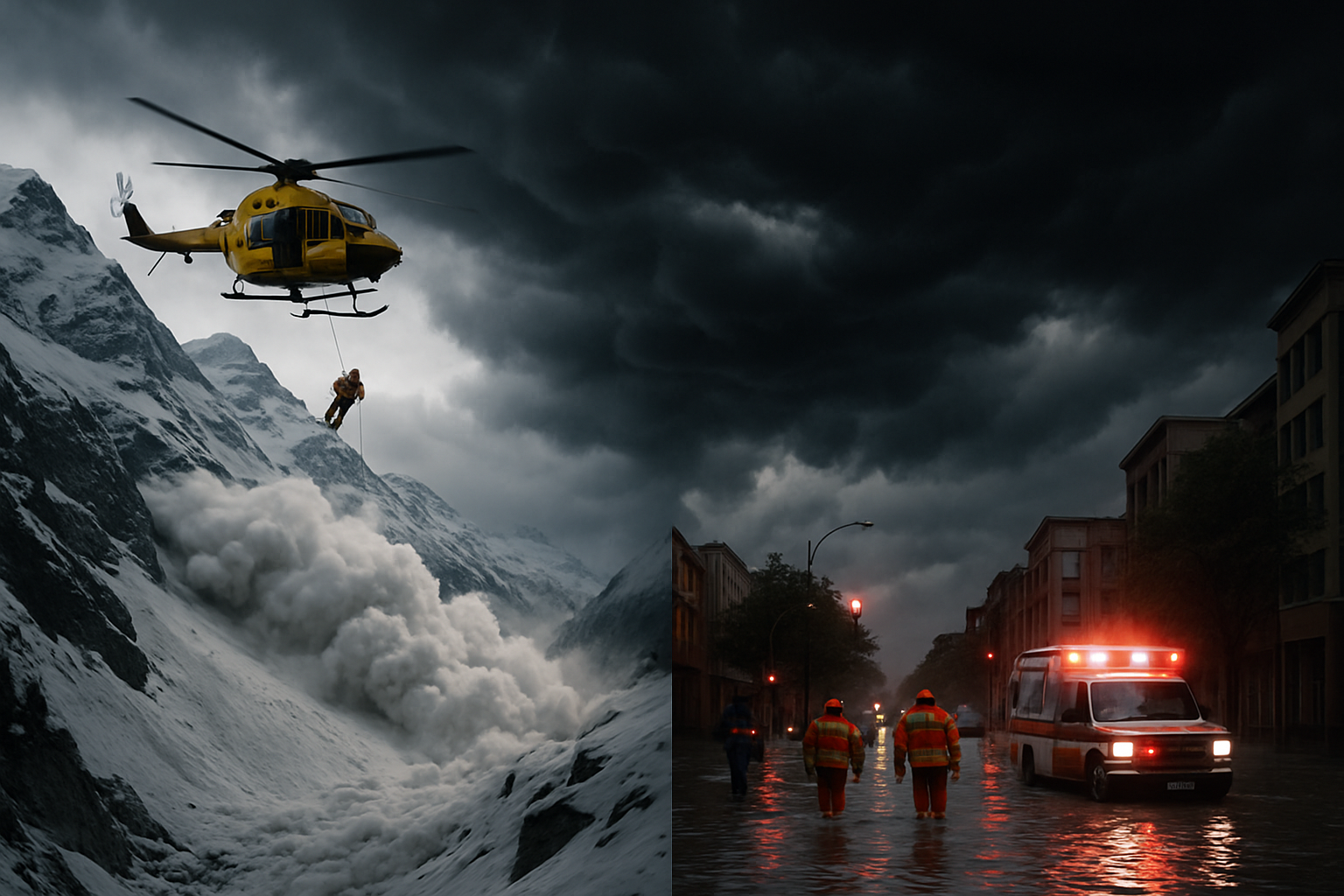
Four people have died in two separate avalanches in British Columbia's northwest region, while extreme weather warnings span multiple continents during what scientists confirm is the 21st consecutive month of global temperatures exceeding critical climate thresholds.
The Royal Canadian Mounted Police reported that three heli-skiers were killed in an avalanche on Mount Knauss, just north of Terrace, B.C., on Sunday. In a separate incident the same day, one person died in another avalanche near the British Columbia-Alaska border, marking a deadly weekend in the province's backcountry.
According to The Globe and Mail, one survivor from the Mount Knauss incident suffered serious injuries and was airlifted to hospital, highlighting the dangerous conditions facing outdoor enthusiasts across the region.
Worldwide Weather Emergency Unfolds
The Canadian tragedies coincide with severe weather warnings across multiple continents, creating an unprecedented pattern of simultaneous global weather emergencies. Cyprus faces an unusual weather phenomenon with thunderstorms, hail, and strong winds bringing 35-55mm of rainfall per hour, while snow is expected on the Troodos peaks - a rare occurrence for the Mediterranean island.
Meanwhile, New Zealand's MetService has issued orange heavy rain warnings for parts of the North Island, with meteorologists tracking storm systems that could deliver significant precipitation to already saturated regions.
"Cyprus is in for a stormy few days, with showers, thunderstorms and snow on the Troodos peaks expected to persist through Wednesday before conditions begin to ease."
— Cyprus Weather Service
Historic Climate Context Amplifies Risks
These events occur during what climate scientists are calling an unprecedented warming period. January 2026 marked the hottest month ever recorded in human history, extending a streak of 21 consecutive months where global temperatures have exceeded 1.5°C above pre-industrial levels - the longest sustained extreme warming period on record.
This creates what researchers term the "climate volatility paradox," where sustained global warming enables both record heat and devastating regional extreme weather events through disrupted atmospheric circulation patterns and polar vortex instability.
The World Meteorological Organization has confirmed a 50-60% probability of El Niño development during July-September 2026, which could drive temperatures into unprecedented territory by combining baseline warming with natural cycle amplification.
Emergency Services Under Unprecedented Strain
The simultaneous nature of these weather emergencies is overwhelming traditional emergency response systems designed for sequential, regional disasters rather than concurrent global crises. Emergency services across multiple continents report operating at or beyond capacity limits.
In British Columbia, search and rescue teams are coordinating complex avalanche recovery operations in dangerous terrain, while maintaining readiness for additional incidents as unstable snow conditions persist across the region's mountainous areas.
Transportation networks, power grids, and communication systems designed for historical climate patterns are repeatedly failing as extreme weather exceeds operational parameters. This infrastructure mismatch is creating cascading effects that compound the primary impacts of severe weather events.
Building on a Pattern of Extreme Weather
The current crisis builds on a devastating pattern established throughout early 2026. February saw the extraordinary Atlantic storm succession of Kristin-Leonardo-Marta-Nils-Pedro, which claimed over 35 lives across Portugal, Spain, and France, requiring Portugal's largest peacetime rescue operation involving 26,500 personnel.
The European Union's Civil Protection Mechanism was repeatedly activated, with a Sweden-Denmark assistance package of €246 million representing the largest coordinated European weather response on record. However, even these unprecedented efforts proved insufficient for the scale and simultaneity of current challenges.
Economic and Social Devastation Mounts
The economic toll continues to mount across multiple sectors. Agricultural operations face billions in losses as extreme weather destroys crops and disrupts supply chains during critical growing seasons. Tourism industries confront extended cancellations and infrastructure damage during peak revenue periods.
Perhaps most troubling is the human cost: families losing generational homes, businesses facing extinction, and vulnerable populations requiring extended emergency support. Mental health services report increased demand as communities struggle with climate anxiety and repeated extreme weather trauma.
Recovery timelines have shifted from traditional weeks to months or years, representing a fundamental change in disaster response and preparation approaches. The concept of "building back better" with climate-resilient infrastructure has evolved from an optional enhancement to an essential survival strategy.
International Cooperation at Breaking Point
Environmental challenges transcend political boundaries as atmospheric systems and ocean currents transport climate effects globally, making unilateral adaptation efforts insufficient. Traditional aid frameworks, developed assuming stable regions could assist others during isolated emergencies, are breaking down as multiple continents face simultaneous disasters.
The success of future climate resilience depends on coordinated policy frameworks, shared monitoring systems, and innovative financing that recognizes environmental protection as essential infrastructure for human prosperity and planetary sustainability.
A Watershed Moment for Climate Action
March 2026 represents a potential watershed moment in global climate preparedness. Current conditions provide a preview of routine circumstances expected in the 2030s without comprehensive climate adaptation investment. The choice between reactive crisis management and transformative infrastructure adaptation has become increasingly critical as the window for effective climate action continues to narrow.
Traditional seasonal patterns that have guided infrastructure design, agricultural planning, and emergency preparedness for centuries are no longer reliable frameworks. The urgency for fundamental system reassessment grows as ecological systems approach critical thresholds that could trigger irreversible changes affecting global food security, climate stability, and human settlements.
"The tools, knowledge, and cooperation frameworks exist for comprehensive environmental protection, but success requires unprecedented speed and coordination through sustained international cooperation."
— Climate Adaptation Experts
As additional weather systems develop across the Atlantic and Pacific regions, authorities maintain high alert status globally, recognizing that current crisis conditions may persist for weeks. This persistence is establishing a "new normal" of extreme weather frequency and intensity that permanently challenges traditional emergency response frameworks.
The fundamental question facing humanity is no longer whether transformative climate action is needed, but whether we can organize and implement solutions rapidly enough to maintain planetary habitability during Earth's most environmentally challenging period in recorded history.