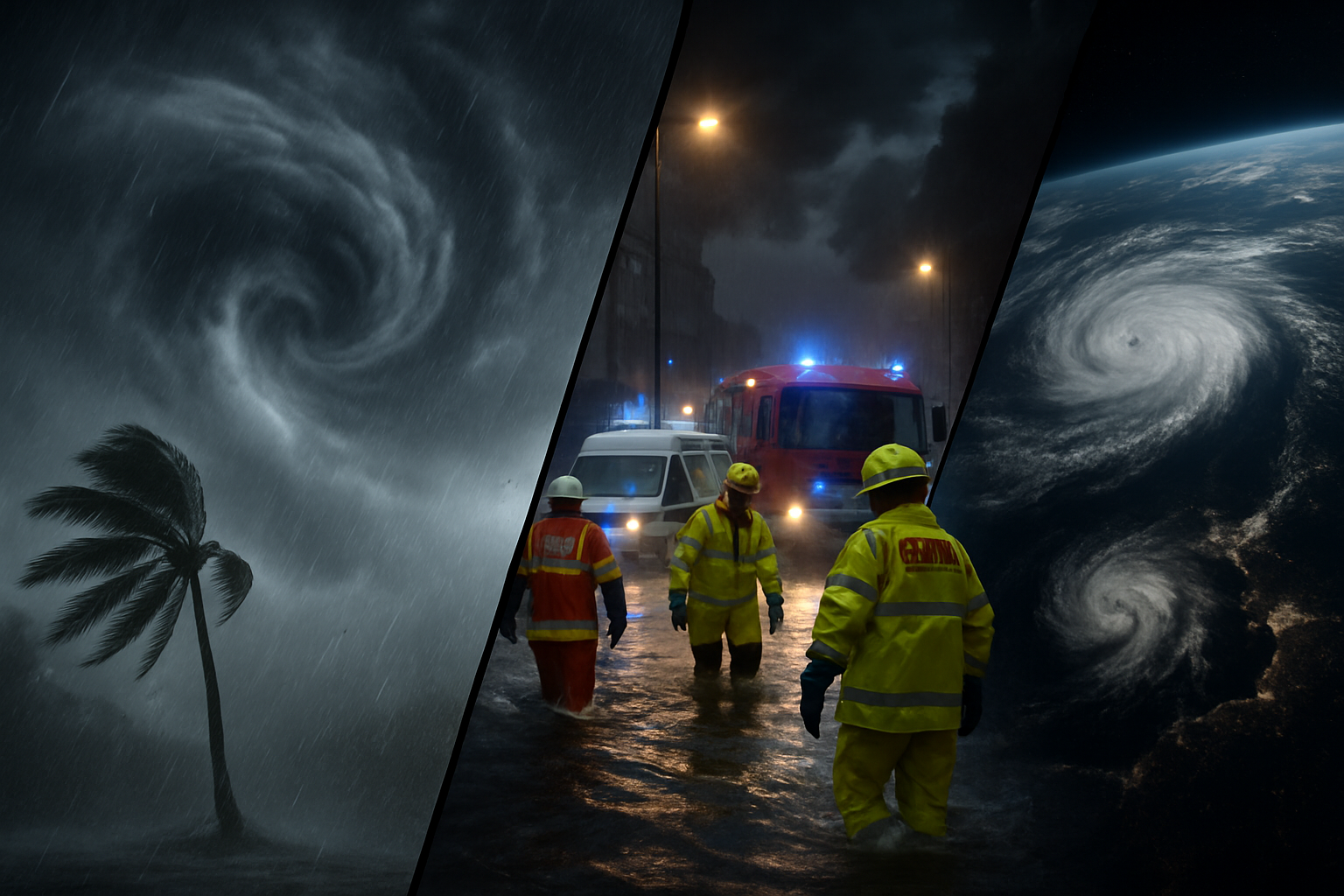
A convergence of extreme weather events across multiple continents is testing global emergency response systems to their breaking point, as Cyclone Vaianu approaches New Zealand's North Island while communities from Medellín to Papua New Guinea battle devastating floods and prepare for powerful typhoons.
Pacific Storm Systems Threaten Multiple Nations
Tropical Cyclone Vaianu is gaining strength as it tracks toward New Zealand's North Island, prompting MetService to issue urgent warnings of "damaging, potentially life-threatening" conditions. The Category 2 system threatens the already flood-saturated Northland region, which remains particularly vulnerable after repeated extreme weather events throughout 2026.
Civil Defence has activated comprehensive emergency protocols across the upper North Island, with major population centers including Auckland, Hamilton, and Tauranga within the projected impact zone. Prime Minister Christopher Luxon has urged immediate preparation, recognizing that emergency response capabilities remain stretched from previous disasters.
Simultaneously, the Marianas region faces its own tropical threats. Typhoon Condition III has been declared for Saipan, Tinian, and Rota, indicating typhoon conditions with winds of 74 mph or more are possible within 48 hours. The near-stationary system Sinlaku could strengthen into a major typhoon by Monday, with forecasters warning that "even small track changes will matter locally but will not eliminate the threat."
Global Flooding Crisis Intensifies
In Colombia's second-largest city, Medellín faces a complex flooding crisis as rapid urbanization and reduced natural waterways challenge the drainage network during intense rainfall. The combination of urban development and extreme precipitation has transformed city streets into waterways, overwhelming infrastructure designed for historical rather than current climate conditions.
Namibia's Zambezi region confronts seasonal flooding that has left thousands of communities in what officials describe as a "severely destitute state." The Popular Democratic Movement warns that rising water levels have created humanitarian conditions requiring immediate international attention.
Papua New Guinea telecommunications company Digicel has begun offering free emergency calls as Cyclone Maila approaches coastal communities, recognizing the critical role of communication during natural disasters. This gesture highlights how private sector coordination has become essential to modern emergency response.
Emergency Preparedness Under Strain
The simultaneous nature of these disasters represents what emergency management experts describe as a paradigm shift from isolated regional emergencies to "compound disasters" affecting multiple geographic areas concurrently. This evolution fundamentally challenges traditional resource allocation and mutual aid mechanisms designed for sequential rather than simultaneous global crises.
"Traditional mutual aid mechanisms designed for sequential disasters are inadequate for simultaneous multi-continental events. Emergency services are operating at or beyond capacity limits globally."
— Emergency Management Analysis, 2026
In New Zealand, communities demonstrate enhanced preparedness compared to previous years, with households equipped with Starlinks, generators, and strengthened community networks developed through successive weather events. However, mental health services report increased demand for climate anxiety support as families face the prospect of losing homes multiple times within a single decade.
Infrastructure Crisis and Adaptation Challenges
Transportation networks, power grids, and communication systems designed for historical climate patterns are repeatedly failing as extreme weather exceeds operational parameters. The frequency and intensity of these events have fundamentally altered recovery timelines, shifting expectations from weeks to months or years for complete restoration.
The concept of "building back better" has evolved from an optional enhancement to an essential survival strategy. Traditional seasonal patterns that guided infrastructure design, agricultural planning, and emergency preparedness for centuries are no longer reliable frameworks for future planning.
Economic devastation continues mounting across affected regions, with agricultural sectors facing billions in losses from damaged crops and disrupted supply chains during critical growing seasons. Tourism industries experience extended cancellations and infrastructure damage during peak revenue periods.
Climate Context and Future Implications
These disasters occur during the 23rd consecutive month of global temperatures exceeding 1.5°C above pre-industrial levels—the longest sustained extreme warming period in recorded human history. January 2026 remains the hottest month ever documented, while the World Meteorological Organization indicates a 50-60% probability of El Niño conditions developing between July and September 2026.
Climate scientists describe a "climate volatility paradox" where sustained global warming enables both heat records and devastating regional extremes through disrupted atmospheric circulation and polar vortex patterns. This phenomenon allows simultaneous extreme conditions across different regions that would have been impossible under previous climate norms.
International Cooperation at Breaking Point
Environmental challenges transcend national boundaries through atmospheric systems and ocean currents that transport climate effects globally, making unilateral adaptation efforts insufficient for comprehensive resilience. The simultaneity of current disasters tests international cooperation mechanisms developed under the assumption that stable regions could assist others during isolated emergencies.
Recent European examples, including Portugal's deployment of 26,500 emergency personnel in its largest peacetime operation and the EU Civil Protection's €246 million assistance package for Sweden and Denmark, demonstrate both the potential and limitations of international cooperation during climate emergencies.
Technology and Community Response Innovation
Successful responses increasingly rely on sophisticated integration of cutting-edge technology with traditional ecological knowledge and community-based management systems. Advanced monitoring through satellite imagery, environmental DNA analysis, and artificial intelligence enhances conservation and disaster preparedness, but requires community engagement and local expertise for effectiveness.
Social media platforms have become essential for emergency communication when traditional systems are overwhelmed, enabling rapid coordination of rescues and family connections during crises. However, this dependency also highlights vulnerabilities when communication infrastructure fails.
Strategic Watershed Moment
April 2026 represents a critical choice between reactive crisis management and transformative infrastructure adaptation. Current conditions provide a preview of routine circumstances in the 2030s without comprehensive climate adaptation investment.
The window for effective climate action continues narrowing as ecological systems approach critical thresholds that could trigger irreversible changes affecting global food security, climate stability, and human settlements. Additional weather systems developing in both Atlantic and Pacific regions suggest this crisis pattern may persist for weeks or months, potentially establishing a "new normal" of extreme weather frequency and intensity.
The convergence of extreme weather events, infrastructure vulnerabilities, and emergency response limitations underscores the urgent need for coordinated international action. The tools, knowledge, and cooperation frameworks exist for comprehensive environmental protection, but success requires unprecedented speed of coordination and sustained international cooperation during what experts describe as the decisive climate action decade.
As communities worldwide brace for the next wave of extreme weather, the question is no longer whether transformative action is needed, but whether humanity can organize and implement solutions rapidly enough to maintain planetary habitability during Earth's most environmentally challenging period in recorded history.