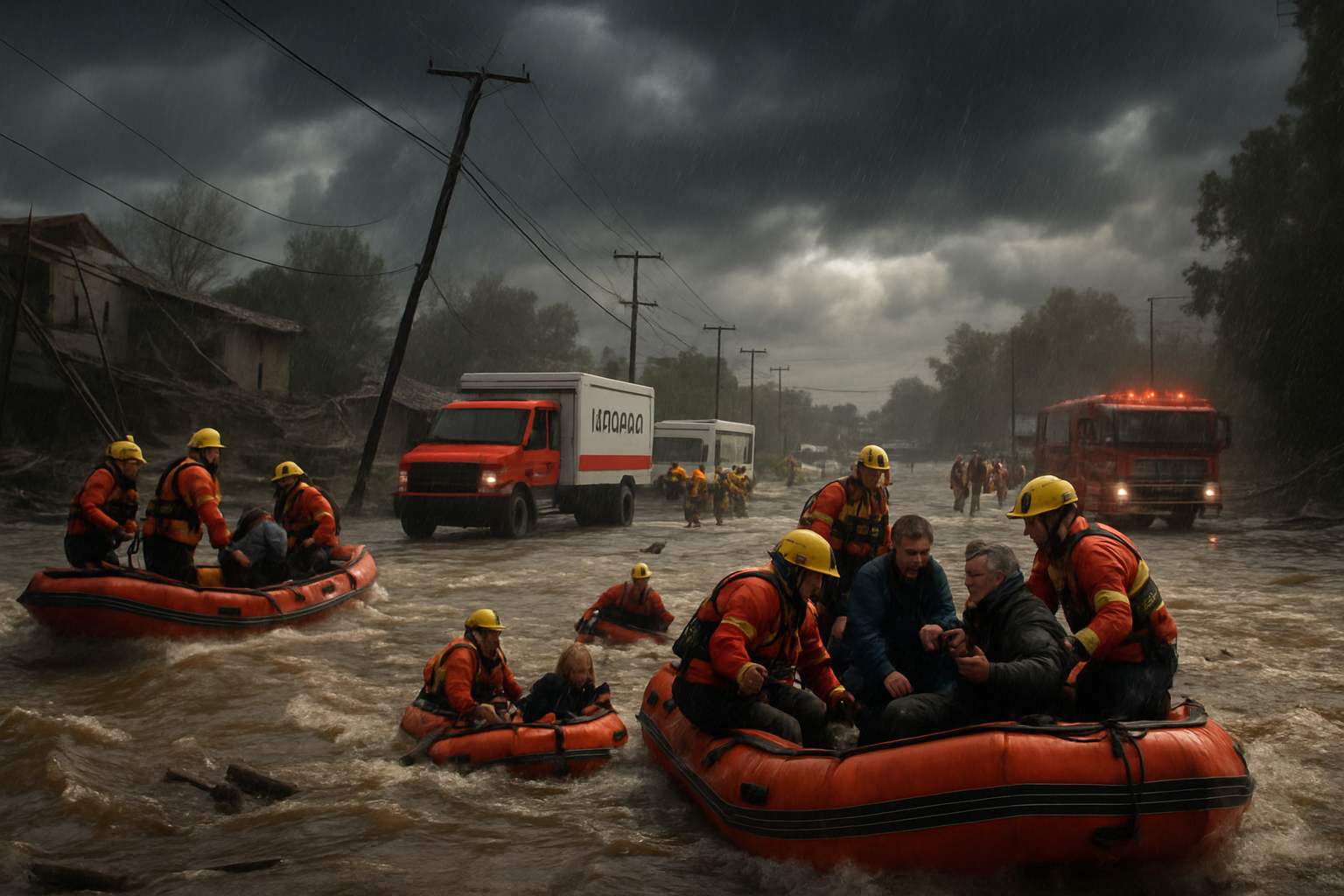
A devastating convergence of extreme weather events across five continents has pushed global emergency services to their operational limits, with simultaneous disasters from Colombia's catastrophic flooding to New Zealand's emergency declarations creating an unprecedented international crisis requiring coordinated response mechanisms.
The crisis, unfolding throughout February 2026, represents the most extensive simultaneous weather emergency in modern history, affecting millions of people across dramatically different climate zones while exposing critical vulnerabilities in international disaster response systems designed for regional rather than global catastrophes.
Colombia's Caribbean Coast Catastrophe
Colombia faces its worst flooding disaster in recent memory, with official death tolls reaching 17 people and over 254,000 individuals affected across multiple departments. The Sinú River basin has become the epicenter of destruction, with the Cruz Roja Colombiana mobilizing extensive donation networks to support thousands of displaced families.
"El agua nos llegó en silencio y de madrugada"
— Flood Survivor, Córdoba Region
Emergency authorities report that floodwaters arrived silently during early morning hours, separating entire families and erasing homes throughout the Sinú River watershed. The Unidad para la Gestión del Riesgo de Desastres has documented extensive infrastructure damage beyond the human casualties, with transportation networks collapsed and essential services disrupted across the affected regions.
The emergency has prompted government authorities to establish comprehensive relief operations, with donation centers and supply distribution networks activated throughout Córdoba and neighboring departments to address the immediate humanitarian crisis.
New Zealand's State of Emergency
On the opposite side of the Pacific, New Zealand's Waipā region faces severe weather impacts that prompted MetService to issue multiple orange heavy rain and strong wind warnings extending from Sunday morning through Monday evening. The intensity of recent weather events has created dangerous conditions across eastern and southern regions of the North Island.
Local residents report unprecedented damage to agricultural operations, with Ryan Vickers describing scenes on his family's Waipā farm as unlike anything previously witnessed following Friday's intense rainfall. The agricultural sector, vital to New Zealand's economy, faces significant challenges as extreme weather patterns disrupt normal seasonal operations.
MetService forecasters warn of continued heavy rain and damaging gales throughout the weekend, with emergency services maintaining high alert status across multiple regions. The weather service's orange warnings indicate conditions sufficiently severe to cause considerable disruption to daily activities and pose risks to life and property.
Panama's River Systems in Crisis
Central America contributes to the global emergency through Panama's Bocas del Toro province, where recent rainfall has caused dangerous river overflow conditions affecting homes and agricultural areas. The Sixaola River overflow in La Mesa sector has created flooding in residential areas while devastating local crop production and livestock operations.
The National Civil Protection System (SINAPROC) has placed the Teribe River under red flag status due to significant flow increases with turbid waters and dangerous current conditions. Local producers report substantial losses in crops and livestock, directly impacting family economies dependent on agricultural activities.
"The rising river increases the risk of dragging people and vehicles, accidents in riverine areas, and flash floods"
— SINAPROC Official Report
Traffic on the critical road connecting Chiriquí with Bocas del Toro continues under risk conditions, particularly in the Hornito sector known as "La Quijada del Diablo," where saturated ground increases landslide probability. SINAPROC personnel maintain constant monitoring while issuing evacuation recommendations for residents in vulnerable areas.
Peru's Dual Climate Threats
Peru confronts a complex dual climate emergency as ENFEN (Estudio Nacional del Fenómeno El Niño) declares national alert status for the "El Niño Costero" phenomenon, while simultaneously issuing extreme ultraviolet radiation warnings for Lima's coastal regions. The country's National Meteorological and Hydrological Service (SENAMHI) warns that Lima's littoral will experience very high to extremely dangerous ultraviolet radiation levels.
The declaration of El Niño Costero alert indicates heightened risk for extreme weather events along Peru's Pacific coast, potentially bringing intense rainfall, flooding, and related disasters to regions already stressed by climate variability. The simultaneous UV radiation warnings reflect broader atmospheric disruptions affecting the region.
Emergency authorities emphasize the need for enhanced preparedness measures as Peru faces the possibility of concurrent climate emergencies requiring different response strategies—flood preparedness for potential El Niño impacts while maintaining public health protection protocols for extreme radiation exposure.
Algeria's Multi-Hazard Weather Crisis
North Africa's contribution to the global emergency comes through Algeria's complex weather situation, where authorities report dangerous driving conditions and road closures across multiple provinces. Recent weather fluctuations and heavy rainfall have created treacherous conditions affecting several wilayat, with the national gendarmerie documenting road closures on major transportation corridors.
The crisis particularly impacts the connectivity between Bouira and Tizi Ouzou provinces, where Route Nationale 33 has been closed due to snow accumulation at Tikjda in the Asnam municipality. Additional closures affect Route Nationale 15 connecting Bouira and Tizi Ouzou provinces at Col Tirouda in Aghbalou municipality.
Weather services report continued instability with precipitation varying from rain to snow depending on elevation and regional conditions. The Algerian crisis demonstrates how even moderate weather events can create significant disruption when they occur simultaneously with global weather emergencies, straining regional response capabilities.
Global Climate Context and Implications
This unprecedented simultaneous weather crisis occurs during what climate scientists confirm as January 2026 being the hottest month in recorded history—the 18th consecutive month exceeding 1.5°C above pre-industrial levels. The apparent contradiction between record global warmth and extreme regional weather events illustrates the complex dynamics of climate volatility.
Climate researchers explain that global warming doesn't eliminate extreme weather but rather enables more volatile atmospheric conditions, allowing for both heat records and devastating regional storms to coexist. The polar vortex disruption and altered jet stream patterns create conditions where traditional weather predictions become increasingly unreliable.
Infrastructure Vulnerabilities Exposed
The simultaneous nature of these disasters has revealed critical weaknesses in global infrastructure designed for historical rather than future climate conditions. Transportation networks across all affected regions—from Colombia's collapsed bridges to New Zealand's flooded roads and Algeria's snow-blocked highways—demonstrate systematic vulnerabilities.
Communication systems, power grids, and emergency service coordination mechanisms face unprecedented strain when multiple disasters occur simultaneously, preventing the traditional redistribution of resources from unaffected to affected regions that characterizes typical disaster response.
Agricultural systems across the Pacific Basin, South America, and North Africa face disruption during critical growing seasons, threatening food security and economic stability across diverse ecological zones simultaneously.
International Coordination Challenges
The scale and simultaneity of these weather emergencies test international disaster response frameworks in ways previously unanticipated. Traditional mutual aid agreements assume regional disasters where neighboring countries can provide assistance, but simultaneous global emergencies strain these mechanisms.
Emergency services from Colombia to New Zealand report reaching operational capacity limits, requiring extended deployment of military personnel and specialized equipment typically reserved for the most severe individual disasters. The competing demands across multiple continents create resource allocation challenges that existing international frameworks struggle to address.
UN disaster response agencies emphasize the need for fundamental transformation in global emergency preparedness, moving from reactive regional assistance models toward proactive global coordination systems capable of managing simultaneous multi-continental crises.
Economic and Social Cascading Effects
Beyond immediate disaster response, the simultaneous weather emergencies create cascading economic effects across multiple sectors. Tourism industries from Panama to New Zealand face disruption during peak seasons, while agricultural systems across three continents confront harvest threats and livestock losses.
Supply chains connecting South America, Central America, and Asia-Pacific regions experience compound disruption as transportation networks in multiple countries face weather-related closures. The maritime trade routes linking these regions encounter additional complications from extreme weather conditions affecting port operations.
Insurance systems designed for individual catastrophic events struggle to assess exposure when multiple territories face simultaneous claims, potentially requiring industry restructuring to address climate volatility era realities.
Recovery and Future Preparedness
Recovery timelines vary dramatically across affected regions, but emergency management experts warn that traditional post-disaster reconstruction approaches may prove inadequate for the frequency of extreme events anticipated in coming years. The concept of "building back better" gains critical importance when disasters occur with insufficient recovery time between events.
Climate scientists emphasize that the February 2026 global weather crisis represents a preview of routine conditions expected in the 2030s without significant climate adaptation measures. The simultaneity and geographic scope suggest that isolated emergency management approaches require replacement with globally coordinated climate resilience strategies.
International cooperation mechanisms need fundamental enhancement to address the reality that extreme weather events will increasingly occur simultaneously across multiple continents, preventing traditional regional compensation strategies that have historically characterized disaster response.
Lessons for Climate Adaptation
The multi-continental weather emergency of February 2026 provides critical lessons for global climate adaptation strategies. The crisis demonstrates that climate change impacts will not occur sequentially, allowing recovery and resource redistribution between events, but rather simultaneously across diverse geographic regions and ecological systems.
Emergency services worldwide require enhanced capacity and equipment stockpiling, anticipating scenarios where traditional mutual aid agreements cannot provide adequate support due to simultaneous disasters affecting potential donor countries. Early warning systems need integration across international boundaries to provide comprehensive global weather emergency coordination.
The crisis highlights the urgent need for infrastructure hardening across all climate zones, designed for volatile rather than stable climate conditions. Transportation, communication, and power systems require fundamental redesign anticipating extreme weather as routine rather than exceptional conditions.
Most critically, the February 2026 crisis demonstrates that climate adaptation cannot be addressed individually by countries or regions, but requires unprecedented international coordination recognizing that extreme weather events will increasingly affect multiple continents simultaneously, demanding global rather than regional solutions to an inherently planetary challenge.