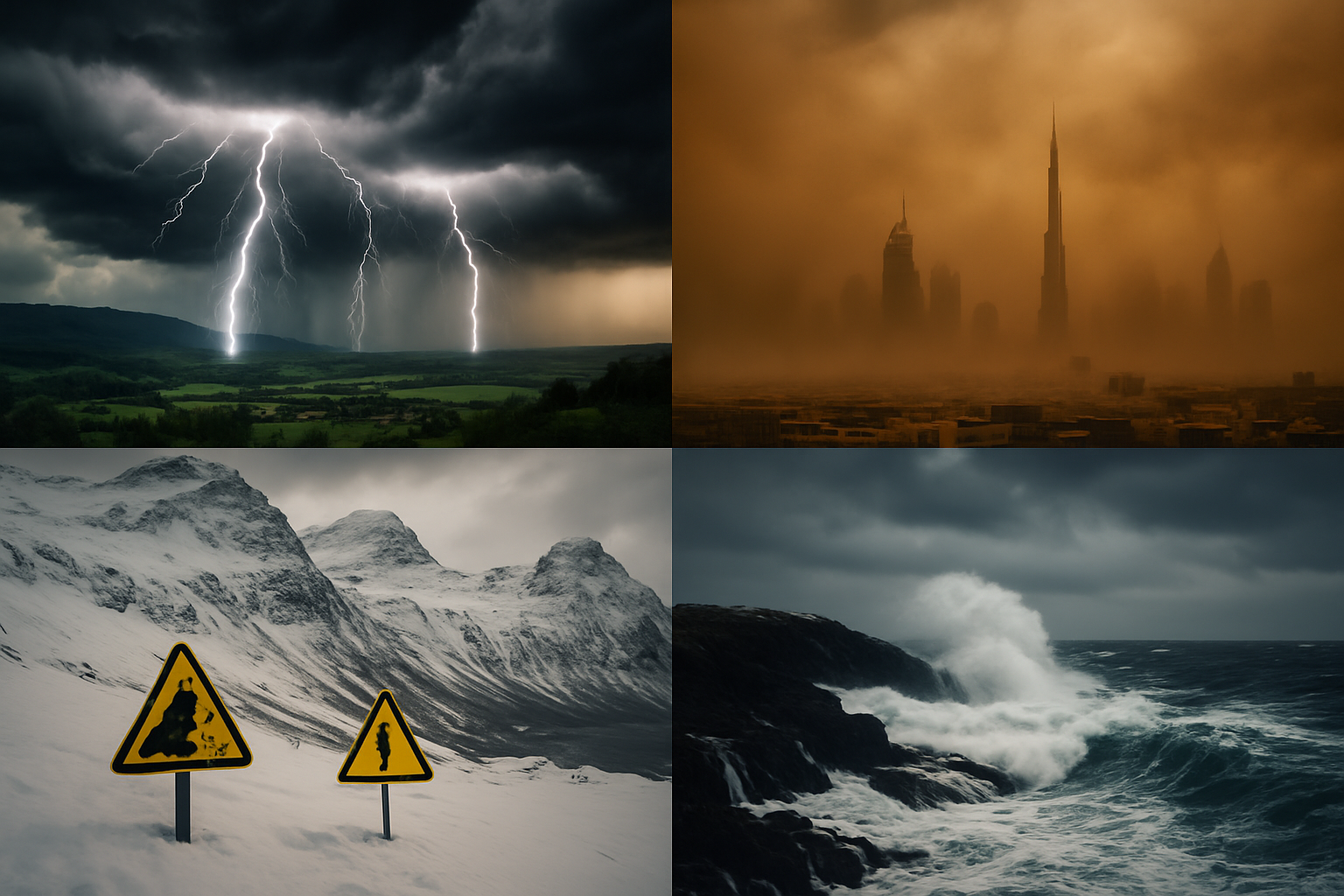
Emergency services across multiple continents are operating beyond capacity as simultaneous extreme weather disasters, including record-breaking dust storms, severe thunderstorms, and dangerous winter conditions, challenge global response systems during what meteorologists confirm is the 23rd consecutive month of unprecedented global warming.
Cyprus Faces Extreme Dust Storm Crisis
The Mediterranean island of Cyprus is experiencing one of its most severe dust episodes in a decade, with the Larnaca Municipality instructing all staff to suspend outdoor work and activities as airborne particle concentrations exceed 200 μg/m³ across the island. The unprecedented conditions have transformed the normally crystal-clear Mediterranean skies into an apocalyptic orange haze.
Philippos Tymvios, Director of the Department of Meteorology, told local media the episode is "considered extreme," adding that episodes of this strength are recorded roughly once every ten years. The dust cloud has completely blanketed fields of wildflowers in Kaimakli, Nicosia, creating surreal imagery as visibility drops to dangerous levels.
"The public, and particularly vulnerable groups including children, the elderly and people with respiratory or cardiac conditions, should avoid unnecessary movement outdoors, limit physical activity, keep windows closed and follow the guidance of the relevant authorities."
— Larnaca Municipality Official Statement
Algeria Battles Triple Weather Threat
Algeria's meteorological services have issued urgent warnings for a dangerous triple threat affecting multiple provinces. Heavy rainfall exceeding 50mm has struck northern regions, accompanied by winds surpassing 100 km/h and dense snowfall above 1,100m in western and central mountains. The simultaneous weather systems have created dust storms posing serious respiratory hazards across affected areas.
Civil protection teams have been conducting rescue operations, with multiple families requiring assistance after being trapped by sudden weather changes. The provinces of Blida, Boumerdès, Tizi Ouzou, and Béjaïa have experienced thunderstorms with hail exceeding 50mm, while mountain regions face heavy snow accumulation threatening transportation networks.
Jordan Issues Comprehensive Weather Warnings
Jordanian meteorological authorities have warned of widespread dust storm conditions affecting large areas of the kingdom, significantly reducing horizontal visibility in numerous regions according to satellite imagery. The dust wave is causing severe visibility problems that are disrupting both ground and air transportation.
Officials have urged drivers to exercise maximum caution while driving, emphasizing the need to reduce speed and maintain adequate safety distances to avoid accidents resulting from poor visibility. Health authorities have specifically recommended that allergy and asthma patients avoid going outside except when necessary, wear masks, and stay in closed places to preserve their safety.
Weather Conditions Across the Region
The broader Middle East region is experiencing relatively cool weather conditions with partly cloudy skies in most areas, while the Jordan Valley, Dead Sea, and Aqaba regions maintain relatively warm temperatures. Light to moderate rain showers are expected in southwestern parts of the kingdom, with conditions stabilizing and clouds decreasing by midday, leading to sunny weather with moderate northwesterly winds.
Nordic Countries Face Severe Storm Systems
Scandinavian countries are bracing for what meteorologists are calling Storm "Dave," a powerful weather system threatening to bring chaotic conditions for holiday travelers across the region. Norwegian meteorological services have issued urgent storm warnings for western regions, Agder, and parts of eastern Norway, with authorities considering the highest red danger level for coastal areas.
In Sweden, the Swedish Meteorological and Hydrological Institute (SMHI) has issued warnings for heavy snowfall in Värmland province, with meteorologist Hilda Westberg warning that "low-pressure systems are lining up." The unseasonable conditions are forcing Easter egg hunts to be held indoors as the weather brings rain, cold, and snow far down into the country.
"The storm is being taken very seriously. We advise against driving home on Sunday due to the dangerous conditions expected."
— Norwegian Meteorological Authority
Denmark is also experiencing weather-related incidents, with unusual spring fire risks emerging as changing seasonal patterns create unexpected hazards. The convergence of different weather systems across the Nordic region demonstrates the increasingly unpredictable nature of European weather patterns.
Global Climate Context and Emergency Response Strain
These simultaneous weather emergencies occur during what climate scientists confirm is the 23rd consecutive month of global temperatures exceeding 1.5°C above pre-industrial levels—the longest sustained extreme warming period in recorded human history. January 2026 remains the hottest month ever recorded, with human-induced climate change completely overriding natural cooling mechanisms.
The World Meteorological Organization has indicated a 50-60% probability of El Niño development during July-September 2026, potentially driving temperatures into unprecedented territory by combining baseline warming with natural cycle amplification. This "climate volatility paradox" demonstrates how sustained global warming enables both temperature records and devastating regional extremes through disrupted atmospheric circulation patterns.
Infrastructure Under Unprecedented Strain
Emergency services across the affected regions are operating at or beyond capacity limits, with traditional mutual aid mechanisms proving inadequate for simultaneous multi-continental disasters. Transportation networks, power grids, and communication systems designed for historical climate patterns are repeatedly failing as extreme weather exceeds operational parameters.
The European Union's Civil Protection Mechanism has been repeatedly activated throughout 2026, with the Sweden-Denmark €246 million assistance package representing the largest coordinated European weather response on record—yet proving insufficient for the scale and simultaneity of current challenges.
Economic and Social Impact
The convergence of extreme weather events is causing mounting economic devastation across multiple sectors. Agricultural operations face billions in losses as extreme weather destroys crops and disrupts supply chains during critical growing seasons. Tourism industries are experiencing extended cancellations and infrastructure damage during what should be peak revenue periods.
Mental health services report increased demand for support related to climate anxiety and repeated weather trauma, as families face the prospect of losing generational properties multiple times within a decade. Small businesses face extinction threats from repeated disruptions, while vulnerable populations require extended emergency support.
Recovery timelines have fundamentally shifted from traditional expectations of weeks to months or years, representing a fundamental change in disaster response approaches. The concept of "building back better" with climate-resilient infrastructure has evolved from an optional enhancement to an essential survival strategy.
International Cooperation at Breaking Point
Environmental challenges transcend national boundaries as atmospheric and ocean systems operate regardless of borders, making unilateral adaptation efforts insufficient. The simultaneity of disasters is testing mechanisms designed for stable regions to assist isolated emergencies, requiring unprecedented cooperation and enhanced coordination.
Traditional frameworks for sequential disasters are proving inadequate for simultaneous global events, highlighting the urgent need for fundamental restructuring of international response mechanisms. Success requires coordinated policy frameworks, shared monitoring systems, and innovative financing that recognizes environmental protection as essential infrastructure for planetary sustainability.
Scientific Warnings and Future Implications
Climate scientists warn that current conditions provide a preview of routine 2030s circumstances without comprehensive climate adaptation investment. The choice between reactive crisis management and transformative infrastructure adaptation is becoming increasingly critical as the window for effective climate action narrows.
Traditional seasonal patterns that have guided infrastructure design, agricultural planning, and emergency preparedness for centuries are no longer reliable frameworks in an era of permanent climate volatility. Emergency management systems require fundamental restructuring to address ongoing climate volatility rather than exceptional weather events.
Technology and Traditional Knowledge Integration
Successful responses to these complex challenges require sophisticated integration of cutting-edge technology with traditional ecological knowledge and community-based management. Advanced monitoring systems, satellite imagery, and AI-enhanced analysis must be combined with local expertise and time-tested adaptation strategies to provide effective responses to rapidly changing conditions.
Looking Forward: A Watershed Moment
April 2026 represents a potential watershed moment in global climate preparedness, with the convergence of extreme weather, infrastructure vulnerabilities, and emergency response limitations underscoring the urgent need for coordinated international action. Additional weather systems are developing across Atlantic and Pacific regions, suggesting that current conditions may persist for weeks, potentially establishing a "new normal" of extreme weather frequency and intensity.
The question is no longer whether transformative climate action is needed, but whether humanity can organize and implement solutions rapidly enough to maintain planetary habitability during Earth's most environmentally challenging period in recorded history. The tools, knowledge, and cooperation frameworks exist for comprehensive environmental protection, but success depends on unprecedented speed of coordination and sustained international cooperation.
As emergency services worldwide continue to respond to these interconnected crises, the choices made in the coming months may prove decisive for global climate resilience strategies affecting generations to come. The current emergency demonstrates that climate change is not a future threat but a present reality requiring immediate, transformative responses across all sectors of society.