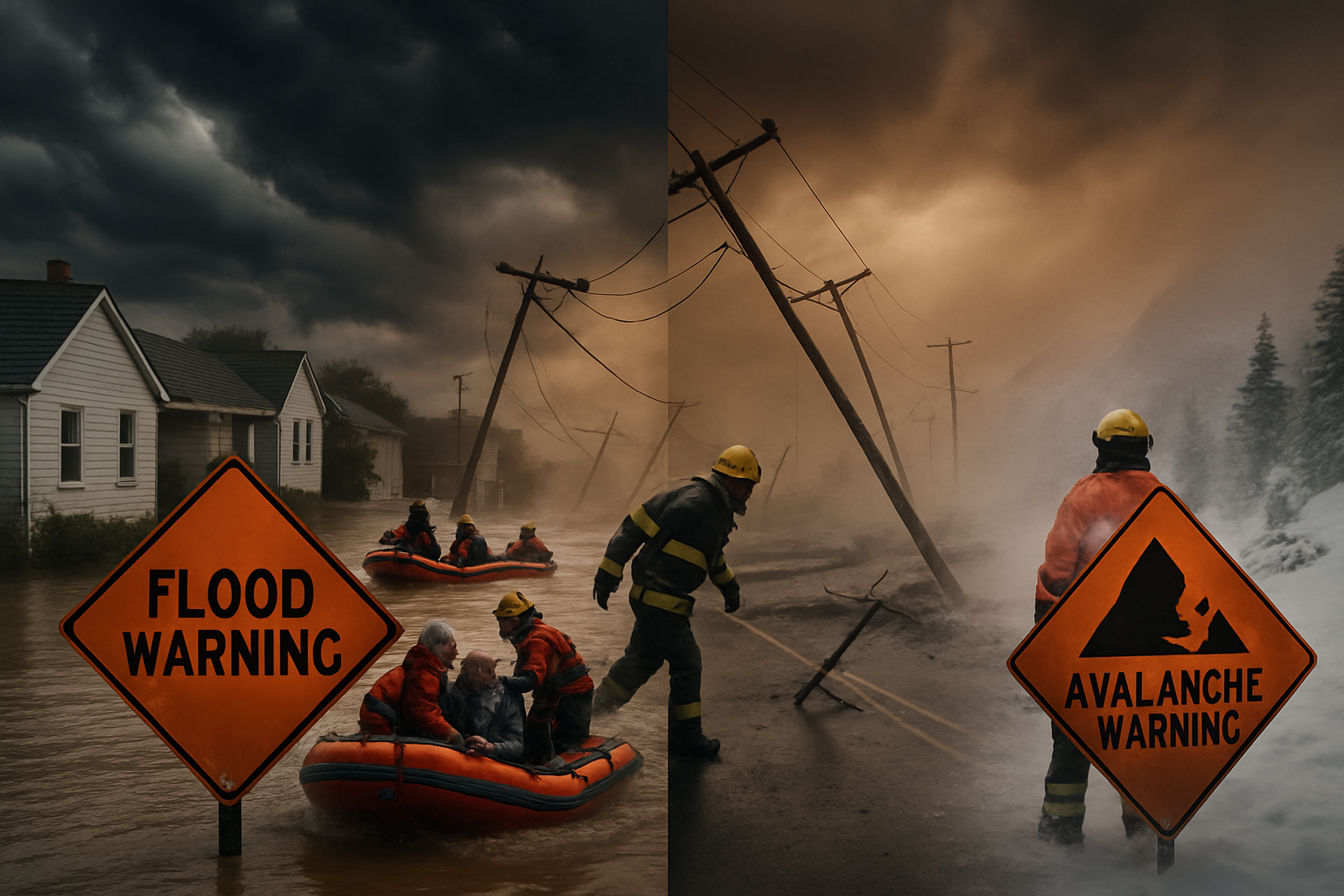
Six nations across three continents are battling devastating weather emergencies as April 2026 marks the 23rd consecutive month of global temperatures exceeding 1.5°C above pre-industrial levels—the longest sustained extreme warming period in recorded human history.
From Algeria's dangerous triple-threat weather system to Pakistan's deadly flooding in Peshawar, emergency services worldwide are operating beyond capacity limits as traditional mutual aid mechanisms prove inadequate for the scale of simultaneous disasters.
Algeria Faces Unprecedented Triple Weather Threat
Meteorological authorities in Algeria have issued urgent warnings as the country confronts a dangerous combination of thunderstorms exceeding 50mm of rainfall, mountain snowfall above 1,100 meters, and dust storms creating respiratory hazards. The National Institute of Meteorology reports winds surpassing 100 km/h across northern regions through Tuesday, threatening widespread infrastructure damage in northern Algeria, the northern Sahara, oases, and southwestern areas.
This unprecedented March intensity represents a significant departure from historical weather patterns, with authorities warning of potential catastrophic impacts on both urban and rural communities.
Pakistan's Devastating Floods Claim Lives
In Pakistan, rescue personnel have evacuated dozens of people as torrential rains caused severe flooding in parts of Peshawar, the capital of Khyber Pakhtunkhwa province. Rescue 1122 spokesperson Bilal Ahmed Faizi confirmed that at least 65 people were evacuated from Peshawar's Sardar Colony due to flooding in the Budhni nullah during Tuesday's heavy downpour.
"Water level in the nullah has increased significantly, with water entering residential areas. We're conducting continuous rescue operations,"
— Bilal Ahmed Faizi, Rescue 1122 Spokesperson
The flooding has also affected Mohmand district, where rescue operations are underway to assist people stranded in floodwater. The continuing spell of rain over the past few days has already claimed several lives across Khyber Pakhtunkhwa, Punjab, and Balochistan provinces.
Bulgaria Braces for Hurricane-Force Winds
The National Institute of Meteorology and Hydrology (NIMH) in Bulgaria has declared a yellow code alert for dangerous winds across the entire country for Wednesday, April 8. Meteorologists forecast sustained winds between 50-69 km/h, with gusts potentially reaching 90 km/h (24 m/s) in some areas, particularly around Ruse.
Authorities have issued warnings about potential material damage and advised residents to secure loose objects and avoid unnecessary travel during peak wind periods.
Sweden Battles Storm Dave's Aftermath
Sweden's emergency response system has been severely tested by Storm Dave, with the southeastern region's emergency center receiving a record number of alerts. Gustav Hultegård, who served as regional incident commander, reported that Jönköping County alone generated approximately fifty alerts for people trapped between fallen trees on roadways.
"This was an extraordinary situation. We had about fifty separate incidents just of people trapped by fallen trees blocking roads. The scale was unprecedented,"
— Gustav Hultegård, Regional Incident Commander
Power outages have affected thousands across Östra Götaland, with helicopter operations deployed to assess damage and coordinate emergency responses in the most severely affected areas.
Greece Reports Deadly Weather Impacts
Greek authorities are monitoring severe weather conditions that have contributed to deadly incidents across Afghanistan and Pakistan. The broader regional weather system has created a wave of extreme conditions affecting millions across South Asia over the past two weeks, with authorities in both countries reporting dozens of casualties from the ongoing extreme weather pattern.
Norway's Chess Documentary Weather Connection
While Norway hasn't experienced direct severe weather impacts in this current wave, the country's media attention has been focused on the upcoming Netflix documentary about the chess rivalry between Hans Niemann and Magnus Carlsen. However, meteorological services remain on alert as the same Atlantic systems affecting other European nations continue to track across the North Sea.
Climate Science: Breaking the 1.5°C Threshold Continuously
The current crisis unfolds against the backdrop of an unprecedented climate milestone. January 2026 was confirmed as the hottest month in recorded history, extending a warming streak that has now persisted for nearly two years. The World Meteorological Organization reports a 50-60% probability of El Niño development between July and September 2026, which could drive temperatures to unprecedented levels by combining baseline global warming with natural cycle amplification.
Climate scientists describe this as the "climate volatility paradox"—where sustained global warming enables both record-breaking heat and devastating regional extreme weather events through disrupted atmospheric circulation patterns and polar vortex instability.
Emergency Response Systems Under Unprecedented Strain
Emergency services across all affected regions are operating at or beyond their design capacity limits. Traditional mutual aid mechanisms, developed for sequential regional disasters, have proven inadequate when multiple continents face simultaneous extreme weather events.
The European Union's Civil Protection Mechanism has been repeatedly activated, with Sweden and Denmark receiving €246 million in assistance—representing the largest coordinated European weather response in recorded history. However, experts note this response remains insufficient for the scale and simultaneity of current global challenges.
Infrastructure Failures Expose Vulnerabilities
Transportation networks, power grids, and communication systems designed for historical climate patterns are repeatedly failing as extreme weather exceeds operational parameters. The crisis has exposed critical vulnerabilities in infrastructure systems that were never designed to handle the current intensity and frequency of extreme weather events.
Recovery timelines have fundamentally shifted from the traditional framework of weeks to months or even years, representing a permanent change in disaster response approaches. This has led experts to emphasize that "building back better" with climate-resilient infrastructure has evolved from an optional enhancement to an essential survival strategy.
Economic and Social Devastation Mounts
Agricultural sectors across the affected regions face mounting losses as extreme weather destroys crops and disrupts supply chains during critical growing seasons. Tourism industries are experiencing extended cancellations and infrastructure damage during what should be peak revenue periods.
Mental health services report increased demand for support related to climate anxiety and repeated trauma. Families in multiple regions face the prospect of losing generational properties, while businesses confront extinction-level threats from recurring extreme weather disasters.
The Path Forward: Transformation vs. Reaction
April 2026 represents a critical watershed moment for global climate preparedness. Experts emphasize that the world faces a stark choice between reactive crisis management and transformative infrastructure adaptation.
Traditional seasonal patterns that have guided infrastructure design, agricultural planning, and emergency preparedness for centuries are no longer reliable frameworks for planning. Current conditions provide a preview of what could become routine in the 2030s without comprehensive climate adaptation investment.
International Cooperation at Breaking Point
Environmental challenges transcend national boundaries through atmospheric and ocean systems that transport climate effects globally regardless of borders. The simultaneity of disasters is testing cooperation mechanisms that were designed for stable regions to assist others during isolated emergencies.
Success in addressing these challenges requires unprecedented cooperation, enhanced coordination, and sustained financial commitments to treat environmental protection as essential infrastructure for both human prosperity and planetary sustainability.
Strategic Significance for Global Future
The climate action window is narrowing rapidly as ecological systems approach critical thresholds that could trigger irreversible changes affecting global food security, climate stability, and human settlements. Additional weather systems are developing across the Atlantic and Pacific regions, and authorities remain on high alert globally.
The persistence of current crisis conditions may establish a "new normal" characterized by extreme weather frequency and intensity that permanently challenges traditional emergency response frameworks.
The tools, knowledge, and cooperation frameworks exist for comprehensive environmental protection, but success depends on unprecedented speed of coordination through sustained international cooperation and political commitment to environmental protection as essential infrastructure.
The fundamental question facing humanity is whether we can organize and implement solutions rapidly enough to maintain planetary habitability during what may be Earth's most environmentally challenging period in recorded history. The choices made in the coming months will be decisive for climate resilience strategies that will define human societies for generations to come.