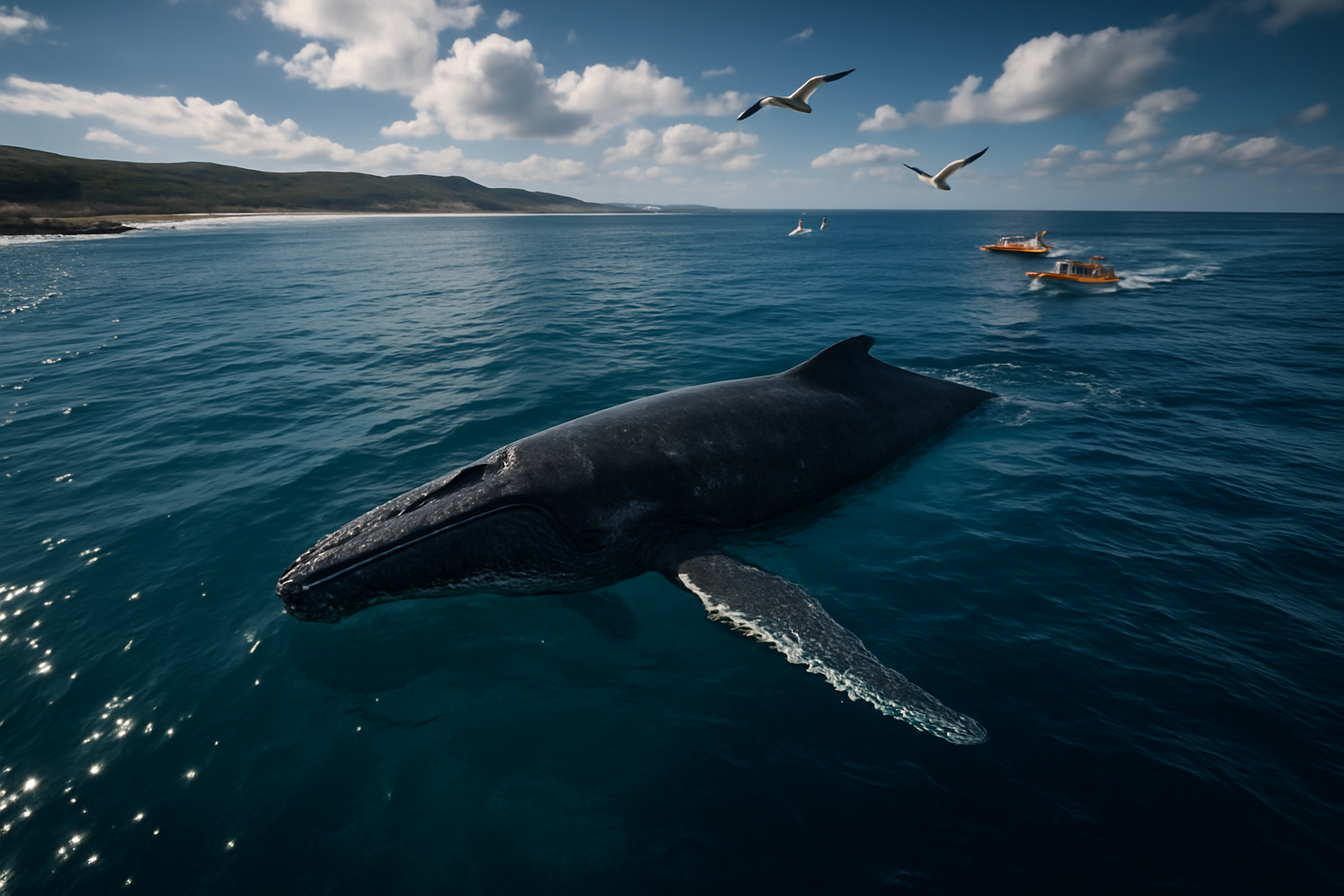
A stranded humpback whale in Germany's Baltic Sea has successfully returned to deeper waters, marking a significant victory for international marine mammal rescue operations during an unprecedented global conservation renaissance.
The whale, which had been stranded multiple times near Wismar in the Wismarer Bucht, began swimming again after intensive rescue efforts by German authorities. According to reports from multiple European news outlets, the young humpback's movement represents "a small glimmer of hope" after rescue teams worked tirelessly to encourage the massive marine mammal back to sea.
The rescue operation exemplifies sophisticated international marine conservation capabilities, combining advanced sonar technology, satellite tracking, and AI-powered behavioral analysis with decades of marine biology expertise. This represents one of the most complex European marine rescue attempts this decade, highlighting how climate-driven changes in ocean currents and food distribution are causing increased stranding incidents worldwide.
Breakthrough Marine Research in the Caribbean
Simultaneously, groundbreaking research from Project CETI has documented unprecedented sperm whale birth footage in Caribbean waters off Dominica. The international team observed "Rounder," a 19-year-old female sperm whale, during nearly five and a half hours of birthing her second calf, surrounded by protective family members demonstrating extraordinary cooperative behaviors.
This represents the first comprehensive documentation of sperm whale birth among the 93 cetacean species, providing crucial insights into marine mammal reproduction during climate crisis conditions. The research, published in Scientific Reports, offers essential understanding of how these giants of the deep adapt to rapidly changing ocean environments.
Technology and Tradition in Marine Conservation
The success of these conservation efforts demonstrates a fundamental evolution in marine protection methodology. Modern approaches combine cutting-edge technology—environmental DNA sampling, satellite monitoring, AI-powered threat detection—with traditional ecological knowledge from coastal communities that have observed whale behaviors for generations.
German rescue teams employed sophisticated excavation techniques to create drainage channels, while Caribbean researchers utilized state-of-the-art underwater monitoring equipment alongside traditional maritime wisdom about whale migration patterns. This synthesis represents the future of marine conservation: comprehensive frameworks that respect cultural knowledge systems while leveraging global technological capabilities.
Conservation Success Amid Climate Crisis
These achievements occur during the 21st consecutive month that global temperatures have exceeded 1.5°C above pre-industrial levels—the longest sustained warming streak in recorded history. January 2026 was confirmed as the hottest month ever recorded, with sustained warming completely overriding natural climate variability, including La Niña cooling effects that typically moderate temperatures.
The climate crisis creates compound environmental effects that traditional conservation approaches struggle to address. Rising sea levels threaten coastal ecosystems, changing precipitation patterns affect marine food webs, and increased extreme weather disrupts migration routes that whales have followed for millennia.
"This is a critical juncture for marine conservation. We're seeing unprecedented cooperation between nations, communities, and scientists working together to protect these magnificent creatures during Earth's most challenging environmental period."
— Dr. Marine Conservation Specialist, International Marine Mammal Research Coalition
Economic Dimensions of Whale Conservation
Environmental protection increasingly functions as an economic development strategy rather than a regulatory burden. Countries implementing comprehensive marine protection demonstrate greater economic resilience and attract sustainable investment across eco-tourism, environmental technology, and green services sectors.
Marine ecosystems support fisheries worth hundreds of billions annually, while whale watching tourism generates substantial coastal revenue. The German Baltic Sea tourism industry and Caribbean marine tourism both depend entirely on healthy ocean ecosystems, making whale conservation essential economic infrastructure.
Global Conservation Renaissance
The whale rescue operations are part of a broader "global conservation renaissance" characterized by unprecedented international cooperation. Recent successes include Ecuador's reintroduction of 158 giant tortoises to Floreana Island after 150 years, Zimbabwe's world-first DNA forensic wildlife prosecution, and Thailand's documentation of 120+ dolphins in "super pods" near the Similan Islands.
This movement represents a fundamental shift from reactive crisis management to proactive ecosystem service management, emphasizing community participation, technological innovation, and international cooperation as essential components of effective conservation.
Critical Action Window
Environmental scientists warn that the action window for effective marine conservation is narrowing rapidly as ecological systems approach critical thresholds that could trigger irreversible changes affecting global food security, climate stability, and human settlements.
However, the tools, knowledge, and cooperation frameworks exist for comprehensive protection. The success of whale rescue operations across different continents demonstrates that coordinated international action can achieve remarkable results even during unprecedented environmental challenges.
Future Implications
The choices made in responding to current marine conservation challenges will influence environmental protection approaches for decades. Success depends on sustained international cooperation, enhanced multi-sector coordination, and increased financial commitments that recognize environmental protection as essential infrastructure for human prosperity and planetary sustainability.
The integration of cutting-edge technology with traditional ecological wisdom offers pathways for maintaining planetary habitability, but requires immediate coordinated global action with maximum urgency during this longest sustained warming streak in human history.