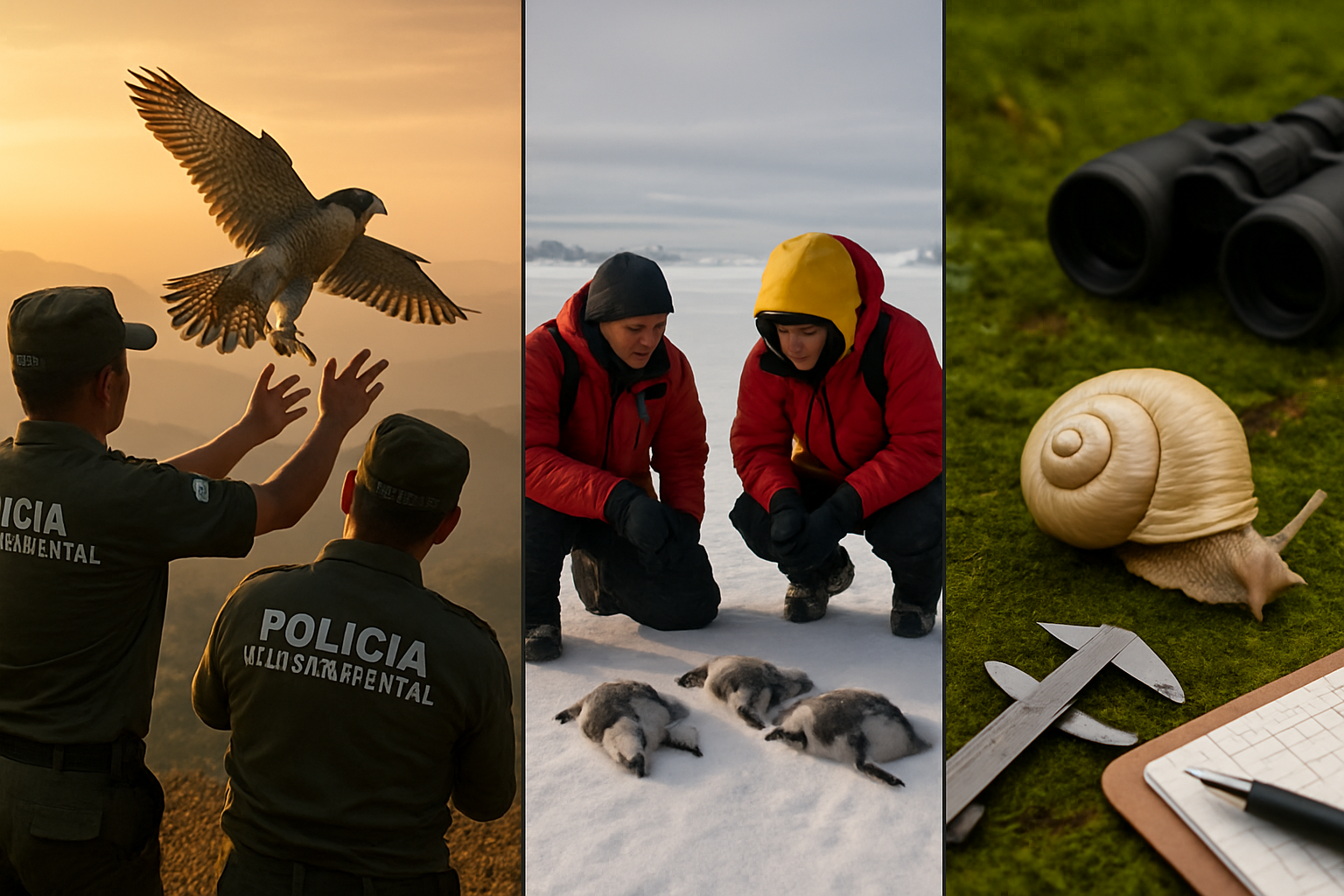
Across three continents this week, wildlife conservation stories illuminate both the remarkable potential for species recovery and the devastating toll of environmental degradation on vulnerable populations.
Environmental police in El Salvador's Texistepeque Division successfully rescued and released a peregrine falcon (Falco peregrinus) near Lake Coatepeque, marking another victory for the nation's growing wildlife protection program. The migratory bird, one of the world's fastest, was evaluated by the National Civil Police's Environmental Division and found fit for return to its natural habitat.
The rescue represents a broader pattern of conservation success emerging across Central America, where community-based wildlife protection initiatives have yielded remarkable results. El Salvador's environmental police have developed sophisticated protocols combining traditional ecological knowledge with modern veterinary science, creating a model increasingly adopted throughout the region.
Antarctic Penguin Crisis Deepens
In stark contrast to El Salvador's conservation triumph, Norway reported devastating news from Antarctic research stations where thousands of emperor penguin chicks have drowned as climate change destabilizes traditional ice platforms. The brief Norwegian report, translated as "Thousands of penguin babies drown," confirms what scientists have feared as emperor penguins face their greatest existential threat in recorded history.
Emperor penguins were officially classified as endangered by the International Union for Conservation of Nature (IUCN) as Antarctic sea ice becomes increasingly fragile, literally breaking under the weight of colonies during traditional nesting periods. French Antarctic research has documented unprecedented challenges as breeding grounds become unreliable, with ice platforms essential for the five-month chick development period proving unstable.
Dr. Christophe Barbraud of the French Antarctic Research Program has confirmed "complete breakdown of systems that have functioned for millennia." The Antarctic Peninsula is experiencing the fastest warming on Earth, threatening an entire polar ecosystem that has evolved over thousands of years.
New Zealand's Conservation Heartbreak
Meanwhile, New Zealand faced a poignant conservation loss as "Ned," a rare left-spiraling snail, died before finding a mate. The death of this unique specimen represents more than individual tragedy—it highlights the desperate race against time facing many endangered species as climate change and habitat destruction accelerate.
Ned's quest for companionship had captured international attention as scientists searched for another left-spiraling individual among a species where such genetic variations are extraordinarily rare. The snail's death underscores how climate change serves as a "threat multiplier," making ecosystems vulnerable to extinction cascades while disrupting natural protective barriers.
Technology and Tradition Unite
These conservation stories, emerging during the 24th consecutive month of global temperatures exceeding 1.5°C above pre-industrial levels, demonstrate both the potential and limitations of modern wildlife protection efforts. The most successful programs integrate cutting-edge technology—environmental DNA sampling, satellite monitoring, AI-powered threat detection—with traditional ecological knowledge and community-based management systems.
El Salvador's falcon rescue utilized genetic analysis and satellite tracking combined with generations of traditional bird-handling expertise. Antarctic research employs advanced ice-monitoring systems alongside indigenous polar observations. Even New Zealand's snail conservation efforts merged modern genetic screening with traditional ecological understanding of native species relationships.
Economic Dimensions of Conservation
Environmental protection increasingly functions as an economic development strategy rather than regulatory burden. Countries implementing comprehensive wildlife protection demonstrate greater economic resilience and attract sustainable investment across eco-tourism, environmental technology, and green services.
El Salvador's growing conservation capabilities enhance the nation's environmental credentials while supporting rural community livelihoods through nature-based tourism. Antarctic research generates international scientific partnerships and climate finance opportunities. New Zealand's conservation economy contributes billions annually through nature-based tourism and environmental research collaborations.
Economic analyses consistently show that ecosystem services provided by intact natural systems often deliver greater long-term economic benefits than resource extraction activities. Wetlands prevent billions in flood damage, forests regulate water and climate patterns, and biodiversity hotspots support pharmaceutical research and eco-tourism worth hundreds of billions annually.
International Cooperation Imperative
These wildlife stories highlight how environmental challenges transcend political boundaries through ocean currents, atmospheric systems, and species migrations connecting ecosystems globally. Peregrine falcons migrate across continents, Antarctic ice loss affects global sea levels, and species extinction cascades impact international food webs.
Success requires unprecedented coordination through shared monitoring systems, collaborative enforcement mechanisms, and innovative financing that recognizes ecosystem services as essential economic infrastructure. The diversity of approaches—from Central American community engagement to Antarctic scientific research to Pacific island species management—provides resilience against single-solution dependencies while offering multiple adaptation pathways for complex challenges.
Critical Action Window Narrowing
Environmental scientists warn that the window for effective conservation action is narrowing rapidly as ecological systems approach critical thresholds that could trigger irreversible changes affecting global food security, climate stability, and human settlements. The choice between reactive crisis management and proactive ecosystem service management may determine whether conservation efforts can keep pace with accelerating environmental change during this decisive climate action decade.
Yet these April 2026 wildlife stories also demonstrate remarkable human capacity for protecting essential natural systems. El Salvador's falcon rescue, Antarctic penguin monitoring, and New Zealand's species conservation efforts—despite tragic losses—provide practical templates for scaling environmental protection globally through coordinated approaches that address multiple challenges while building local capacity and fostering international cooperation.
"Every species lost represents not just ecological tragedy, but the loss of solutions we haven't discovered yet."
— Marine Conservation Scientist
Looking Forward
The convergence of conservation successes and environmental tragedies in April 2026 encapsulates humanity's current environmental moment. We face unprecedented challenges but also demonstrate remarkable adaptive capacity for species protection. The question remains whether humanity can organize and implement solutions rapidly enough to maintain planetary habitability during Earth's most environmentally challenging period in recorded history.
Success depends on sustained international cooperation, enhanced multi-sector coordination, and increased financial commitments that recognize environmental protection as essential infrastructure for human prosperity and planetary sustainability. The integration of cutting-edge technology with traditional ecological wisdom offers pathways for maintaining planetary habitability, but requires immediate, coordinated global action with maximum urgency during this decisive climate action decade.