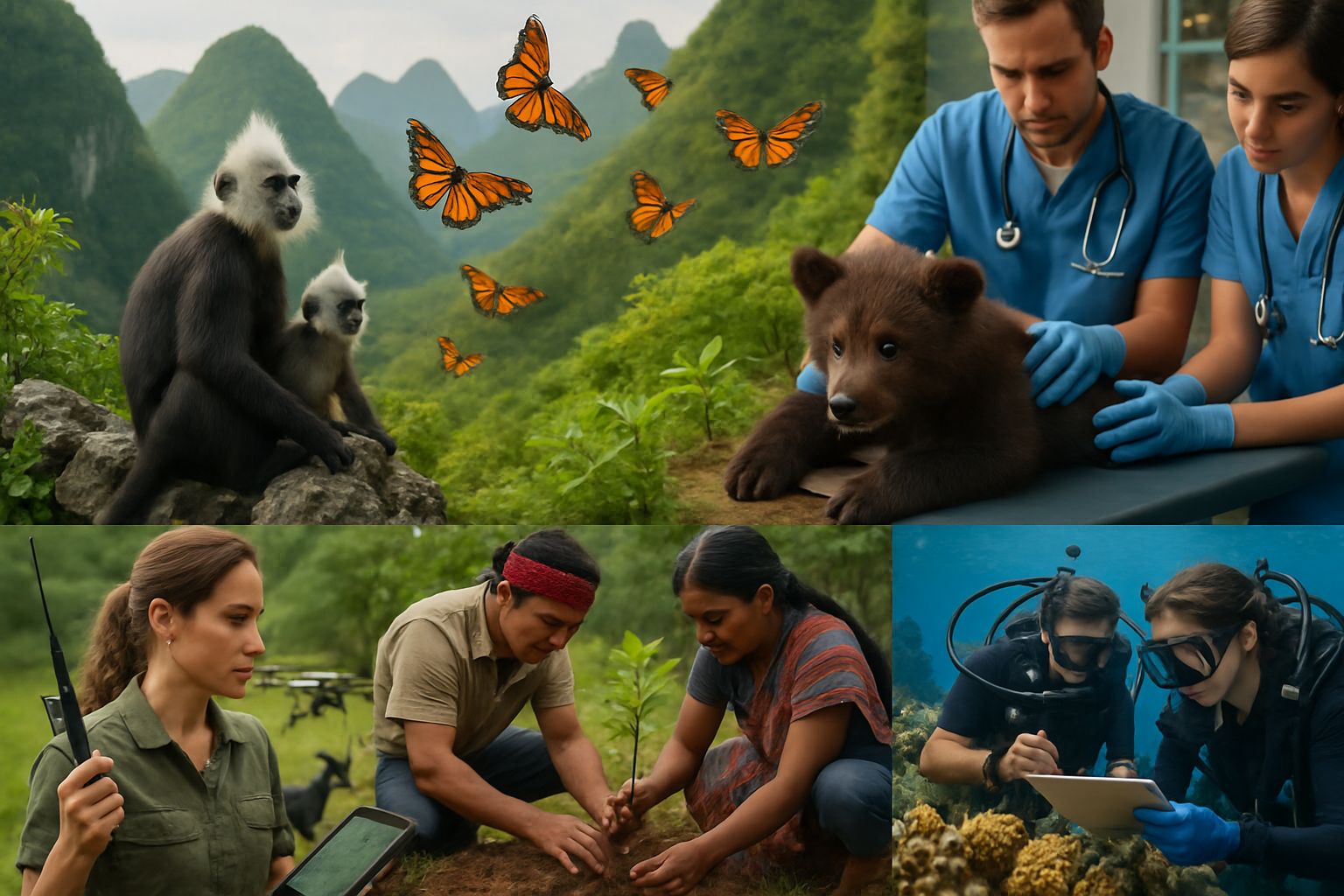
Emergency teams are racing to save a stranded humpback whale in northern Germany's shallow waters, while conservationists in the Democratic Republic of Congo celebrate the birth of rare mountain gorilla twins, highlighting a remarkable surge in global wildlife protection efforts during the most challenging environmental period in recorded history.
The young humpback whale rescue operation in German waters represents one of the most complex marine mammal interventions attempted in European seas this decade. Marine biologists and rescue specialists are working around the clock to free the massive creature, which became stranded in increasingly common incidents linked to climate-driven changes in ocean currents and food distribution patterns. The operation requires sophisticated coordination between multiple agencies, specialized equipment, and unprecedented international expertise.
Congo Gorilla Conservation Triumph
Simultaneously, thousands of kilometers away in Virunga National Park, Democratic Republic of Congo, conservation teams are celebrating an extraordinary breakthrough: the birth of mountain gorilla twins to an endangered female. This remarkable event occurs within one of Africa's most biodiverse yet conflict-affected regions, where dedicated conservationists have maintained wildlife protection programs despite decades of regional instability.
Mountain gorillas, with fewer than 1,100 individuals remaining in the wild, represent one of conservation biology's most fragile success stories. The birth of twins is exceptionally rare, occurring in less than 1% of mountain gorilla births, making this development particularly significant for genetic diversity and population stability. The successful birth reflects years of community-based conservation, anti-poaching efforts, and veterinary care that have enabled gradual population recovery.
"These twin births represent hope for the future of mountain gorillas and demonstrate that effective conservation can succeed even in the most challenging circumstances."
— Dr. Emmanuel de Merode, Former Virunga National Park Director
Global Conservation Renaissance Emerges
These simultaneous conservation efforts exemplify what researchers are calling a "Global Conservation Renaissance" – an unprecedented surge in coordinated international wildlife protection during 2026. This phenomenon builds on remarkable recent successes including Ecuador's historic reintroduction of 158 giant tortoises to Floreana Island after 150 years, Zimbabwe's world-first DNA forensic wildlife crime prosecution, and community-led forest protection initiatives spanning multiple continents.
The timing is critical. January 2026 marked the hottest month in recorded history, extending an unprecedented streak of 21 consecutive months with global temperatures exceeding 1.5°C above pre-industrial levels. This sustained warming has overridden natural climate patterns, creating compound environmental pressures that traditional conservation approaches struggle to address effectively.
Technology Meets Traditional Knowledge
Modern conservation success increasingly depends on sophisticated integration of cutting-edge technology with traditional ecological knowledge and community-based stewardship. The German whale rescue employs advanced marine mammals sonar, satellite tracking, and AI-powered behavioral analysis alongside decades of marine biology expertise. Congo gorilla protection combines environmental DNA sampling, camera trap networks, and GPS monitoring with traditional Congolese forest knowledge and community guardian programs.
This technology-tradition synthesis represents a fundamental evolution in conservation methodology, moving beyond purely technological or traditional approaches toward comprehensive frameworks that combine scientific rigor with cultural sensitivity and community ownership. The approach has proven particularly effective in regions where indigenous and local communities possess generations of environmental stewardship experience.
Economic Engines of Protection
Conservation efforts are increasingly recognized as economic development strategies rather than regulatory constraints. The Democratic Republic of Congo's mountain gorilla protection supports substantial eco-tourism revenue, international research partnerships, and sustainable employment for local communities. Similarly, Germany's marine conservation capabilities enhance the nation's environmental leadership reputation, attracting sustainable investment in green technology and environmental services.
Economic analyses consistently demonstrate that environmental degradation costs exceed proactive conservation investments. Healthy ecosystems provide essential services including water purification, carbon sequestration, climate regulation, and biodiversity maintenance that support agricultural productivity, reduce infrastructure costs, and prevent natural disasters worth billions annually.
Climate Crisis Acceleration
The conservation breakthroughs occur against unprecedented environmental pressure. Climate change is fundamentally altering species migration patterns, breeding cycles, and habitat availability. Marine mammals like the stranded humpback whale face disrupted food webs as warming ocean temperatures affect krill distribution and abundance. Mountain gorillas confront habitat fragmentation as changing precipitation patterns affect forest regeneration and food plant availability.
Traditional conservation timelines designed for stable environmental conditions require fundamental evolution to address rapidly changing baseline conditions while maintaining long-term species recovery goals. Adaptive management approaches that can respond quickly to climate-driven environmental changes have become essential for conservation success.
International Cooperation Imperative
Wildlife conservation challenges transcend political boundaries through natural systems – ocean currents carry marine species across continents, atmospheric systems affect migration patterns globally, and species movements connect ecosystems regardless of borders. The German whale rescue benefits from decades of international marine mammal research collaboration, while Congo gorilla protection leverages global expertise in primate conservation, anti-poaching technology, and community engagement strategies.
Success requires coordinated policy frameworks, shared monitoring systems, collaborative enforcement, and innovative financing mechanisms that recognize the economic value of ecosystem services. The diversity of conservation approaches provides resilience against single-solution dependencies, offering multiple adaptation pathways for complex environmental challenges.
Critical Action Window
March 2026 represents a critical juncture in global environmental protection, presenting a choice between reactive crisis management and proactive ecosystem service management. Environmental scientists warn that the window for effective conservation action is narrowing rapidly as ecological systems approach critical thresholds that could trigger irreversible changes affecting global food security, climate stability, and human settlements.
The tools, knowledge, and cooperation frameworks exist for comprehensive environmental protection, as demonstrated by the coordinated international responses to wildlife emergencies. However, success requires unprecedented speed and coordination through sustained international cooperation, enhanced multi-sector coordination, and increased financial commitments that recognize environmental protection as essential infrastructure for human prosperity and planetary sustainability.
Future Implications
The conservation developments in Germany and Democratic Republic of Congo may prove decisive for conservation approaches in the decades ahead. The successful integration of emergency response capabilities, long-term species management, community engagement, and international cooperation provides templates that can be adapted globally while respecting local conditions and cultural priorities.
The convergence of technological innovation, traditional ecological wisdom, community stewardship, and political commitment offers pathways for maintaining planetary habitability during Earth's most environmentally challenging period. Whether humanity can organize and implement conservation solutions rapidly enough to match the pace of environmental change will determine the future of countless species and the natural systems upon which human prosperity depends.
As rescue teams continue their intensive efforts to save the German whale and Congolese communities celebrate new gorilla life, these parallel conservation stories illuminate both the extraordinary challenges and remarkable human capacity for protecting the natural world when knowledge, resources, and international cooperation align with sufficient urgency and commitment.