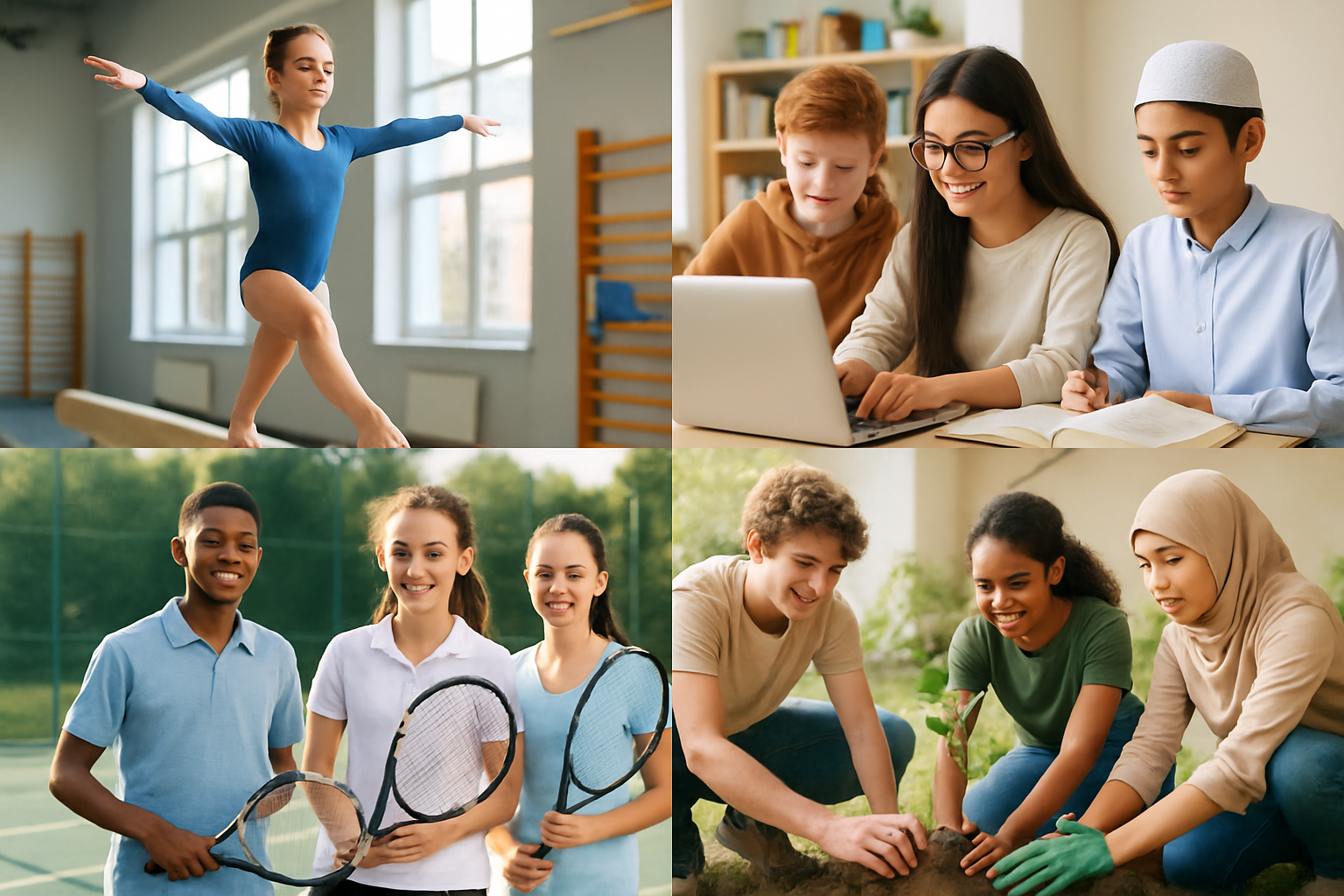
Across four continents this February, young people are achieving remarkable success in diverse fields while educational institutions worldwide embrace innovative approaches to nurture the next generation's potential, marking a pivotal moment in global youth development.
From tennis courts in Bulgaria to gymnastics centers in Gabon, from Islamic schools in Bosnia to conservation projects in India, exceptional young achievers are demonstrating that the future belongs to a generation prepared to excel across traditional and emerging disciplines.
Athletic Excellence Across Continents
In Bulgaria, the tennis world has witnessed extraordinary achievements as Kaloyan Shikov from Tennis Club Tundja in Yambol and Karolina Kostova from TC Lokomotiv 1924 in Plovdiv triumphed with singles titles at the National Indoor Tennis Championship for youth under 18. The championship, organized by the Bulgarian Tennis Federation and TC "Kristi" in Dryanov, showcased the country's rising tennis talent in the VTK Kentavar hall.
Meanwhile, Bulgaria's national badminton team made history at the European Women's Team Championship in Istanbul, Turkey. The squad, comprising Stefani and Gabriela Stoevi, Kaloyana Nalbantova, Gergana Pavlova, Tsvetina Popivanova, Elena Popivanova, and Maria Mitsova, secured gold medals in what team members described as a "unique feeling."
"It certainly wasn't easy in all the matches I played, as there was tension and wins were important for the team. Team championships are among the toughest, as everyone must give their maximum on the court," reflected one team member.
— Bulgarian National Badminton Team Member
In Gabon, eight-year-old gymnast Alexia Nzamba has emerged as the nation's newest sports sensation, claiming second place on the podium at an international competition held January 27 in Atlanta, United States. This remarkable achievement has positioned Gabon prominently on the international gymnastics map and highlighted the potential of young African athletes when given proper support and opportunities.
Educational Innovation and Cultural Preservation
Religious and cultural education continues to play a vital role in youth development. In Bosnia and Herzegovina, the fifth competition for students of the Sarajevo Mufti's Hifz School took place at the Gazi Husrev-Bey Library, featuring 63 competitors demonstrating their mastery of Quranic recitation.
The competition was evaluated by two expert committees comprising distinguished scholars including Dr. Hfz. Abdulaziz Drkić, Dr. Hfz. Maid Ibrahimović, Hfz. Edin Bukva, Hfz. Mensud Đulović, Hfz. Sead Babaluk, and Hfz. Hikmet Džanko. Competitors were divided into five categories following the school's curriculum: Ame-džuz (grades 1-6), Ame-džuz (grades 7-9), two džuz, five džuz, and recitation.
The event, supported by the "Hifz of the Noble Quran" Foundation and an aviation company, emphasized the primary goal of bringing children together through the Quran while encouraging perseverance in learning hifz (memorization of the Quran).
Environmental Leadership Through Youth Action
Perhaps one of the most inspiring developments comes from India, where the Chorai Bandhob initiative of children from Bongaon Chola High School has expanded to several institutions, promoting urban nesting spaces ahead of breeding season. This environmental conservation program demonstrates how young people are taking leadership roles in addressing ecological challenges in their communities.
The initiative reflects a growing global trend where students are moving beyond traditional classroom learning to engage in practical environmental conservation, creating measurable positive impact while developing leadership skills and environmental consciousness.
Part of a Global Educational Renaissance
These achievements occur within what educational experts are calling the "2026 Educational Technology Renaissance," a global phenomenon characterized by thoughtful integration of digital tools with traditional educational values and human-centered learning approaches.
Recent developments include Malaysia's world-first AI-integrated Islamic school, Singapore's WonderBot 2.0 for heritage education, and Canada's responsible AI teaching assistants. However, the focus remains on enhancing rather than replacing fundamental educational relationships and cultural transmission.
The success patterns observed across these diverse initiatives share common elements: sustained community engagement with authentic participation from knowledge bearers, economic viability through sustainable funding models, institutional support that maintains flexibility for local adaptation, and international cooperation enabling knowledge sharing without imposing standardized solutions.
Technology Serving Educational Goals
What distinguishes this wave of educational innovation is the sophisticated understanding that technology should enhance rather than replace human connections and cultural knowledge. Whether in Bosnia's Quranic competitions maintaining centuries-old traditions, Bulgaria's athletic programs using modern training methods, Gabon's gymnastics development, or India's environmental initiatives, the emphasis remains on fostering genuine human development.
This approach contrasts sharply with purely technological solutions and reflects growing awareness that effective youth development requires balancing innovation with cultural authenticity, individual achievement with community benefit, and global competencies with local identity.
Challenges and Opportunities Ahead
Despite these success stories, challenges remain significant. Educational systems worldwide face funding sustainability concerns, infrastructure limitations, the need for comprehensive teacher training, and the global memory crisis affecting technology programs due to semiconductor shortages.
However, the evidence from these diverse programs suggests that youth development combining traditional wisdom with contemporary challenges, individual agency with community benefit, and local authenticity with global cooperation achieves superior outcomes compared to standardized approaches.
A Template for Global Youth Empowerment
The February 2026 developments represent a fundamental shift in human capital development, recognizing that traditional educational models alone are insufficient for addressing technological change and environmental challenges. The emphasis on practical skills, collaborative problem-solving, and early engagement in meaningful activities provides a template for global youth empowerment initiatives.
From the precision and discipline required in Quranic memorization to the athletic excellence demonstrated on tennis courts and gymnastics floors, from environmental stewardship to academic achievement, these young people are demonstrating that excellence transcends cultural and geographical boundaries when supported by committed communities and effective educational frameworks.
As these young achievers continue to excel in their respective fields, they serve as inspiration for educational systems worldwide seeking to balance tradition with innovation, local identity with global connectivity, and individual achievement with community development. Their success stories provide evidence that when given proper support, young people can achieve remarkable things while maintaining their cultural identities and contributing meaningfully to their communities.