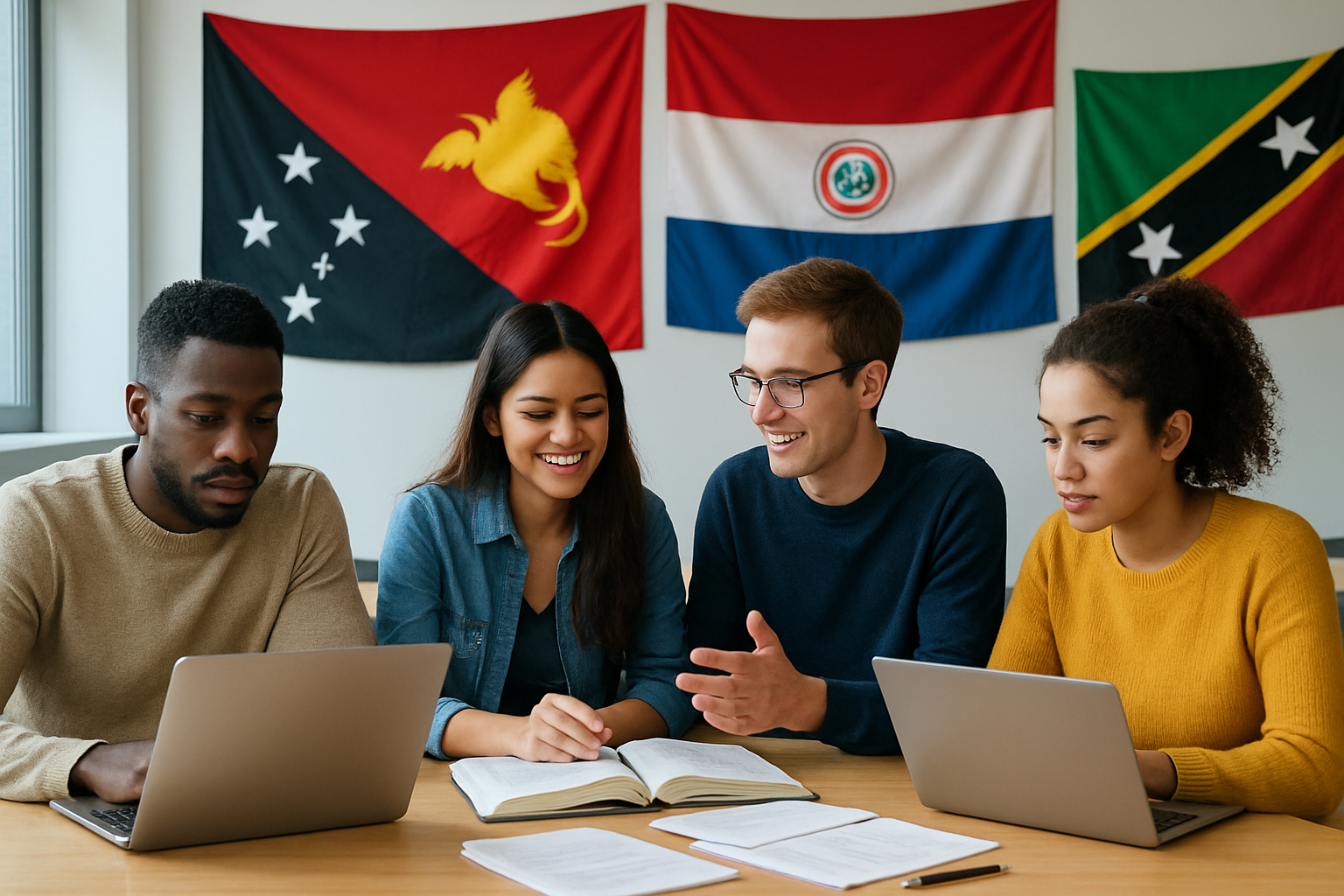
A remarkable wave of youth-focused educational initiatives is sweeping across three continents this week, as countries from the Pacific to the Caribbean demonstrate unprecedented commitment to empowering young people through innovative programs, strategic partnerships, and expanded access to higher education.
From Papua New Guinea's representation in prestigious Commonwealth Youth Awards to Paraguay's comprehensive scholarship evaluation process and Saint Kitts and Nevis' historic university partnership with Ghana, February 2026 has emerged as a defining moment for global youth development initiatives.
Commonwealth Youth Awards Showcase Pacific Excellence
The Commonwealth unveiled its 20 regional finalists for the 2026 Youth Awards on Wednesday, with Papua New Guinea among the nations represented in this prestigious recognition program. The Commonwealth Youth Awards celebrate young trailblazers who are making significant contributions to their communities and demonstrating exceptional leadership potential across the Commonwealth's 54 member nations.
This year's regional finalists represent diverse fields including social innovation, environmental sustainability, community development, and technological advancement. The awards program, now in its established cycle, continues to serve as a platform for recognizing and amplifying the voices of young changemakers who are addressing critical challenges in their communities.
Papua New Guinea's inclusion among the regional finalists reflects the nation's growing investment in youth development and the increasing recognition of Pacific Island nations' contributions to global progress. The country has been steadily building its reputation for nurturing young talent in various sectors, from environmental conservation to digital innovation.
Paraguay's Comprehensive Scholarship Revolution
In a parallel development showcasing systematic investment in youth education, Paraguay launched an ambitious evaluation process for its 2026 Government Scholarship Program on Wednesday. The National Institute of Statistics (INE) began training census-takers and supervisors who will conduct home visits to assess the socioeconomic status of more than 7,800 applicants who successfully passed the Basic Competencies Test.
INE National Director Iván Ojeda presided over the training launch, emphasizing the transformative potential of the initiative. "In the work you are going to do lies the hope of thousands of young people seeking access to scholarships to study and develop their potential," Ojeda stated during the opening ceremony.
"In the work you are going to do lies the hope of thousands of young people seeking access to scholarships to study and develop their potential."
— Iván Ojeda, National Director, INE Paraguay
The program represents a collaborative effort involving multiple institutions, including ITAIPU, whose Social Responsibility Advisor Rogelio Sallaberry and Scholarship Unit Manager Mabel Benítez participated in the training launch. Nancy Cano, acting director of the General Directorate of Statistical Technical Production, also attended the ceremony, underscoring the program's institutional significance.
This comprehensive approach to scholarship allocation reflects Paraguay's commitment to ensuring equitable access to higher education. By conducting detailed socioeconomic assessments, the program aims to direct resources to students who demonstrate both academic merit and financial need, maximizing the social impact of educational investment.
Caribbean-African Educational Bridge
Simultaneously, Saint Kitts and Nevis achieved a historic milestone in international educational cooperation with the signing of a Memorandum of Understanding (MOU) with the University of Ghana on Tuesday, February 3. Education Minister Hon. Dr. Geoffrey Hanley signed the agreement, witnessed by Permanent Secretary staff, marking a significant step in strengthening educational ties between the Caribbean and Africa.
The MOU acknowledges the deep historical and cultural connections between Saint Kitts and Nevis and Ghana, seeking to deepen these relationships through meaningful partnerships in education and development. The agreement establishes frameworks for academic collaboration, joint research initiatives, youth-focused programs, and the exchange of knowledge and expertise between the two nations.
"This collaboration reaffirms St. Kitts and Nevis' commitment to promoting human capital development, youth empowerment, and international cooperation in education, research, and innovation," ministry officials stated following the signing ceremony.
The partnership represents more than a traditional academic exchange program. It embodies a strategic approach to leveraging shared cultural heritage for educational advancement, creating opportunities for students and faculty from both nations to engage in cross-cultural learning experiences that honor their common history while building future capabilities.
Global Context of Educational Renaissance
These developments occur within a broader context of educational innovation and international cooperation that has characterized early 2026. The global education landscape is experiencing a renaissance of technological integration, international partnerships, and targeted youth development programs.
From Singapore's AI-powered learning systems to Malaysia's innovative AI-integrated Islamic schools, countries worldwide are reimagining educational delivery and expanding access to quality learning opportunities. The emergence of comprehensive scholarship programs, like Paraguay's systematic approach and Mexico's expanded Beca Rita Cetina program, demonstrates growing recognition that education investment drives economic development and social progress.
The strengthening of South-South cooperation, exemplified by the Saint Kitts and Nevis-Ghana partnership, reflects a mature understanding that educational advancement benefits from diverse perspectives and shared resources. These partnerships enable knowledge transfer, cultural exchange, and collaborative problem-solving approaches that enrich the educational experience for all participants.
Addressing Contemporary Challenges
The timing of these initiatives is particularly significant given the challenges facing youth globally. Climate change impacts, technological disruption, and evolving job markets require educational systems that can prepare young people for rapidly changing circumstances while providing them with foundational skills and knowledge.
The Commonwealth Youth Awards program addresses this need by recognizing young leaders who are already demonstrating innovation and resilience in addressing contemporary challenges. By celebrating these achievements, the Commonwealth creates role models and networks that inspire and support other young people in their own development journeys.
Paraguay's scholarship program takes a different but complementary approach by ensuring that financial barriers do not prevent capable students from accessing higher education. The program's comprehensive evaluation methodology reflects understanding that educational opportunity must be both merit-based and need-sensitive to achieve maximum social impact.
The Saint Kitts and Nevis-Ghana partnership addresses the challenge of small-nation educational capacity by creating networks that enable resource sharing and expertise exchange. This approach allows smaller countries to access world-class educational opportunities while contributing their own unique perspectives and capabilities to global knowledge systems.
Economic and Social Implications
The economic implications of these educational investments extend far beyond immediate program costs. Countries that successfully develop their human capital through strategic educational investments position themselves advantageously in the global knowledge economy, attracting investment and creating opportunities for sustainable economic growth.
Paraguay's systematic approach to scholarship allocation exemplifies this strategic thinking. By identifying and supporting students with both academic potential and financial need, the program creates conditions for broad-based economic advancement. Scholarship recipients are likely to contribute significantly to their communities and national development upon completing their studies.
The cultural and diplomatic dimensions of the Saint Kitts and Nevis-Ghana partnership also carry economic value. Educational exchanges promote understanding and cooperation that can facilitate trade, tourism, and investment relationships between participating countries and regions.
Technology Integration and Innovation
While these three initiatives represent different approaches to youth development, they share common elements of innovation and adaptation to contemporary needs. The use of systematic evaluation processes in Paraguay reflects modern approaches to evidence-based program management, ensuring that resources are allocated efficiently and effectively.
The Commonwealth Youth Awards program incorporates digital platforms and global communication networks to identify, evaluate, and celebrate young leaders across diverse geographical and cultural contexts. This technological integration enables the program to maintain relevance and accessibility in an increasingly connected world.
The Saint Kitts and Nevis-Ghana partnership, while rooted in historical connections, utilizes contemporary frameworks for international educational cooperation, including digital communication, online learning platforms, and virtual exchange opportunities that complement traditional in-person programs.
Looking Forward
As these programs develop through 2026, they will likely serve as models for other countries seeking to strengthen their youth development capabilities. The diverse approaches represented—international recognition programs, comprehensive scholarship systems, and strategic bilateral partnerships—offer multiple pathways for countries to invest in their young people's futures.
The success of these initiatives will depend on sustained commitment from participating institutions, adequate resource allocation, and continued adaptation to changing needs and opportunities. Early indicators suggest strong institutional support and community engagement across all three programs.
The convergence of these developments in early February 2026 signals a potentially transformative period for global youth education. As countries recognize the critical importance of human capital development in addressing contemporary challenges and seizing future opportunities, programs like these may become increasingly central to national development strategies worldwide.