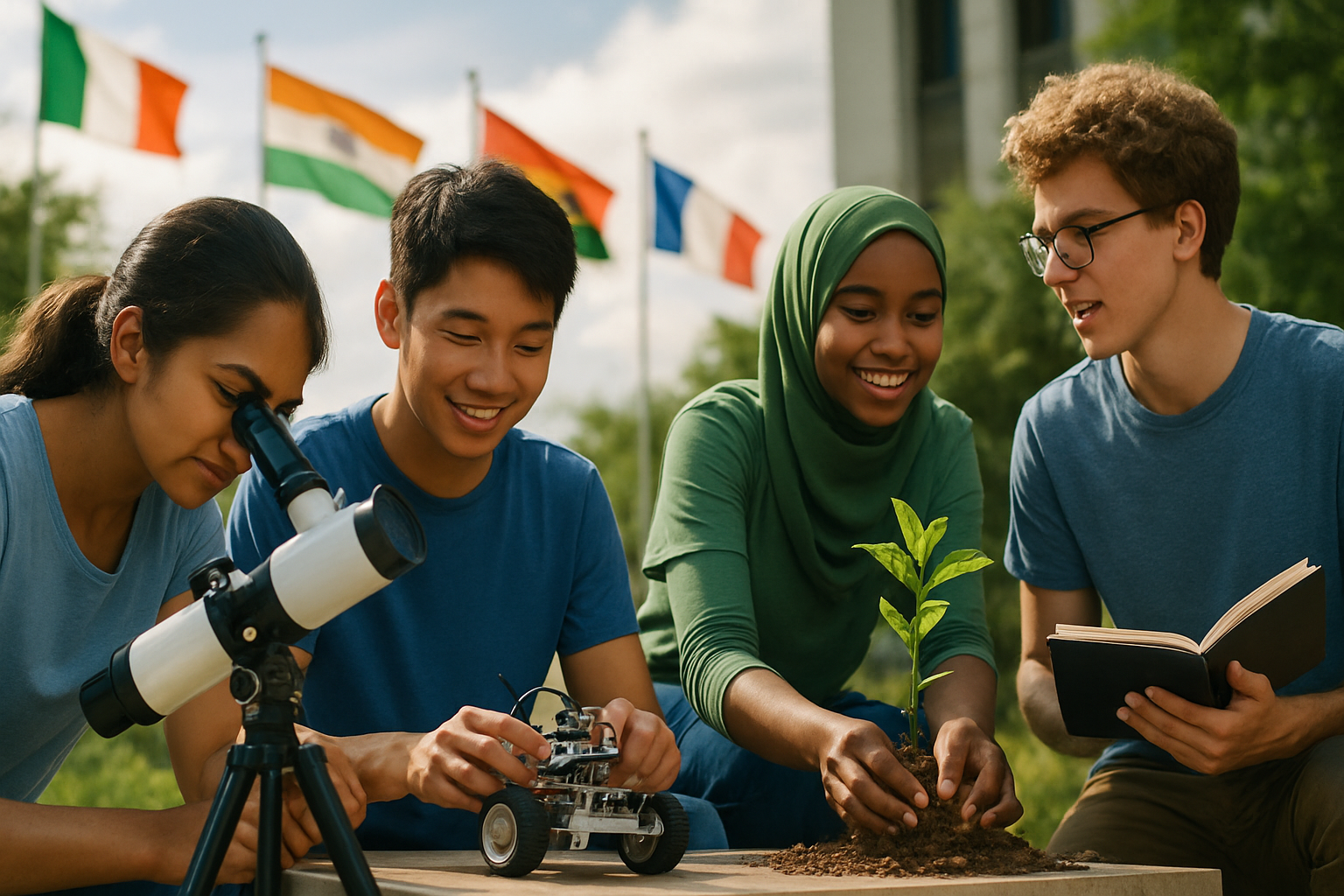
Young minds across four nations are transforming educational landscapes through groundbreaking programs spanning astronomy, robotics, environmental conservation, and collaborative governance, signaling a global renaissance in youth empowerment initiatives that bridges traditional knowledge with cutting-edge technology.
From Algeria's national astronomy olympiad selection to South Sudan's robotics certification program, February 2026 has witnessed an unprecedented surge in youth-focused educational initiatives that demonstrate coordinated international commitment to preparing the next generation for an increasingly complex global environment.
Algeria Launches International Astronomy Competition
Algeria's National Education Ministry has initiated a comprehensive selection process to identify representatives for the 2026 International Olympiad of Astronomy and Astrophysics, marking a significant investment in scientific education. Education Minister Mohamed Seghir Saadaoui personally oversaw the national competition launch at Hussein Ait Ahmed High School in Bab Ezzouar, Algiers.
"This competition provides an appropriate opportunity for students to demonstrate their abilities in scientific competition to participate in this international event dedicated to astronomy and astrophysics," Minister Saadaoui declared, emphasizing the program's role in nurturing scientific talent at the national level.
The initiative represents Algeria's broader commitment to STEM education excellence, positioning young Algerian scientists to compete on the international stage while developing critical thinking skills essential for modern scientific careers. The astronomy focus aligns with global trends recognizing space science as crucial for addressing climate change, resource management, and technological innovation.
Bhutan Strengthens Youth Leadership Networks
Bhutan's capital witnessed a groundbreaking gathering of youth leaders as more than 40 representatives from seven organizations and clubs convened for the National Youth Collaboration Forum. The initiative addresses persistent coordination challenges that have limited the effectiveness of youth-led social, developmental, and environmental programs despite their demonstrated importance in addressing national challenges.
The forum represents a strategic shift from isolated youth initiatives toward systematic collaboration designed to amplify youth voices in national decision-making processes. Bhutanese youth organizations have emerged as key drivers of social innovation, particularly in environmental conservation and community development projects that align with the nation's Gross National Happiness philosophy.
"Poor coordination and limited resources have constrained youth efforts. This forum strengthens collaboration and amplifies youth voices in decision-making."
— Forum organizers, National Youth Collaboration Forum
The collaborative approach builds on Bhutan's constitutional commitment to youth development while recognizing that complex 21st-century challenges require coordinated responses that transcend individual organizational boundaries.
Malawi's Environmental Education Through Action
In Monkey Bay, Malawi, the youngest environmental advocates demonstrated that age is no barrier to meaningful climate action. Pupils at Fishland Kindergarten School planted 50 trees on Friday as part of an innovative early childhood environmental education program that combines hands-on conservation with foundational learning about ecological systems.
School Director Hamisi Nyampesi explained the philosophy behind engaging children as young as kindergarten age in environmental stewardship: "Through initiatives like this, we hope to raise environmentally conscious citizens. Teaching children about environmental conservation is key to tackling climate change."
The tree-planting initiative reflects a growing recognition that environmental education must begin early and involve practical action rather than theoretical instruction alone. Malawi faces significant climate challenges, including deforestation, soil degradation, and unpredictable rainfall patterns that threaten agricultural communities.
By involving young children in tree planting, the program creates lasting emotional connections to environmental stewardship while demonstrating that effective climate action requires multi-generational engagement beginning at the earliest educational levels.
South Sudan Advances Technical Education
South Sudan marked a significant milestone in technical education as STEMpower Juba awarded certificates to 29 graduates of its comprehensive robotics training program. The initiative represents a crucial investment in technical skills development in a nation rebuilding its educational infrastructure after decades of conflict.
The robotics program addresses critical skills gaps in engineering, programming, and technical problem-solving while providing young South Sudanese with practical experience in emerging technologies. Robotics education combines multiple STEM disciplines, encouraging integrated thinking about mechanical systems, electronic controls, and software programming.
The certificate program demonstrates South Sudan's commitment to technical education that prepares students for modern employment opportunities while building indigenous capacity for technological innovation. The initiative aligns with broader African trends emphasizing technical and vocational education as complementary to traditional academic pathways.
Global Context: Youth Education Renaissance
These developments occur within a broader context of educational transformation documented across continents throughout February 2026. Recent initiatives include Singapore's WonderBot 2.0 AI learning system, Malaysia's AI-integrated Islamic schools, and comprehensive digital reforms across multiple nations that demonstrate coordinated international recognition of education as strategic infrastructure.
The diversity of approaches—Algeria's competitive academic excellence, Bhutan's collaborative governance, Malawi's environmental action, and South Sudan's technical skills—illustrates how different nations are adapting global educational trends to local contexts and priorities.
Technology and Tradition Integration
A common thread across all four initiatives is the sophisticated integration of technological advancement with traditional educational values. Algeria combines modern astronomical instruments with classical scientific methodology. Bhutan leverages digital communication tools while maintaining community-based decision-making traditions. Malawi uses environmental science to reinforce cultural values of stewardship. South Sudan employs cutting-edge robotics while building on traditional craftsmanship skills.
This synthesis suggests that effective 21st-century education requires neither abandoning cultural heritage nor avoiding technological innovation, but rather finding creative ways to combine both for enhanced learning outcomes.
Challenges and Opportunities
Despite these successes, youth education programs face significant challenges including funding sustainability, infrastructure limitations, and the need for trained educators capable of delivering innovative curricula. The global memory crisis affecting semiconductor availability has created particular challenges for technology-dependent programs, while climate change disrupts traditional academic calendars and threatens educational infrastructure.
However, these challenges also create opportunities for international cooperation, resource sharing, and innovative approaches that may prove more sustainable than traditional educational models. The success of programs across diverse economic and political contexts suggests that youth empowerment through education transcends national boundaries and economic development levels.
Future Implications
These youth education initiatives represent more than isolated programmatic successes; they signal a fundamental shift in how nations approach human capital development in an era of rapid technological change and environmental challenges. The emphasis on practical skills, collaborative problem-solving, and early engagement suggests recognition that traditional educational models may be insufficient for preparing young people for the complexities they will inherit.
The international coordination evident across these programs—from astronomy competitions to robotics training to environmental action—demonstrates how youth education is becoming a platform for diplomatic cooperation and knowledge sharing that transcends traditional geopolitical boundaries.
As these programs mature and expand, they may provide templates for scaling youth empowerment initiatives globally, offering hope that investment in educational innovation today will yield dividends in the form of a generation better equipped to address tomorrow's challenges through creativity, collaboration, and technical competence.