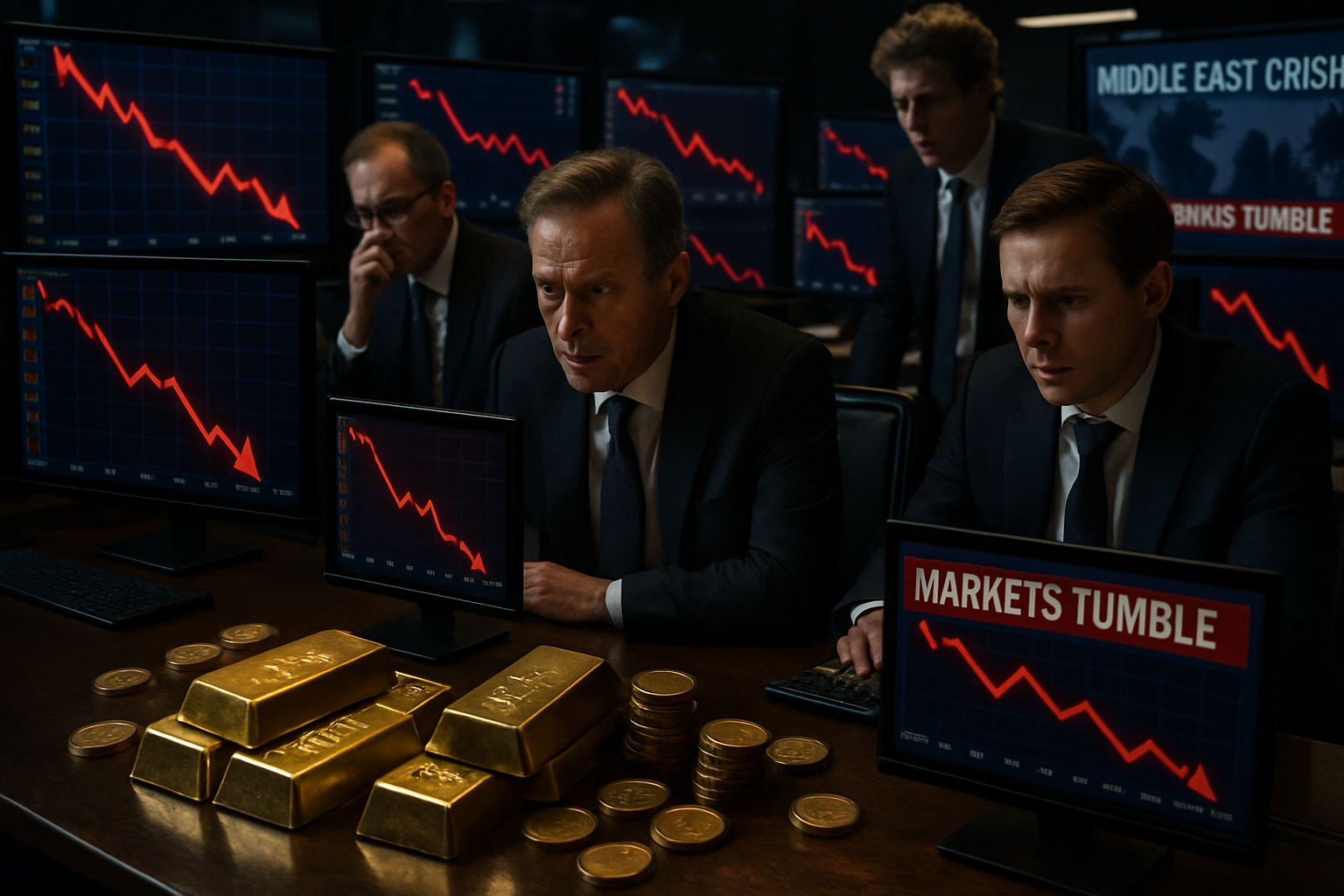
Gold markets have suffered their largest weekly decline since 2011, plummeting 1.8% on Friday to $4,563.64 per ounce as geopolitical tensions in the Middle East and reports of potential US military deployments create unprecedented market volatility in what has traditionally been viewed as a safe-haven asset.
The dramatic sell-off represents one of the most paradoxical market reactions in recent history, with gold—traditionally investors' refuge during times of crisis—posting its steepest weekly decline in 14 years despite ongoing warfare and escalating tensions across the Middle East. This counterintuitive movement has shocked financial markets and raised fundamental questions about gold's role as a store of value during modern geopolitical crises.
Dollar Strength Drives Gold Weakness
The primary catalyst for gold's decline came Friday afternoon following a Reuters report citing three US officials that the American military is deploying thousands of additional marines and sailors to the Middle East. This news triggered an immediate strengthening of the US dollar and surge in Treasury yields, making dollar-denominated gold less attractive to international investors.
Spot gold futures for April delivery dropped 0.7% to $4,574.90, compounding the weekly losses that began as markets digested the implications of expanded US military involvement in the region. The strengthening dollar creates a direct headwind for gold prices, as international buyers face higher costs when purchasing the precious metal in their local currencies.
Geopolitical Tensions Intensify
The gold sell-off occurs against the backdrop of the most serious international crisis since the end of the Cold War. The ongoing US-Israeli conflict with Iran has already claimed thousands of lives and spread across the Middle East, with Iranian forces systematically targeting Western allies and infrastructure.
Recent developments include the Revolutionary Guard's declaration that the Strait of Hormuz is "unsafe for shipping," effectively closing the waterway that handles 40% of global oil transit. This has triggered an unprecedented energy crisis, with oil prices surging past $100 per barrel for the first time since 2022, reaching peaks of $119.50 for Brent crude and $108.15 for WTI—an 18.98% record single-day jump.
"This is one of the most paradoxical reactions we've seen in precious metals markets. Gold should be rallying during such severe geopolitical instability, but the dollar's strength and concerns about prolonged military engagement are overriding traditional safe-haven demand."
— Financial Market Analyst
Federal Reserve Policy Complicates Outlook
Adding complexity to gold's decline is the Federal Reserve's recent decision to maintain interest rates unchanged amid the crisis, creating additional market uncertainty. Fed Chair Powell emphasized central bank independence during what he described as the "most challenging economic environment in decades," but the policy divergence with other central banks is affecting currency dynamics and precious metals flows.
Higher interest rates and stronger dollar expectations reduce gold's appeal as a non-yielding asset. Investors are increasingly factoring in the possibility that prolonged military engagement could necessitate higher government spending and potentially more hawkish monetary policy to combat inflationary pressures from disrupted energy supplies.
Energy Crisis Reshapes Investment Flows
The Middle East conflict has created the most severe energy crisis since the 1970s oil shocks, fundamentally altering global investment patterns. Iran's mining of the Strait of Hormuz with an estimated 2,000-6,000 naval devices has stranded over 150 tankers worth billions in cargo, forcing major shipping companies Maersk and MSC to suspend Persian Gulf operations entirely.
Natural gas prices have exploded 24% in Europe and 78% in the US, reaching €47.32/MWh—the highest levels since February 2025. Qatar's halt of LNG production at major facilities represents approximately 20% of global exports, creating severe supply constraints that are redirecting investment capital away from precious metals toward energy securities and infrastructure.
Aviation and Supply Chain Disruptions
The crisis has created unprecedented disruptions beyond energy markets, with over 18,000 flights cancelled worldwide—the most extensive aviation disruption since COVID-19. Eight Middle Eastern countries have simultaneously closed their airspace, severing critical Asia-Europe flight corridors and forcing Dubai International Airport, the world's busiest with 86 million passengers annually, to remain shuttered due to missile damage.
Major airlines including Emirates, Air France-KLM, and Wizz Air have suspended operations indefinitely, creating ripple effects through global commerce and supply chains that extend far beyond the immediate conflict zone.
Market Psychology and Safe-Haven Demand
The gold market's reaction highlights a fundamental shift in investor psychology during modern crises. While precious metals have historically benefited from geopolitical uncertainty, the current environment presents a complex web of factors that are overwhelming traditional safe-haven demand.
Financial markets have crashed globally, with Pakistan's KSE-100 index posting its largest single-day decline in history at -8.97%, and South Korea's KOSPI dropping 12% before circuit breakers activated. The Korean won has fallen to a 17-year low, while European markets have suffered severe losses as the crisis spreads beyond Middle Eastern boundaries.
Congressional Opposition and Market Constraints
Growing bipartisan opposition in Congress to the military engagement is creating additional market uncertainty. Senator Richard Blumenthal expressed being "more concerned than ever" about potential ground troop deployments, while the conflict maintains historically low public support at just 25%—almost unprecedented for early-stage military operations.
Financial markets are emerging as what analysts describe as the "ultimate constraint" on further escalation. Operation Epic Fury has already cost $11.3 billion in its first week, with Pentagon operations now planned through September, far beyond the initially projected 4-6 week timeline.
Nuclear Diplomacy Breakdown
Compounding market uncertainty is the complete collapse of nuclear diplomacy between the US and Iran. Despite achieving what negotiators described as "broad agreement on guiding principles" in Geneva talks—the most progress since the JCPOA collapsed in 2018—fundamental disagreements over scope proved insurmountable.
Iran continues uranium enrichment at 60% purity with over 400kg of weapons-grade material, while excluding ballistic missiles and regional proxy forces from negotiations as "red lines." The US insists on comprehensive agreements addressing missiles, armed groups, and human rights—the same structural obstacles that have prevented breakthrough for over a decade.
Global Economic Implications
The crisis has exposed dangerous vulnerabilities in global economic architecture. The 21-mile Strait of Hormuz represents a critical single-point failure in modern logistics, with no realistic alternatives for the massive volume of energy and goods that typically transit the waterway.
Manufacturing sectors dependent on Gulf supply networks—including automotive, electronics, and textiles—are experiencing severe disruptions. China has suspended refined fuel exports, Singapore logistics costs have increased 30%, and the International Energy Agency has been forced to implement its largest strategic petroleum reserve release in 50 years, deploying 400 million barrels from 32 countries.
Looking Ahead: Market Uncertainty
As the crisis enters its third week, gold's unprecedented decline during a major geopolitical event raises fundamental questions about precious metals' role in modern investment portfolios. Traditional safe-haven assets are being tested by a complex interplay of currency dynamics, energy disruptions, and military escalation that defies historical patterns.
The recovery timeline remains uncertain, dependent on military operations and diplomatic normalization rather than predictable economic factors. UN Secretary-General António Guterres has called this the "greatest test of multilateral cooperation in the modern era," with implications extending decades beyond current events.
"We're witnessing a template-setting moment for 21st-century crisis management. The rapid transition from diplomacy to military confrontation demonstrates the fragility of international cooperation in our multipolar world."
— UN Secretary-General António Guterres
For gold investors, this crisis represents a fundamental reassessment of precious metals' protective qualities in an era where traditional geopolitical threats intersect with currency warfare, energy security, and supply chain vulnerabilities. Whether gold can regain its safe-haven status will depend largely on the conflict's resolution and the broader implications for global financial stability.
As markets continue to grapple with these unprecedented circumstances, the gold market's largest weekly decline since 2011 serves as a stark reminder that even the most established investment paradigms can be challenged by the complex realities of modern warfare and economic interdependence.