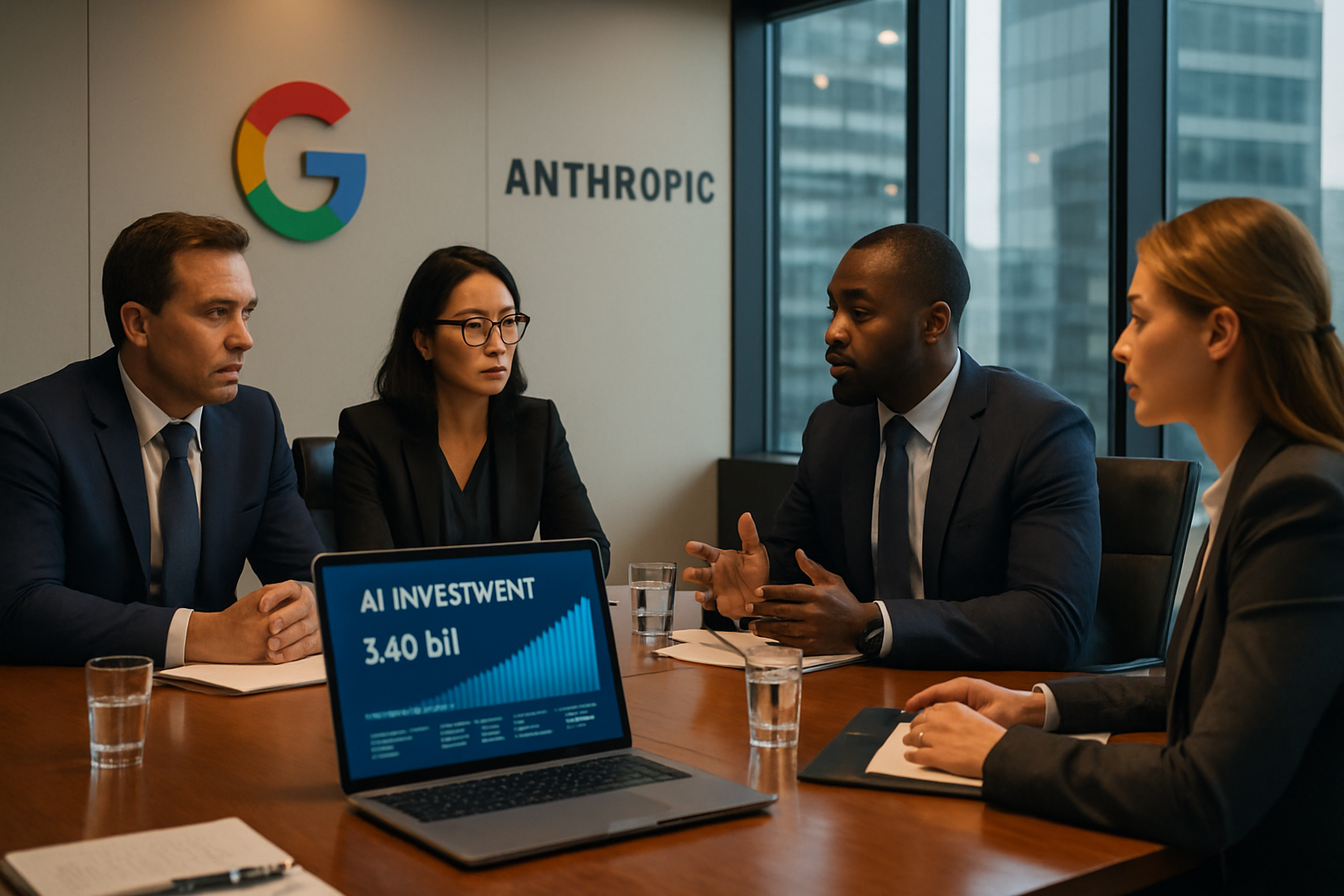
Google-parent Alphabet has announced plans to invest up to $40 billion in artificial intelligence company Anthropic, marking the largest single corporate AI investment in history as the tech giant deepens its partnership with the creator of Claude AI amid intensifying global competition.
The massive commitment includes an immediate $10 billion cash injection at a $350 billion valuation, with an additional $30 billion contingent on performance milestones. The investment will support a major expansion of Anthropic's computing capacity and AI development capabilities during what industry experts call a "civilizational choice point" for artificial intelligence.
Strategic Partnership Amid Market Upheaval
The announcement comes just days after Amazon revealed its own $25 billion investment in Anthropic, bringing the total potential backing for the AI safety-focused company to over $65 billion. This surge in investment underscores the extraordinary demand for advanced AI capabilities as companies race to secure partnerships with leading AI developers.
According to Bloomberg's reporting, Anthropic has experienced a sharp uptick in demand throughout 2026, with the company's annual run-rate revenue surpassing $30 billion this month, up dramatically from approximately $9 billion at the end of 2025. This represents a more than three-fold increase in just four months, reflecting the rapid adoption of AI technologies across industries.
"This partnership represents our commitment to ensuring AI serves human welfare while maintaining the highest safety standards," stated an Alphabet spokesperson in response to the investment announcement.
— Alphabet Corporate Communications
Investment Amid Global AI Infrastructure Crisis
The record investment occurs during an unprecedented global semiconductor crisis that has seen memory chip prices surge sixfold, affecting major manufacturers including Samsung, SK Hynix, and Micron. The shortage, expected to continue until 2027 when new fabrication facilities come online, has created significant bottlenecks in AI development infrastructure.
Despite these constraints, tech giants continue making massive investments. Google's $40 billion commitment to Anthropic adds to Alphabet's already record-breaking $185 billion AI infrastructure investment for 2026, while Amazon has outlined over $1 trillion in AI development plans for the coming decade.
The infrastructure crisis has paradoxically spurred innovation in memory-efficient algorithms and sustainable deployment strategies, potentially democratizing AI access for smaller companies and developing nations. This constraint-driven innovation is forcing the industry to maximize capabilities while minimizing hardware requirements.
Regulatory Landscape and International Competition
Google's investment comes amid intensifying global AI regulation. Spain has implemented the world's first criminal executive liability framework for tech platforms, while France has conducted AI company cybercrime raids. The United Nations has established an Independent Scientific Panel with 40 experts under Secretary-General António Guterres, representing the first fully independent global AI assessment body.
The regulatory environment has created particular challenges for Anthropic, which faces Pentagon pressure over military applications of its Claude AI system. The company has maintained strict safety restrictions, refusing to allow unrestricted military use for surveillance or autonomous weapons applications, despite risking over $200 million in federal contracts.
This stance contrasts sharply with competitors like OpenAI, which has embraced Pentagon partnerships and serves over 800 million weekly military users through ChatGPT integration on classified networks.
Market Transformation and Employment Impact
The AI investment surge occurs during what analysts term the "SaaSpocalypse" - a systematic disruption of traditional software business models that has eliminated hundreds of billions in market capitalization. AI systems are increasingly demonstrating the ability to directly replace rather than merely complement conventional software solutions.
Employment predictions have become increasingly dire, with Microsoft's Mustafa Suleyman forecasting that AI will replace the majority of office workers within two years, and lawyers and auditors within 18 months. However, regional variations show different adaptation strategies, with Indian IT giants like Infosys, Wipro, and HCL implementing comprehensive transition programs rather than mass layoffs.
Successful Human-AI Integration Models
Despite concerns about job displacement, successful integration models are emerging globally. Canadian universities have implemented AI teaching assistants that maintain critical thinking standards, while Malaysia operates the world's first AI-integrated Islamic school combining technology with traditional learning approaches.
Singapore's WonderBot 2.0 heritage education program has demonstrated how AI can enhance cultural preservation efforts. These success stories share common characteristics: treating AI as amplification tools rather than replacement mechanisms, maintaining commitment to human development, and ensuring cultural sensitivity in implementation.
Global Competition and Technological Sovereignty
Google's investment reflects the increasingly multipolar nature of AI development. Chinese companies, led by breakthroughs from DeepSeek and other firms, have challenged US technological dominance despite semiconductor export restrictions. European initiatives, including Deutsche Telekom's Industrial AI Cloud in Munich, represent sovereignty efforts to reduce dependence on US platforms.
The Global South has also emerged as a significant player, with India's AI Impact Summit positioning developing nations as equal governance partners rather than passive technology recipients. The Delhi Declaration, signed by 88 countries, represents the largest AI diplomatic agreement in history.
Environmental and Infrastructure Implications
The massive scale of AI investments raises significant environmental questions. The World Bank projects that AI water demand could reach 4.2-6.6 billion cubic meters annually by 2027 for data center cooling - equivalent to four to six times Denmark's total water consumption.
This environmental pressure is driving investment in renewable energy and more efficient computing architectures. Companies are being forced to balance computational power requirements with sustainability commitments, leading to innovations in green data center design and energy management.
Looking Ahead: Civilizational Choice Point
Industry experts identify April 2026 as a critical "civilizational choice point" - a moment that will determine whether AI serves human flourishing and democratic values or becomes a tool for surveillance and control. The decisions made by companies like Google and Anthropic in the coming months will establish patterns for human-AI relationships that could persist for decades.
The success of these massive investments will depend on unprecedented coordination between governments, technology companies, educational institutions, and civil society. The challenge involves balancing innovation acceleration with safety governance, commercial interests with human welfare, and national competitiveness with international cooperation.
As the window for coordinated action narrows, the stakes extend beyond technological efficiency to fundamental questions about how societies organize around human welfare versus technological metrics in an AI-integrated age. Google's $40 billion bet on Anthropic represents not just a business investment, but a wager on the future of human-AI collaboration.
"We are at a moment where the decisions we make about AI will echo through generations. Our responsibility is to ensure that this technology amplifies human capabilities while preserving the creativity, cultural understanding, and ethical reasoning that define our potential as a species."
— Technology Policy Expert, speaking anonymously
The outcome of Google's partnership with Anthropic, set against the backdrop of global competition, regulatory pressure, and infrastructure constraints, will likely serve as a template for how democratic societies navigate the transition from experimental AI to essential technological infrastructure while preserving human agency and values.