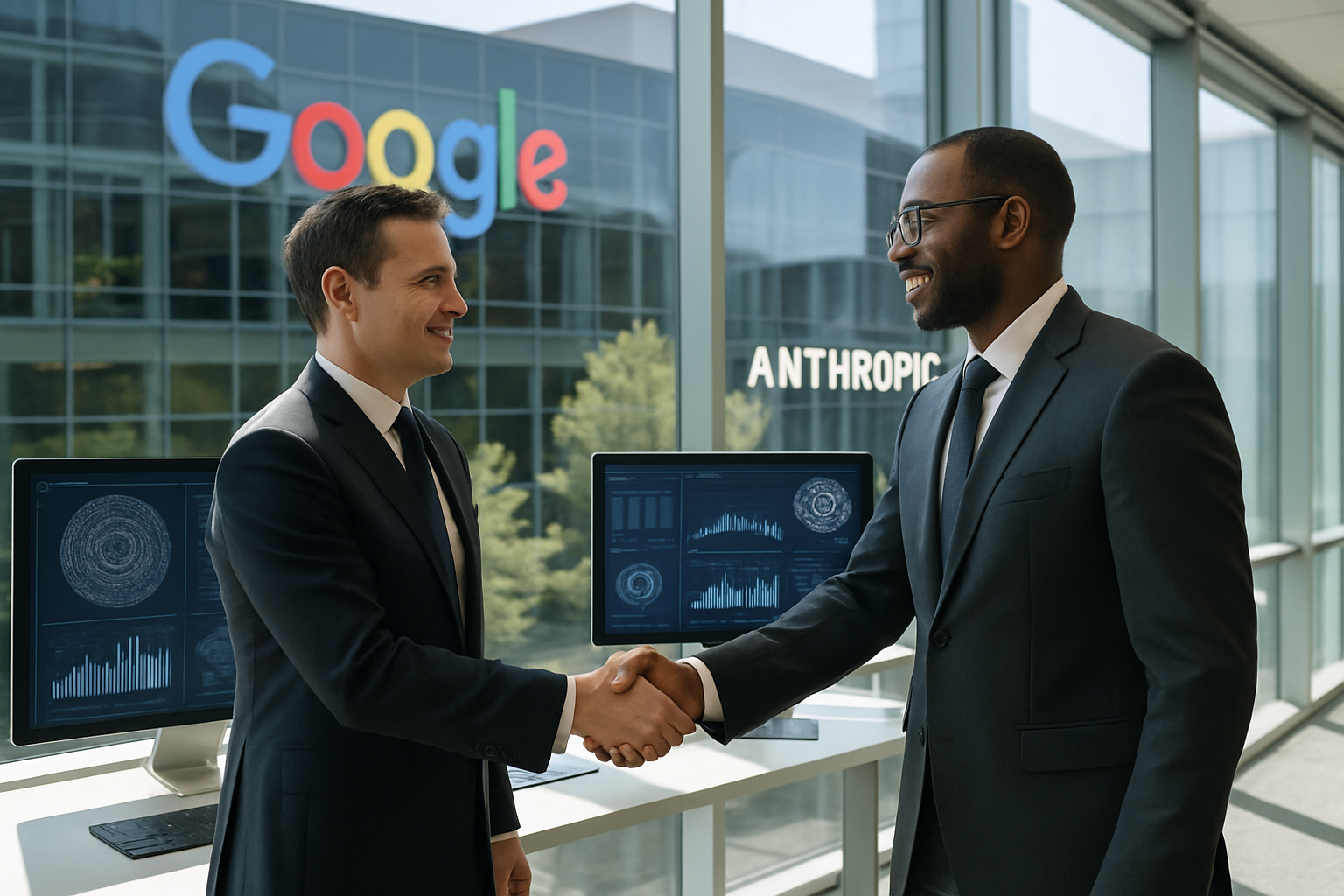
Google has announced a landmark $40 billion investment in Anthropic, the AI safety-focused company behind Claude, representing the largest single corporate artificial intelligence investment in history and fundamentally altering the competitive landscape of AI development.
The massive commitment from Google's parent company Alphabet significantly expands upon Amazon's existing $25 billion investment in Anthropic, bringing the AI company's total external funding to over $65 billion during what industry experts characterize as a critical "civilizational choice point" for artificial intelligence development.
Breaking Investment Records
This unprecedented financial commitment dwarfs previous corporate AI investments and signals Google's determination to maintain leadership in the rapidly evolving artificial intelligence sector. The investment comes as part of Alphabet's broader $185 billion AI infrastructure commitment for 2026, itself the largest single-year technology investment in corporate history.
The timing is particularly significant as the AI industry faces what analysts call the "SaaSpocalypse" – the systematic destruction of traditional software-as-a-service business models that has already eliminated hundreds of billions in market value since February 2026.
Strategic Implications
Anthropic, founded with a focus on AI safety, has emerged as a critical player in the artificial intelligence ecosystem with its Claude AI system. The company has maintained distinctive safety-first principles, recently resisting Pentagon demands for unrestricted military access to its AI capabilities despite $200 million in federal contracts being at stake.
"The roles people play are shifting fundamentally across all sectors as AI transitions from experimental to essential infrastructure."
— Industry Analysis, 2026 AI Transformation Report
The investment positions Google strategically amid intensifying global competition in AI development. Chinese companies, led by breakthroughs from DeepSeek and other domestic players, have captured global AI leadership positions for the first time in 2026, ending years of US market dominance.
Infrastructure Crisis Driving Innovation
The massive investment comes despite ongoing global semiconductor constraints that have driven memory chip prices to surge sixfold, affecting major manufacturers Samsung, SK Hynix, and Micron. Industry experts note that these infrastructure challenges are paradoxically spurring innovation in memory-efficient algorithms and sustainable deployment strategies.
The World Bank projects that AI systems will require 4.2-6.6 billion cubic meters of water annually by 2027 for data center cooling alone – equivalent to four to six times Denmark's total annual water consumption. This environmental challenge is driving significant investment in renewable energy and efficient cooling technologies.
Regulatory Landscape Intensifies
The Google-Anthropic partnership unfolds amid unprecedented global regulatory intensification in AI governance. Spain has implemented the world's first criminal executive liability framework for tech platforms, creating potential imprisonment risks for executives. France has conducted AI company cybercrime raids, while the European Union investigates potential billion-dollar penalties under the Digital Services Act.
The United Nations has established an Independent Scientific Panel of 40 experts under Secretary-General António Guterres, representing the first fully independent international AI assessment body and the most sophisticated global technology governance framework since internet commercialization.
Employment Transformation Accelerates
Microsoft's AI chief Mustafa Suleyman's predictions of majority office worker replacement within two years are gaining credibility as AI systems demonstrate direct replacement rather than complementary capabilities across multiple industries. The partnership between Google and Anthropic could accelerate these workforce transformation patterns.
However, successful integration models from Canada (AI teaching assistants maintaining critical thinking), Malaysia (world's first AI-integrated Islamic school), and Singapore (WonderBot 2.0 heritage education) demonstrate that human-AI collaboration approaches consistently outperform wholesale replacement strategies.
Global AI Competition Intensifies
The investment reflects broader patterns of massive corporate commitment to AI development despite infrastructure constraints. Amazon has outlined $1+ trillion AI development plans over the coming decade, while Chinese companies like Unitree Robotics have scaled production from 5,500 to over 20,000 humanoid robots in 2026 alone.
European initiatives, including Deutsche Telekom's Munich AI Cloud for digital sovereignty and Austria's establishment of the continent's first AI-powered environmental research lab, represent coordinated efforts to maintain technological competitiveness while preserving democratic values.
Critical Choice Point
Industry experts consistently characterize April 2026 as a "civilizational choice point" determining whether artificial intelligence serves human flourishing and democratic values or becomes an exploitation tool beyond democratic accountability.
The Google-Anthropic partnership's success will likely depend on navigating this complex landscape while balancing innovation acceleration with safety governance, commercial interests with human welfare, and national competitiveness with international cooperation.
"Success requires unprecedented coordination between governments, companies, institutions, and civil society to ensure AI serves humanity's highest aspirations while preserving the creativity, empathy, and wisdom that define human potential."
— AI Governance Research Institute, 2026
Looking Forward
The partnership positions both companies to shape the trajectory of AI development during this critical transition period from experimental technology to essential infrastructure. With Anthropic's emphasis on safety-first principles and Google's vast technical resources and global reach, the collaboration could establish important precedents for responsible AI development at scale.
As artificial intelligence capabilities advance faster than governance frameworks, the decisions made by partnerships like Google-Anthropic in 2026 will establish decades-long patterns for human-AI relationships affecting billions of people globally. The challenge remains ensuring that technological transformation serves human welfare while maintaining the distinctly human qualities that artificial intelligence cannot replicate – wisdom, cultural understanding, and ethical reasoning that provide meaning to human experience.