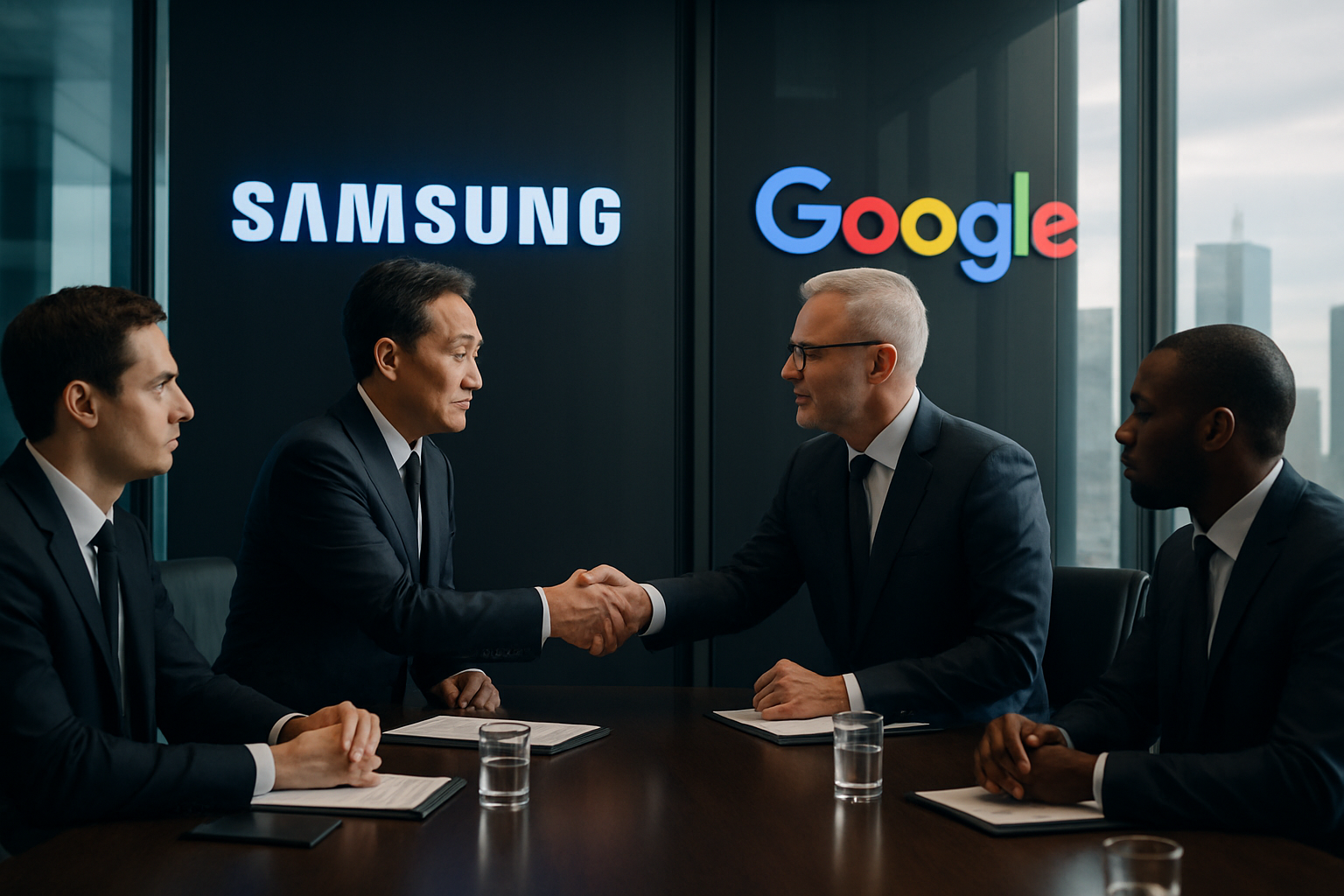
Samsung Electronics has named Google among its top five customers for the first time in 2025, marking a significant milestone that highlights the rapid expansion of global AI infrastructure and its increasing dependence on advanced memory chips.
The elevation of Google to Samsung's elite customer roster represents a dramatic shift in the technology industry's supply chains, driven by the extraordinary demand for high-bandwidth memory (HBM) and other advanced semiconductors essential for artificial intelligence development and deployment.
AI Infrastructure Drives Memory Crisis
This development occurs against the backdrop of an unprecedented global memory semiconductor crisis that has seen prices surge sixfold throughout 2025 and into 2026. Memory manufacturers Samsung, SK Hynix, and Micron are operating at full capacity but remain unable to meet the explosive demand from AI training facilities and data center operations.
The shortage has affected consumer electronics pricing, with costs increasing 20-30% over the past year. Industry experts expect the crisis to persist until 2027, when new fabrication facilities come online after their typical 18-24 month construction cycles.
"The rapid expansion of global AI infrastructure is increasingly dependent on advanced memory chips, creating unprecedented demand across the technology sector."
— Industry Analysis, Korean Media Reports
Google's Strategic AI Investments
Google's emergence as a major Samsung customer reflects the company's massive commitment to AI infrastructure development. Alphabet, Google's parent company, announced a historic $185 billion investment in AI infrastructure for 2026 — representing the largest single-year corporate technology investment in history.
This investment encompasses advanced data centers, high-performance computing systems, and specialized AI hardware across multiple regions. The company's Gemini AI platform and other AI initiatives require enormous computational resources, driving demand for Samsung's cutting-edge memory solutions including HBM4 technology.
The strategic partnership extends beyond simple procurement to encompass co-design strategies that enable faster innovation cycles and provide competitive advantages over alternatives dependent on third-party suppliers.
Market Transformation and Competition
Google's inclusion in Samsung's top-tier customer list coincides with what industry analysts have termed the "SaaSpocalypse" — a massive market disruption that has eliminated hundreds of billions in traditional software market capitalization as AI systems demonstrate direct replacement capabilities for conventional solutions.
This transformation represents a fundamental shift from software-as-a-service models to AI-based alternatives offering more sophisticated, responsive, and cost-effective solutions across multiple business sectors.
The relationship also positions both companies advantageously in the intensifying global competition for AI dominance, particularly as Chinese companies like DeepSeek have achieved breakthrough developments that challenge Western technological assumptions.
Infrastructure Challenges and Innovation
The global semiconductor crisis has paradoxically spurred innovation in memory-efficient algorithms, hybrid processing approaches, and alternative computing architectures. Companies are developing creative deployment strategies that maximize AI capabilities while minimizing hardware requirements.
Samsung's vertical integration advantages — encompassing semiconductors, displays, and manufacturing — provide crucial competitive positioning during the current supply constraints. The company's accelerated HBM4 production timeline could provide industry relief months ahead of schedule for AI infrastructure investments.
Despite infrastructure constraints, major technology companies continue unprecedented investments. Amazon has committed over $1 trillion to AI development plans, while OpenAI recently achieved an $840 billion valuation through record funding from Amazon, Nvidia, and SoftBank.
Regulatory and Environmental Context
The Google-Samsung partnership develops amid intensifying global regulatory oversight of AI development. Spain has implemented the world's first criminal executive liability framework for technology platforms, while France has conducted cybercrime raids on AI companies. The United Nations has established an Independent Scientific Panel with 40 experts as the first fully independent global AI assessment body.
Environmental concerns also mount as the World Bank projects AI water demand of 4.2-6.6 billion cubic meters annually by 2027 for data center cooling — equivalent to four to six times Denmark's annual water consumption. These challenges require sustainable approaches balancing technological advancement with environmental responsibility.
Strategic Implications
The elevation of Google to Samsung's top customer tier reflects the critical transition of AI from experimental technology to essential business infrastructure across all sectors. This relationship exemplifies how the AI revolution is reshaping traditional supplier-customer dynamics and creating new strategic partnerships.
Success in this transformed landscape requires unprecedented coordination between governments, technology companies, educational institutions, and civil society. The challenge involves balancing innovation acceleration with safety governance, commercial interests with human welfare, and national competitiveness with international cooperation.
Industry experts characterize March 2026 as a critical inflection point that will determine whether AI fulfills its transformative promise or creates systemic societal disruption requiring major corrections. The decisions made by partnerships like Google-Samsung will echo through decades, determining the trajectory of human-AI relationships for the remainder of the 21st century.
The Google-Samsung relationship represents more than a customer-supplier dynamic — it exemplifies the fundamental restructuring of the global technology industry as artificial intelligence transitions from experimental applications to the essential infrastructure foundation of the modern economy.