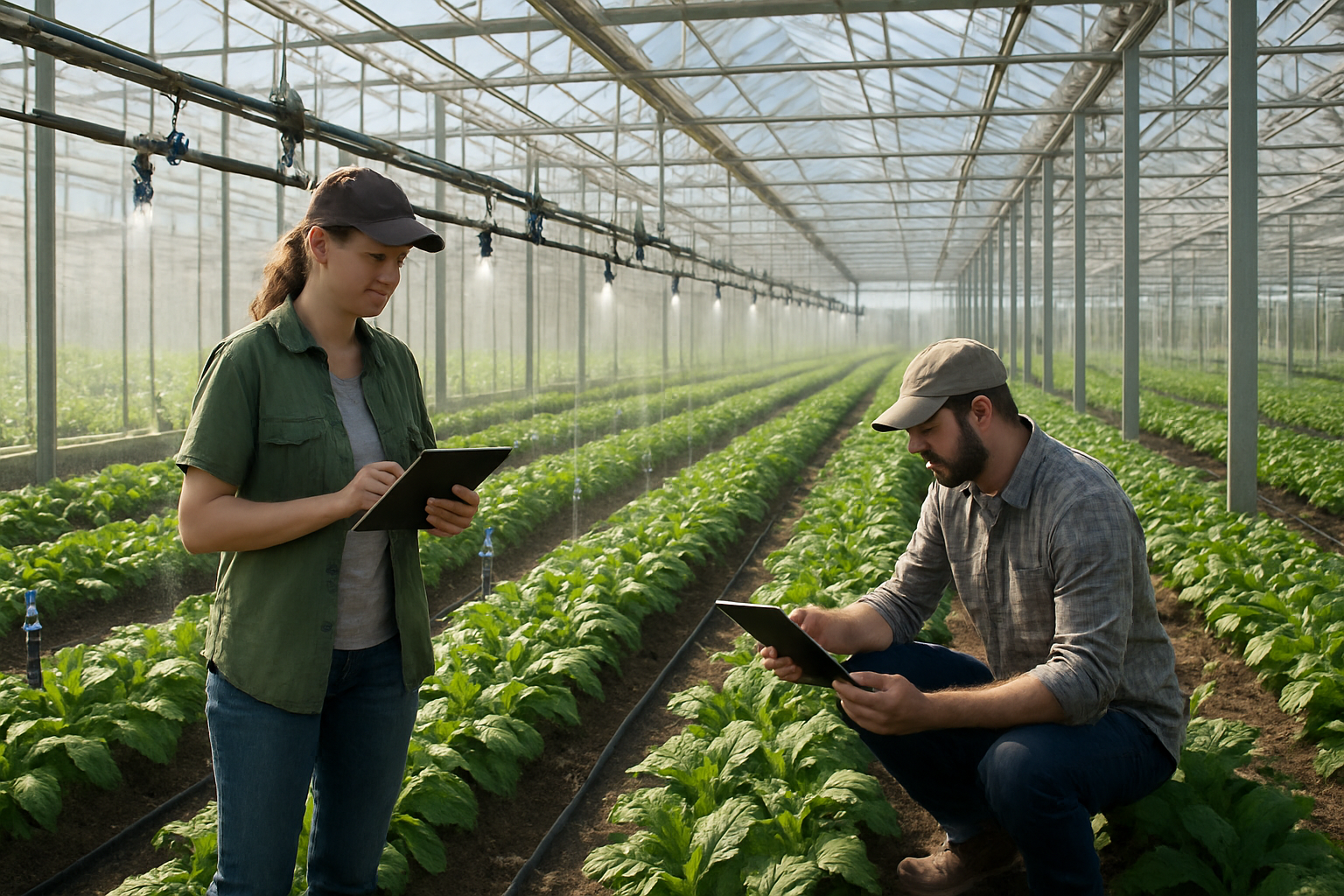
Two nations separated by continents but united by agricultural innovation are reshaping the global food landscape as Greece's cutting-edge greenhouse investment program attracts unprecedented funding while Guyana transforms traditional tomato processing through strategic institutional partnerships.
The convergence of these developments during March 2026 represents a critical moment in global agricultural transformation, occurring as Earth experiences its 20th consecutive month of temperatures exceeding 1.5°C above pre-industrial levels—a sustained warming period that demands immediate agricultural adaptation.
Greece's Greenhouse Revolution: €540 Million Investment Surge
Piraeus Bank's ambitious greenhouse investment program has captured remarkable market enthusiasm, according to data presented at the 31st International Agrotica Exhibition in Thessaloniki. The bank's General Manager of Agricultural Development confirmed that investment interest has exceeded all projections, with total committed funding reaching €540 million across multiple greenhouse projects throughout Greece.
This extraordinary financial commitment represents the largest single agricultural infrastructure investment in modern Greek history, positioning the nation at the forefront of European precision agriculture. The program specifically targets greenhouse operations that combine traditional Mediterranean farming wisdom with cutting-edge climate-controlled technology.
"The response from both commercial farmers and agricultural cooperatives has been unprecedented. We're seeing a fundamental shift toward technology-enabled farming that maintains Greece's agricultural heritage while adapting to climate realities."
— Tarek Suleiman, Piraeus Bank Agricultural Sector Manager
The greenhouse investments incorporate advanced features including automated irrigation systems, digital monitoring of plant health, precise climate control, and energy-efficient LED growing systems. These facilities enable year-round production of premium vegetables and fruits regardless of external weather conditions—a crucial capability as traditional Mediterranean growing seasons face increasing unpredictability.
Guyana's Tomato Innovation: From Research to Commercial Production
Meanwhile, in South America, Guyana demonstrates how strategic institutional partnerships can revitalize traditional food processing. The Institute of Applied Sciences and Technology (IAST) recently ceased its sun-dried tomato ketchup production, but this transition marks evolution rather than abandonment. The National Agricultural Research and Extension Institute (NAREI) has assumed leadership of the entire project with enhanced production arrangements.
This institutional handover represents sophisticated agricultural planning that leverages specialized expertise. NAREI's expanded mandate includes scaling production capacity, improving quality control systems, and developing international market opportunities for Guyanese sun-dried tomato products.
The transition reflects Guyana's broader agricultural transformation strategy, which has established the nation as the Caribbean's leading food security provider. Since 2020, Guyana has successfully repositioned from a food-import dependent country to a regional agricultural powerhouse through strategic investments in both traditional crops and value-added processing.
Technology-Tradition Integration: The New Agricultural Paradigm
Both initiatives exemplify what agricultural experts term "technology-tradition synthesis"—the sophisticated integration of cutting-edge innovation with generations of farming wisdom. This approach has emerged as the most successful model for agricultural adaptation during unprecedented climate pressures.
Greece's greenhouse program respects traditional Mediterranean cultivation techniques while incorporating precision agriculture, advanced irrigation, and digital monitoring systems. The facilities maintain the essence of Greek agricultural heritage while providing protection against extreme weather events that increasingly disrupt outdoor farming.
Similarly, Guyana's tomato processing evolution preserves traditional sun-drying methods that concentrate flavors naturally while introducing modern quality control, packaging, and distribution systems necessary for international competitiveness.
South-South Cooperation: A New Development Model
These agricultural advances occur within a broader pattern of developing nations sharing expertise through peer partnerships rather than traditional North-South aid relationships. This "South-South cooperation" model has proven more culturally appropriate and economically sustainable than conventional development assistance.
Guyana's success has attracted attention from fellow Caribbean nations seeking food security solutions, while Greece's greenhouse innovations are being studied by Mediterranean countries facing similar climate adaptation challenges. Both nations demonstrate that innovative agricultural development can originate from any region, challenging assumptions about global technology transfer patterns.
The African Continental Free Trade Agreement (AfCFTA) has enabled similar agricultural partnerships across national boundaries, creating shared value chains and collective responses to food security challenges that individual nations cannot address independently.
Economic Multiplier Effects: Beyond Farm-Level Success
These agricultural initiatives function as comprehensive economic engines extending far beyond immediate farm improvements. Greece's greenhouse program creates sustainable employment in construction, technology installation, maintenance services, and specialized agriculture, while generating substantial export opportunities for premium produce.
Guyana's tomato processing expansion similarly generates economic multiplier effects through rural employment, transportation networks, processing capabilities, and international trade opportunities. The NAREI facility supports an entire ecosystem of farmers, logistics providers, packaging specialists, and marketing professionals.
Economic analyses demonstrate that such comprehensive agricultural development provides measurable benefits through improved food security, reduced import dependency, enhanced export earnings, and rural poverty reduction. Countries implementing these integrated approaches report better economic resilience and enhanced competitiveness in international markets.
Climate Adaptation: Necessity Drives Innovation
The urgency driving these agricultural innovations cannot be overstated. The current 20-month streak of temperatures above 1.5°C represents the longest sustained warming period in recorded human history, fundamentally altering traditional farming cycles worldwide.
Greece's controlled environment agriculture provides essential protection against the increasing frequency of extreme heat events, irregular precipitation, and severe storms that threaten Mediterranean agriculture. The country's investment in climate-controlled facilities ensures continued food production even as outdoor conditions become increasingly unpredictable.
Guyana's enhanced tomato processing capabilities address similar challenges in the Caribbean, where climate change affects traditional growing seasons and creates pressure for more efficient food preservation and processing methods.
Implementation Challenges and Success Factors
Despite impressive results, both initiatives face significant implementation challenges common to agricultural transformation projects worldwide. Funding sustainability remains a critical concern, particularly for developing nations where immediate economic pressures can override long-term environmental considerations.
Technical capacity building requires sustained investment in education, training, and institutional development beyond initial technology deployment. Climate change continues to disrupt project timelines, requiring adaptive management approaches that can respond rapidly to changing conditions.
- Community ownership: Local stakeholder involvement ensures projects serve actual needs
- International cooperation: Peer partnerships provide technical expertise and market access
- Economic viability: Projects must generate tangible benefits for long-term sustainability
- Transparent governance: Clear management prevents corruption and ensures effective implementation
- Sustained political commitment: Government support must transcend electoral cycles
Global Scaling Potential: Templates for Worldwide Adaptation
The success of Greece's greenhouse program and Guyana's tomato processing transition provides practical templates for scaling similar interventions globally. These models demonstrate that agricultural innovation can emerge from diverse contexts while maintaining effectiveness principles that ensure community benefit.
Cyprus is already exploring similar greenhouse investments following Greece's success, while several Caribbean nations are studying Guyana's institutional approach to agricultural product development. The European Union has expressed interest in supporting greenhouse technology transfer to Mediterranean member states facing climate pressures.
African nations participating in continental integration initiatives see potential applications for both controlled environment agriculture and strategic food processing partnerships. The success factors identified—community ownership, international cooperation, technology-tradition integration—appear adaptable across diverse geographic and cultural contexts.
Strategic Implications for Global Food Security
March 2026 represents a critical juncture for global food security, demonstrating both the urgent challenges facing agricultural systems and the remarkable human capacity for innovative responses. The window for building resilient, equitable food systems continues narrowing as climate pressures intensify, making current agricultural innovations crucial for worldwide planning.
The convergence of Greece's technological advancement and Guyana's institutional cooperation illustrates that effective agricultural development requires diverse complementary approaches rather than singular solutions. Countries can leverage their specific advantages—whether financial resources, institutional capacity, or traditional knowledge—to contribute meaningfully to global food security.
"We're witnessing a fundamental transformation in how nations approach agricultural development. The combination of local innovation with international cooperation offers hope for maintaining food security while adapting to climate change."
— Dr. Zulfikar Mustapha, Guyana Minister of Agriculture
Success in scaling these innovations globally will determine whether agricultural systems can keep pace with accelerating environmental change while serving growing populations during this critical climate action decade. The tools, knowledge, and cooperation frameworks exist for comprehensive responses, but success depends on sustained political commitment, adequate funding, and coordination between immediate crisis response and long-term resilience building.
As Greece and Guyana demonstrate, the future of agriculture lies not in choosing between tradition and innovation, but in thoughtfully integrating both to create resilient food systems that serve communities while protecting the ecological foundations upon which all agriculture ultimately depends.