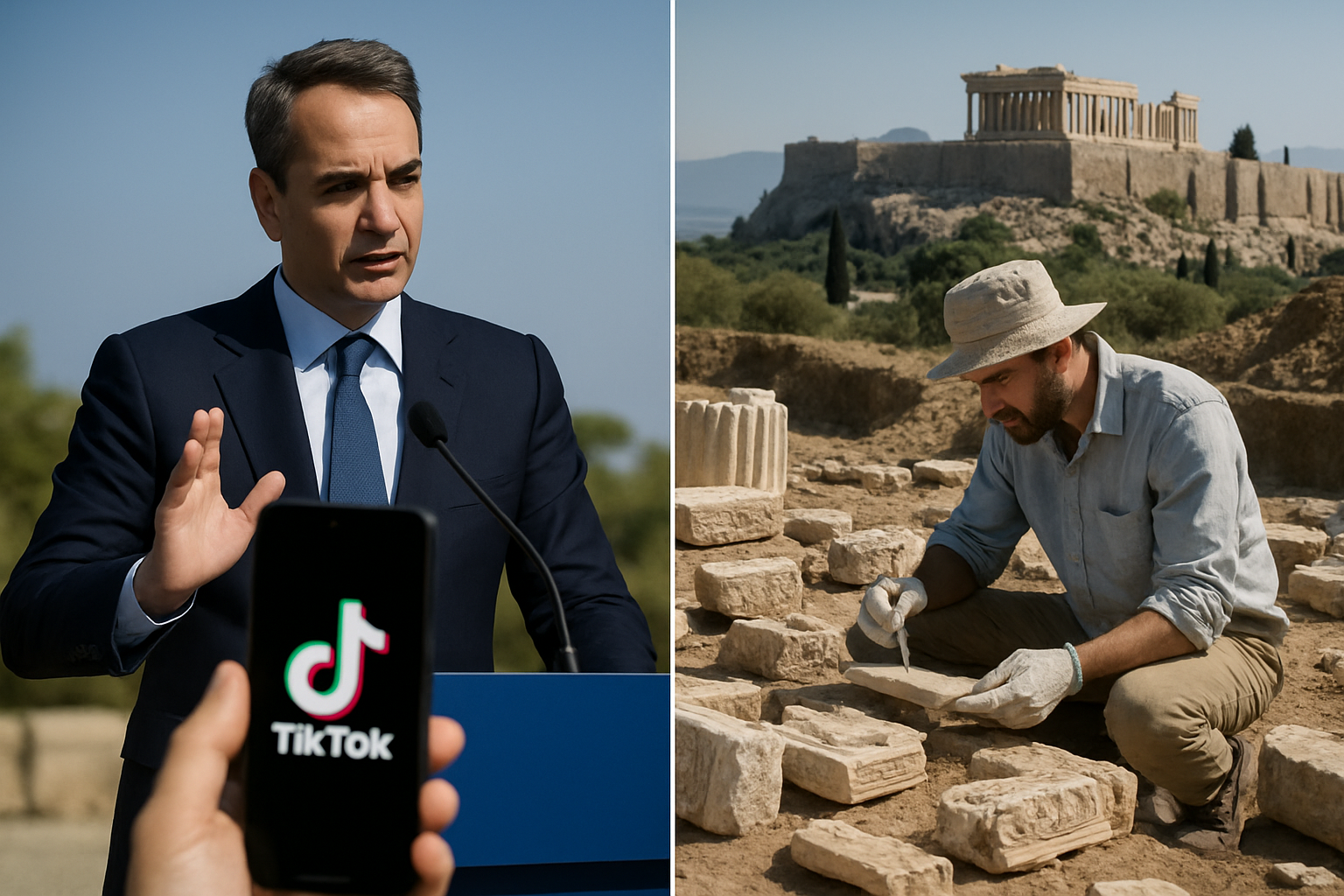
Greek political and archaeological developments converged this weekend as PASOK President Nikos Androulakis launched his TikTok presence while researchers announced the discovery of a marble fragment from the historic Mentor shipwreck containing Lord Elgin's controversial collection.
The dual developments highlight Greece's ongoing engagement with both digital democracy and cultural heritage preservation, occurring amid the country's broader political renaissance and archaeological research initiatives.
Political Digital Engagement
PASOK President Nikos Androulakis announced his entry onto TikTok with the message "174.813 έκαναν την αρχή – Την Ελλάδα που αξίζουμε, θα την κερδίσουμε μαζί" (174,813 made the beginning – The Greece we deserve, we will win together). The move represents a significant digital strategy shift for the center-left party, acknowledging social media's crucial role in modern democratic engagement.
Androulakis emphasized the strong member participation in recent party elections for selecting congress delegates, positioning this democratic involvement as the foundation for broader political change. His TikTok debut comes during a period of political messaging focused on unity and renewal within Greek politics.
The timing coincides with global debates over social media regulation and youth protection, as European nations including Greece have been considering restrictions on platform access for minors. Greece's "Kids Wallet" initiative has been described as bringing the country "very close" to implementing under-15 social media restrictions, part of a coordinated European response to platform accountability concerns.
Archaeological Breakthrough
Simultaneously, Greek archaeologists announced the discovery of a marble fragment from the Mentor shipwreck, representing the first sculptural decoration piece recovered from Lord Elgin's controversial cargo. The British brig Mentor sank off Kythira in 1802 while transporting artifacts from the Parthenon and other ancient Greek monuments to Britain.
The discovery provides new evidence of the extensive collection removed from Greece during the early 19th century, adding to ongoing international debates over cultural heritage repatriation. The marble fragment offers researchers unprecedented insight into the scope and nature of artifacts that were being transported when the ship encountered its fatal storm.
Archaeological investigations of the Mentor wreck have been ongoing for decades, but this marks the first recovery of sculptural material directly connected to the Parthenon collection. The discovery utilizes advanced underwater archaeology techniques and international cooperation in heritage preservation.
Cultural and Political Significance
The juxtaposition of Androulakis's TikTok launch with the archaeological discovery reflects Greece's complex relationship with both historical legacy and contemporary digital culture. The country continues to advocate for the return of the Parthenon Marbles while simultaneously engaging with modern platforms that reach younger demographics.
From memory, Greece has been actively involved in recent diplomatic breakthroughs with Turkey, including the February 11, 2026 comprehensive cooperation agreements that addressed cultural and educational exchanges alongside economic development frameworks. These diplomatic successes provide context for Greece's broader international cultural positioning.
"174,813 made the beginning – The Greece we deserve, we will win together"
— Nikos Androulakis, PASOK President
The political messaging emphasizes democratic participation and collective action, themes that resonate with Greece's ongoing efforts to strengthen democratic institutions and engage younger voters through digital platforms.
International Context
The archaeological discovery occurs within a broader context of international cultural heritage discussions. Museums worldwide have increasingly engaged in repatriation efforts, with institutions like the Metropolitan Museum returning artifacts to origin countries. The Mentor fragment adds tangible evidence to longstanding Greek arguments for the return of cultural materials.
Meanwhile, Androulakis's social media strategy reflects political adaptation to digital engagement requirements, even as European governments grapple with platform regulation. Greece's approach balances democratic participation through social media with concerns about youth protection and platform accountability.
Research and Democratic Implications
The Mentor discovery demonstrates the continuing value of archaeological research in understanding historical cultural exchange and appropriation. Advanced underwater excavation techniques and international scholarly cooperation have enabled recovery of materials that provide new perspectives on 19th-century collecting practices.
The political development shows Greek democratic institutions adapting to contemporary communication requirements while maintaining focus on substantive policy issues and democratic engagement. PASOK's digital strategy represents broader European political adaptation to social media platforms despite ongoing regulatory discussions.
Future Implications
Both developments reflect Greece's positioning as a nation balancing historical legacy with contemporary engagement. The archaeological discovery strengthens cultural heritage arguments while contributing to international scholarship on ancient Greek art and 19th-century collecting practices.
Androulakis's TikTok presence indicates Greek political parties' recognition of social media's importance for democratic communication, particularly with younger voters. This occurs as Greece participates in broader European discussions about platform regulation and youth protection measures.
The convergence of these cultural and political developments illustrates Greece's multifaceted approach to heritage preservation, democratic engagement, and international cooperation. Both the archaeological research and political communication strategies demonstrate institutional commitment to both historical understanding and contemporary democratic participation.