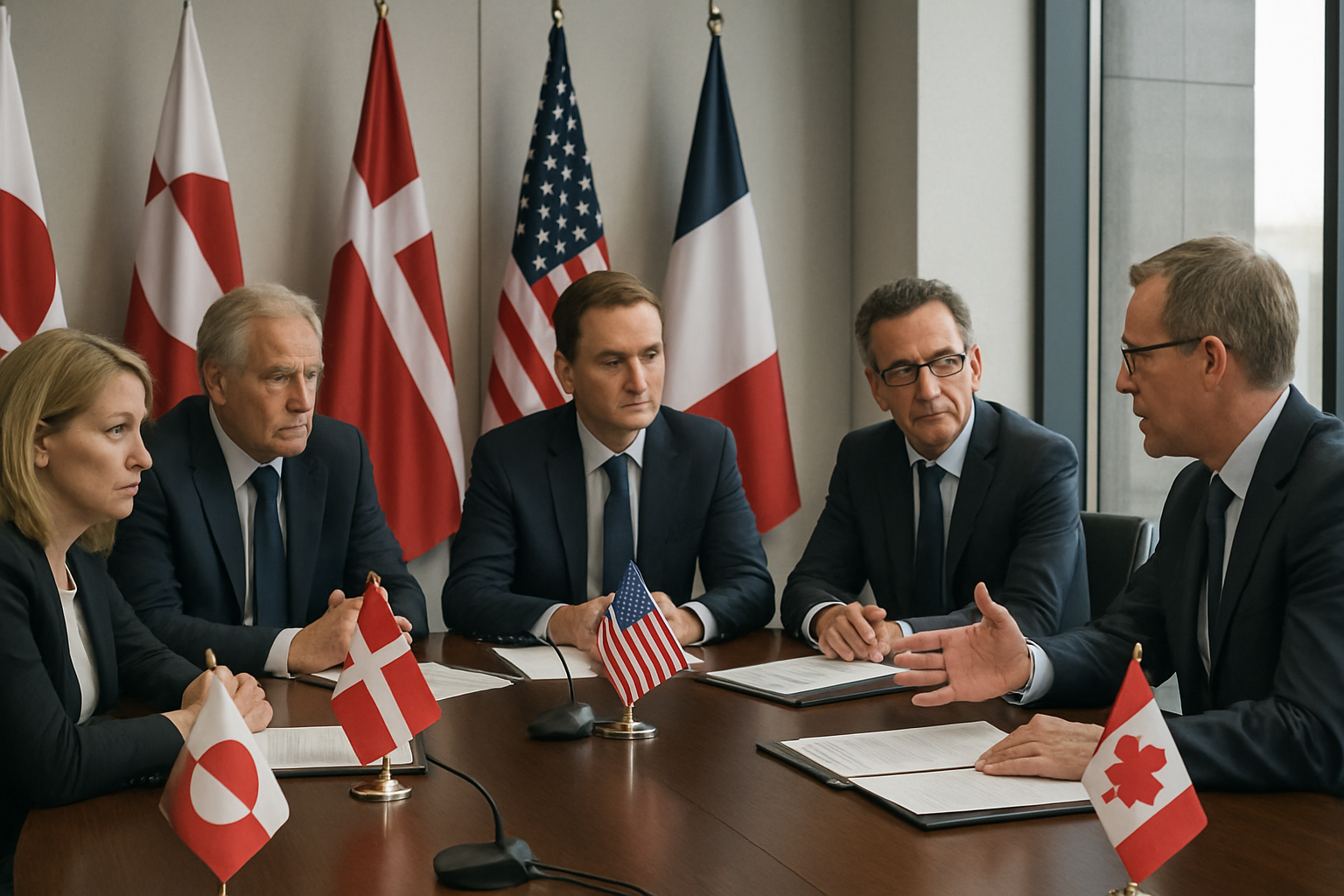
Denmark's Foreign Minister Lars Løkke Rasmussen acknowledged Saturday that while his country is now in a "better position" regarding US President Donald Trump's territorial ambitions for Greenland, the diplomatic crisis remains far from resolved as international negotiations continue with uncertain outcomes.
Speaking from Nuuk, Greenland's capital, alongside Greenlandic Foreign Minister Vivian Motzfeldt, Rasmussen emphasized that "we are not out of the crisis, and we do not have a solution yet," though he noted significant improvement compared to "a few weeks ago." The Danish official confirmed there are currently "no threats on the table, there is no trade war with Europe," and all parties have agreed to pursue resolution through "normal diplomatic channels."
Ongoing Negotiations Yield Limited Progress
Greenlandic Foreign Minister Vivian Motzfeldt described the continuing talks with the United States as a "positive sign," but cautioned that results remain "far from expected" and it remains "too early to say" how negotiations will conclude. The diplomatic discussions follow working group meetings that began January 28, 2026, between US and Greenlandic representatives, marking the Trump administration's renewed push for territorial acquisition.
Prime Minister Jens-Frederik Nielsen has consistently maintained that "Greenland is neither for sale nor for purchase" while engaging cautiously with US officials. The autonomous Danish territory's strategic position has become increasingly valuable due to Arctic shipping routes, rare earth mineral deposits, and military positioning in a region of growing international competition.
International Solidarity Demonstrations
In a coordinated show of diplomatic support, France and Canada simultaneously opened their first consulates in Nuuk on Friday, February 6, 2026. The symbolic timing represented direct opposition to Trump's territorial pressure campaign and demonstrated Western alliance unity in defending sovereignty principles.
Canadian Foreign Minister Anita Anand personally attended the opening with Indigenous Governor General Mary Simon, whose Inuit heritage provided cultural legitimacy to the initiative. A Canadian Inuit delegation reportedly delivered a blunt message to the Trump administration to "back off" from territorial claims. France inaugurated its consulate with General Consul Jean-Noël Poirier leading the ceremony.
The consulate openings enable enhanced cooperation on climate research, Arctic governance, sustainable development, and Indigenous rights preservation. While the French-Canadian citizen populations in Greenland remain minimal, the symbolic and strategic value of the diplomatic presence has proved significant in countering American resource extraction focus.
Strategic Stakes and Regional Implications
Greenland's importance extends far beyond its 56,000 inhabitants. The island territory controls crucial Arctic shipping routes that climate change is making increasingly accessible. Its vast mineral wealth includes rare earth elements essential for modern technology and green energy transitions. Additionally, the territory provides strategic military positioning in an Arctic region where Russia and China are expanding their presence.
Local residents in Nuuk have expressed significant concern about potential US actions, despite the absence of visible military presence or protests. The Greenlandic authorities have issued behavioral recommendations for emergency situations, reflecting deep anxiety about Washington's intentions despite Trump's moderated rhetoric in recent weeks.
Trump Administration's Evolving Approach
Since returning to the White House, Trump has insisted that Washington needs to control the Arctic island for national security reasons. His interest in Greenland dates to a 2019 purchase proposal that was firmly rejected by Denmark and Greenland. The current diplomatic approach represents an evolution from direct acquisition attempts to working group negotiations, though fundamental positions remain unchanged.
European sources indicate the Trump administration has backed off explicit threats of economic warfare or military pressure, instead focusing on diplomatic engagement. However, the underlying territorial ambitions persist, creating ongoing uncertainty about long-term US intentions.
International Law and Sovereignty Principles
The Greenland situation has broader implications for international law and territorial sovereignty principles in an era of great power competition. The coordinated European-Canadian response establishes precedents for collective diplomatic responses to unilateral territorial claims. Legal experts view the crisis as a test case for whether international law can effectively constrain major powers from pressuring smaller territories.
European Union officials privately support the French-Canadian consulate initiative as an appropriate sovereignty defense mechanism. The broader international community is monitoring developments for potential templates addressing territorial pressures in strategically important regions affected by climate change and resource competition.
Economic and Security Considerations
Beyond diplomatic considerations, the Greenland question involves substantial economic interests. The territory's untapped mineral resources could prove crucial for Western supply chain diversification away from Chinese-controlled rare earth deposits. Energy companies have identified significant offshore petroleum potential in Greenlandic waters.
Security analysts emphasize Greenland's strategic value for NATO's Arctic defense architecture. The existing Thule Air Base provides early warning capabilities and potential missile defense positioning. Climate change is opening new Arctic shipping routes that require monitoring and potential control for both commercial and security purposes.
Local Perspectives and Indigenous Rights
The Greenlandic population faces complex considerations balancing economic opportunities with sovereignty concerns. Many residents appreciate increased international attention and potential investment but strongly oppose external control over their territory. The indigenous Inuit population maintains cultural connections across Arctic regions, including Canadian Inuit communities that have voiced solidarity.
Local media in Greenland has covered the diplomatic crisis extensively, with polling showing overwhelming support for maintaining current autonomous status under Danish sovereignty rather than American acquisition. The population values its democratic institutions and gradual progress toward greater self-governance.
Future Diplomatic Trajectory
As negotiations continue, multiple scenarios remain possible. Optimistic observers hope for a comprehensive Arctic cooperation framework addressing security, environmental protection, and economic development without territorial transfers. More pessimistic assessments warn of prolonged diplomatic pressure potentially escalating to economic measures.
The international response has demonstrated that Denmark and Greenland will not face American pressure in isolation. The coordinated Western solidarity, combined with strong local opposition to territorial transfer, has strengthened the position of sovereignty defenders. However, the fundamental disagreement over territorial control remains unresolved.
Coming weeks will prove critical as diplomatic working groups continue their deliberations. Success requires unprecedented compromise addressing legitimate security concerns while respecting sovereignty principles. The outcome will likely establish important precedents for territorial disputes in an era where climate change is making previously inaccessible regions strategically valuable.
The Greenland crisis represents more than a bilateral US-Danish dispute—it has evolved into a multilateral test of international law, democratic solidarity, and Indigenous rights in the face of great power territorial ambitions. The resolution will significantly influence future Arctic governance and establish frameworks for addressing similar challenges in strategically important regions worldwide.