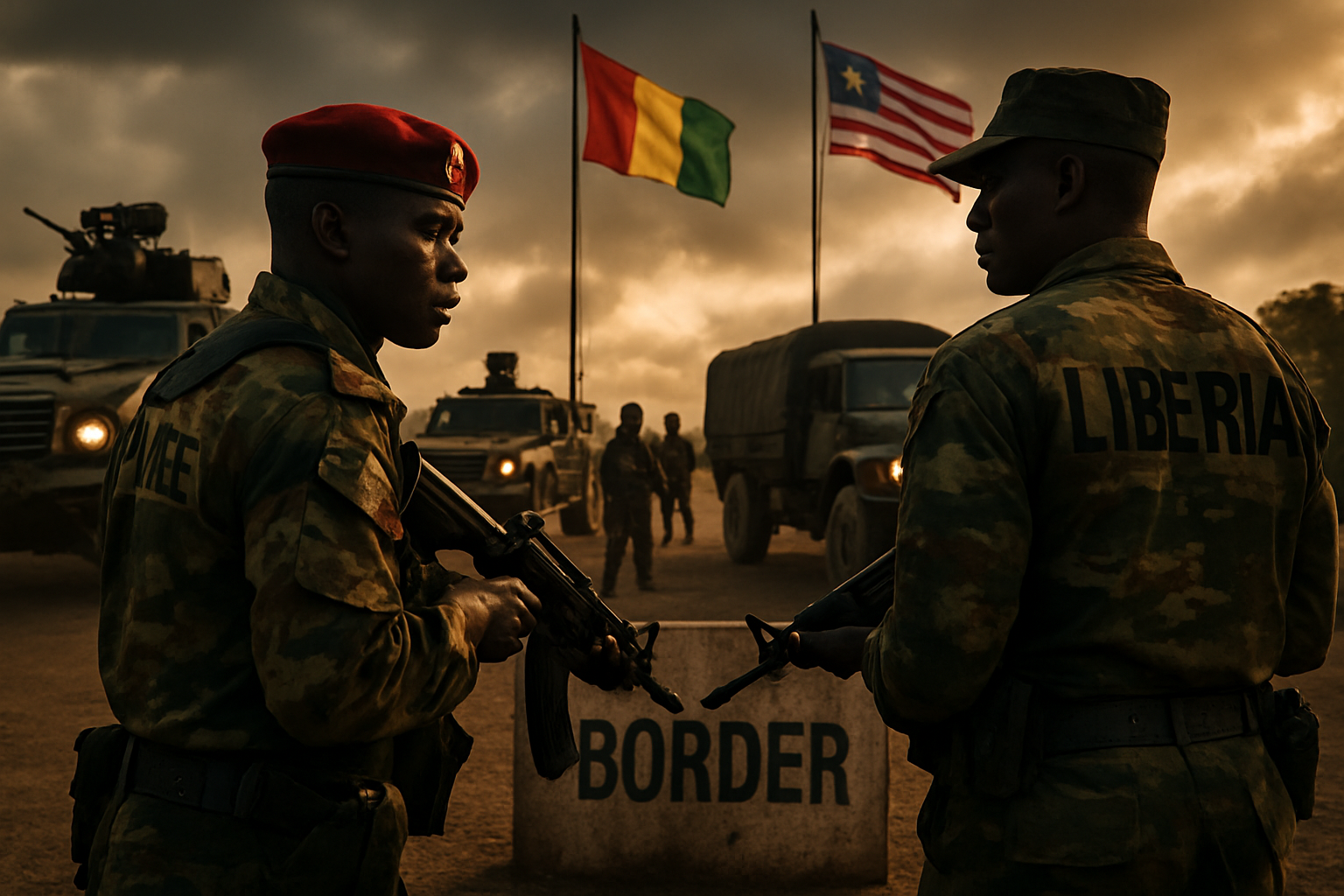
A dangerous border confrontation has erupted between Guinea and Liberia after Guinean soldiers reportedly crossed into Liberian territory in Lofa County, removed the Liberian flag, and hoisted their own at the Sorlumba Port of Entry—an act many Liberians are describing as a brazen violation of sovereignty that signals expanding regional instability.
The incident, which occurred in March 2026, has prompted thousands of residents in border communities along the Makona River to flee their homes, triggering panic and disrupting daily life along what was already a tense frontier. Schools have closed in the affected areas as local authorities struggle to maintain calm while the Liberian government engages in diplomatic efforts to resolve the crisis.
Civilian Response and Government Action
As reports emerged of armed Guinean soldiers occupying the border area, Liberian civilians in Lofa County took matters into their own hands, demonstrating patriotism by raising the Liberian flag in areas where government presence appeared limited. The spontaneous civilian response highlights growing frustration with what residents perceive as inadequate government action in defending national sovereignty.
The Government of Liberia has called on citizens to remain calm as diplomatic engagements continue to address what officials describe as "the emerging situation along the Liberia-Guinea border." However, the government's initial silence on the matter prompted criticism and concerns about its ability to respond effectively to territorial violations.
"While the Government of Liberia remains engaged in diplomatic efforts, the response from our citizens shows the deep patriotic spirit that defines our nation."
— Liberian Government Official
Mass Displacement and Humanitarian Impact
Thousands of residents from several border communities in Sorlumba Clan, Foya District, have abandoned their homes following reports of Guinean military presence near the Makona River. The displacement has created a humanitarian emergency in an already fragile region, with families seeking shelter in safer areas inland.
Local authorities report that the panic has disrupted normal economic activities, including cross-border trade that many communities depend on for their livelihoods. The closure of schools has affected hundreds of children, adding to concerns about the longer-term impact on local development.
Regional Context of Border Tensions
The Guinea-Liberia incident reflects broader patterns of border instability across West Africa, where colonial-era boundaries continue to create friction between neighboring states. Recent months have witnessed similar tensions between Guinea and Sierra Leone, where 16 Sierra Leone military personnel were detained following alleged border incursions in Koudaya district.
These conflicts occur against the backdrop of West Africa's ongoing democratic challenges, with military governments in several countries testing the limits of regional tolerance for authoritarian governance. Guinea itself has been under military rule since Colonel Mamadi Doumbouya's coup in September 2021, and recent actions suggest increasing assertiveness in territorial disputes.
Broader Migration and Border Security Challenges
While West Africa grapples with territorial disputes, other regions face different but equally pressing border security and migration challenges. In Europe, unprecedented policy shifts are reshaping migration management, with countries like Greece collaborating with Germany, Netherlands, Austria, and Denmark to establish "return centres" outside the European Union for rejected asylum seekers.
The European approach, building on Italy's Albanian processing model, represents a fundamental shift from traditional asylum protections toward deterrence-based policies. Recent European Parliament changes allowing deportations to "safe" third countries mark the most significant transformation of European migration policy since the Dublin system establishment.
Technology and Enforcement Evolution
Border security increasingly relies on technological solutions, though implementation challenges persist. The EU's Entry/Exit System (EES) successfully detected over 4,000 overstayers in its first four months of operation, but required partial summer suspensions due to processing delays that created 4-hour queues at major crossings.
Belgium's West Flanders Governor recently called for modern camera equipment to detect migrant boats after fog limited traditional surveillance capabilities, highlighting the ongoing technological arms race between smugglers and enforcement agencies.
Global Patterns and Regional Variations
Border security challenges manifest differently across continents. While West Africa deals with territorial sovereignty disputes and colonial boundary legacies, other regions confront different pressures. Afghanistan faces massive displacement with 88% of female-headed households unable to meet minimum living requirements, while ongoing conflicts create new waves of potential migrants.
Climate change adds another dimension to migration pressures, with January 2026 marking the 18th consecutive month above 1.5°C pre-industrial levels, fundamentally altering agricultural systems and creating ongoing displacement pressures that traditional border management systems struggle to address.
Diplomatic Solutions and International Response
The Guinea-Liberia crisis requires immediate regional mediation, potentially through ECOWAS (Economic Community of West African States), though the organization's effectiveness has been tested by recent military coups and changing political dynamics across the region.
International observers note that successful resolution of such territorial disputes increasingly requires innovative diplomatic frameworks that address not just immediate sovereignty concerns but underlying economic development needs that often drive border tensions.
"Regional stability in West Africa depends on addressing both immediate territorial disputes and the deeper economic challenges that create conditions for conflict."
— Regional Security Analyst
Economic Dimensions of Border Conflicts
Border tensions often reflect competition over economic resources, trade routes, and development opportunities. The Guinea-Liberia border region contains significant mineral resources and serves as a crucial trade corridor, making territorial control economically as well as politically significant.
West Africa's mining renaissance, with the continent holding $29.5 trillion in mineral reserves, adds strategic importance to border regions that might otherwise receive limited attention. Countries increasingly view territorial control as essential for securing resource access and development opportunities.
Looking Forward: Challenges and Opportunities
The current crisis tests West Africa's capacity for conflict prevention and resolution in an era of changing global power dynamics. Success in managing the Guinea-Liberia dispute could provide a template for addressing similar territorial challenges across the region.
However, failure to resolve tensions diplomatically could encourage more assertive territorial behaviors by military governments testing regional and international responses. The international community's reaction will influence whether such incidents become isolated events or precedents for more aggressive territorial assertions.
As borders worldwide face unprecedented pressures from migration, climate change, resource competition, and political instability, the Guinea-Liberia crisis serves as a reminder that effective border security requires not just military solutions but comprehensive approaches addressing the underlying social, economic, and political factors that create frontier instability.
The coming weeks will determine whether diplomatic engagement can restore stability to the Guinea-Liberia border and establish principles for managing similar challenges across West Africa's complex frontier regions.