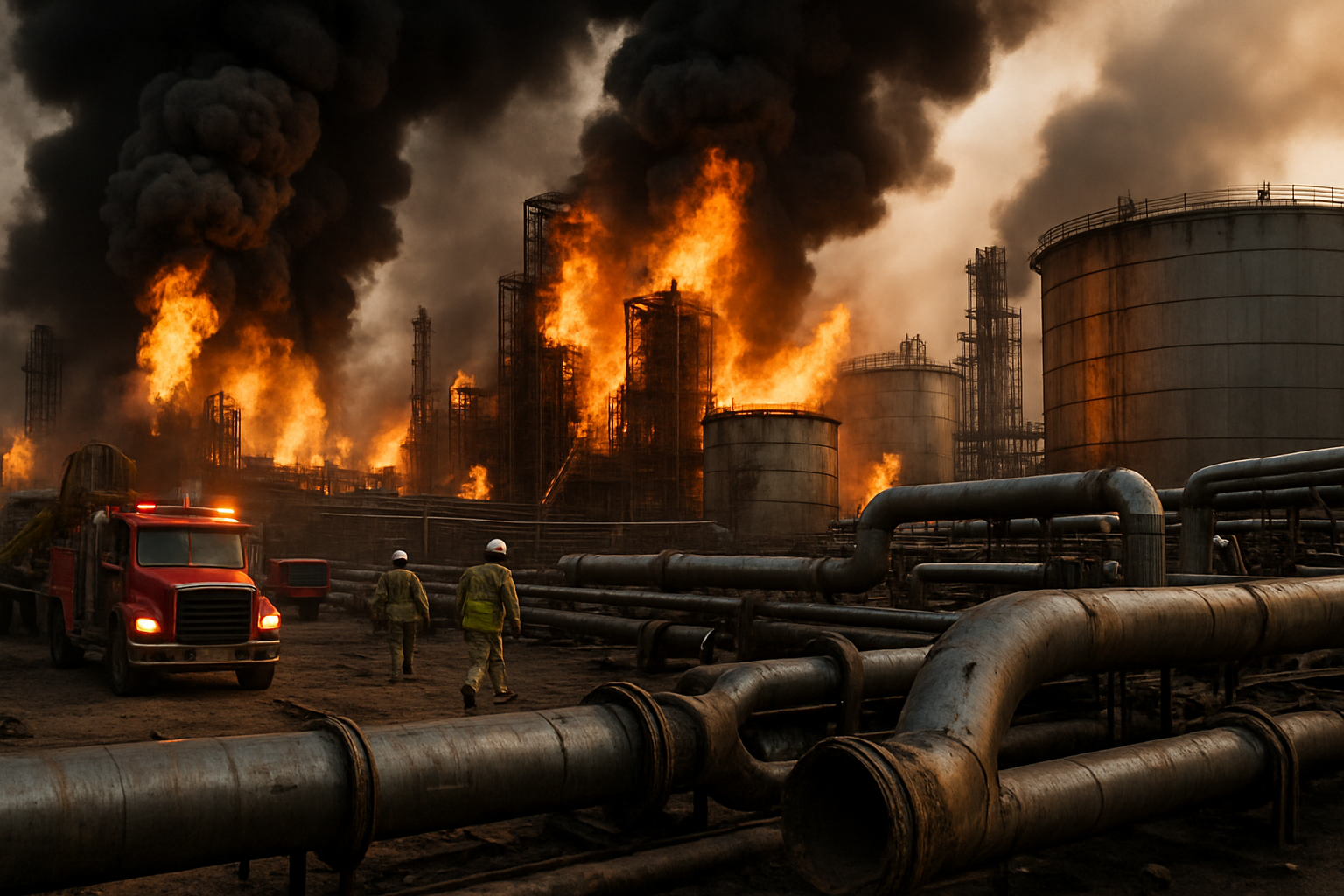
French officials have confirmed that 30-40% of Gulf region energy infrastructure has been destroyed or severely damaged, validating fears of a prolonged global energy crisis as oil markets experience extreme volatility amid diplomatic signals and underlying supply disruptions.
The confirmation comes as oil markets whipsawed dramatically on March 25, 2026, with prices plummeting from near-record highs after President Trump announced potential talks with Iran to end the ongoing conflict. However, the French assessment underscores the devastating physical reality behind the market turbulence - unprecedented infrastructure damage that could take years to fully repair.
Market Volatility Masks Underlying Crisis
Oil prices crashed over 10% following Trump's comments about "constructive dialogue" with Iran, with Brent crude falling from its peak of $119.50 to below $100 per barrel within hours. The dramatic reversal caught global investors off guard, with European markets recovering from early losses to post significant gains.
"The speed of the market reversal demonstrates how desperately the global economy needs de-escalation after weeks of the most severe energy crisis in decades," explained Samuel Ciszuk, lead energy analyst. "However, the physical infrastructure damage confirmed by France suggests this crisis will have long-lasting implications regardless of diplomatic outcomes."
"Thousands of oil contracts -- a far higher volume than normal -- were traded 15 minutes before Trump pledged to halt strikes on Iranian energy infrastructure, sending prices tumbling."
— France 24 Analysis Report
Scale of Infrastructure Destruction
The French confirmation provides the first official validation of the extensive damage to Gulf energy facilities. Iran's Revolutionary Guard declared the Strait of Hormuz "unsafe for shipping," effectively blocking 40% of global seaborne oil transit through the critical 21-mile chokepoint.
Key infrastructure impacts include:
- Qatar's Ras Laffan Industrial City suffering "extensive damage," affecting 20% of global LNG exports
- Multiple refineries across the Gulf region targeted and damaged
- Over 150 oil and LNG tankers stranded in the Persian Gulf
- Naval mining operations disrupting shipping lanes
The International Energy Agency responded with the largest strategic petroleum reserve release in its 50-year history - 400 million barrels from 32 countries, more than double the 2022 Ukraine crisis response.
Global Supply Chain Paralysis
The crisis extends far beyond energy markets, with major shipping companies Maersk and MSC suspending all Persian Gulf operations. The aviation industry has been particularly hard hit, with over 18,000 flights cancelled worldwide - the most extensive disruption since COVID-19.
Dubai International Airport, the world's busiest with 86 million passengers annually, remains shut down due to missile damage. Eight countries have simultaneously closed their airspace, creating what industry experts call an "aviation black hole" across critical Europe-Asia corridors.
Consumer Impact Worldwide
The energy crisis has triggered severe consumer impacts across multiple continents:
In Europe, Sweden faces electricity increases of 10-20 öre and gasoline price rises of 1-2 kronor per liter, with the Malmö region most exposed due to continental market integration. Ireland's heating oil prices are approaching €2 per liter, prompting government officials to condemn "brazen rip-offs."
Asia-Pacific nations are implementing emergency measures, with Bangladesh rationing fuel for 170 million people and Pakistan imposing wartime austerity with four-day government work weeks. The Philippines has declared a year-long "national energy emergency."
Diplomatic Breakthrough or Market Manipulation?
Trump's sudden shift from demanding Iran's "unconditional surrender" to announcing diplomatic dialogue has raised questions about potential insider trading, with unusual trading volumes observed 15 minutes before his announcement.
The diplomatic pivot came amid mounting congressional opposition to the conflict, with American support at a historically low 25% and operations costs reaching $11.3 billion in the first week alone. Financial markets have emerged as what analysts call the "ultimate constraint" on prolonged conflict.
"The reactions are emotional, based on uncertainty. The situation is going longer than initially thought, and financial markets are the ultimate constraint for a prolonged conflict."
— Damien Boey, Portfolio Strategist
Long-term Energy Security Implications
Despite the diplomatic signals, experts warn that the confirmed infrastructure damage represents a watershed moment for global energy security. The 21-mile Strait of Hormuz has proven to be a dangerous single-point failure for modern logistics, with no realistic alternatives for handling the diverted volume.
Qatar Energy Minister Saad Al Kaabi previously warned that Gulf states may be forced to declare force majeure "within weeks" if the crisis continues, with oil potentially reaching $150 per barrel threatening to "bring down the economies of the world."
The crisis has accelerated discussions about fundamental energy architecture transformation, with strategic petroleum reserves proving to be only a temporary buffer for sustained disruptions. Supply diversification and renewable energy transitions, which typically require years or decades to implement, have gained renewed urgency.
Nuclear Governance Context
The energy crisis unfolds against a broader nuclear governance breakdown, with the New START treaty having expired on February 5, marking the first time in over 50 years without US-Russia nuclear constraints. Iran continues uranium enrichment at 60% purity with over 400kg of weapons-grade material sufficient for multiple weapons.
UN Secretary-General António Guterres has called nuclear risks the "highest in decades," describing the current situation as "the greatest test of multilateral cooperation in crisis management of the modern era."
Regional Coalition Under Strain
The unprecedented Saudi/UAE/Qatar/Egypt consensus supporting diplomacy has been severely tested by Iranian retaliation targeting member territories. The UAE suffered 1 civilian killed in Abu Dhabi, Kuwait had 32 injured in airport strikes, and Qatar recorded 8 wounded while intercepting 65 missiles and 12 drones.
Egyptian President Abdel Fattah el-Sisi condemned attacks on "sisterly Arab countries," warning of "comprehensive chaos" if escalation continues.
Recovery Timeline Uncertain
Unlike weather-related disruptions, recovery from this crisis depends on military operations resolution and diplomatic normalization rather than predictable economic factors. Aviation industries cannot implement long-term scheduling while multiple airspaces remain closed, and energy markets remain volatile with critical transit routes blocked.
The template-setting nature of March 2026 events will likely establish new paradigms for energy security planning, requiring fundamental transformation to reduce dependence on strategic chokepoints that can be weaponized in geopolitical tensions.
As markets continue to digest both the diplomatic signals and the confirmed infrastructure damage, the global economy faces what experts describe as the most consequential energy crisis of the modern era, with implications extending decades into the future for international stability mechanisms worldwide.