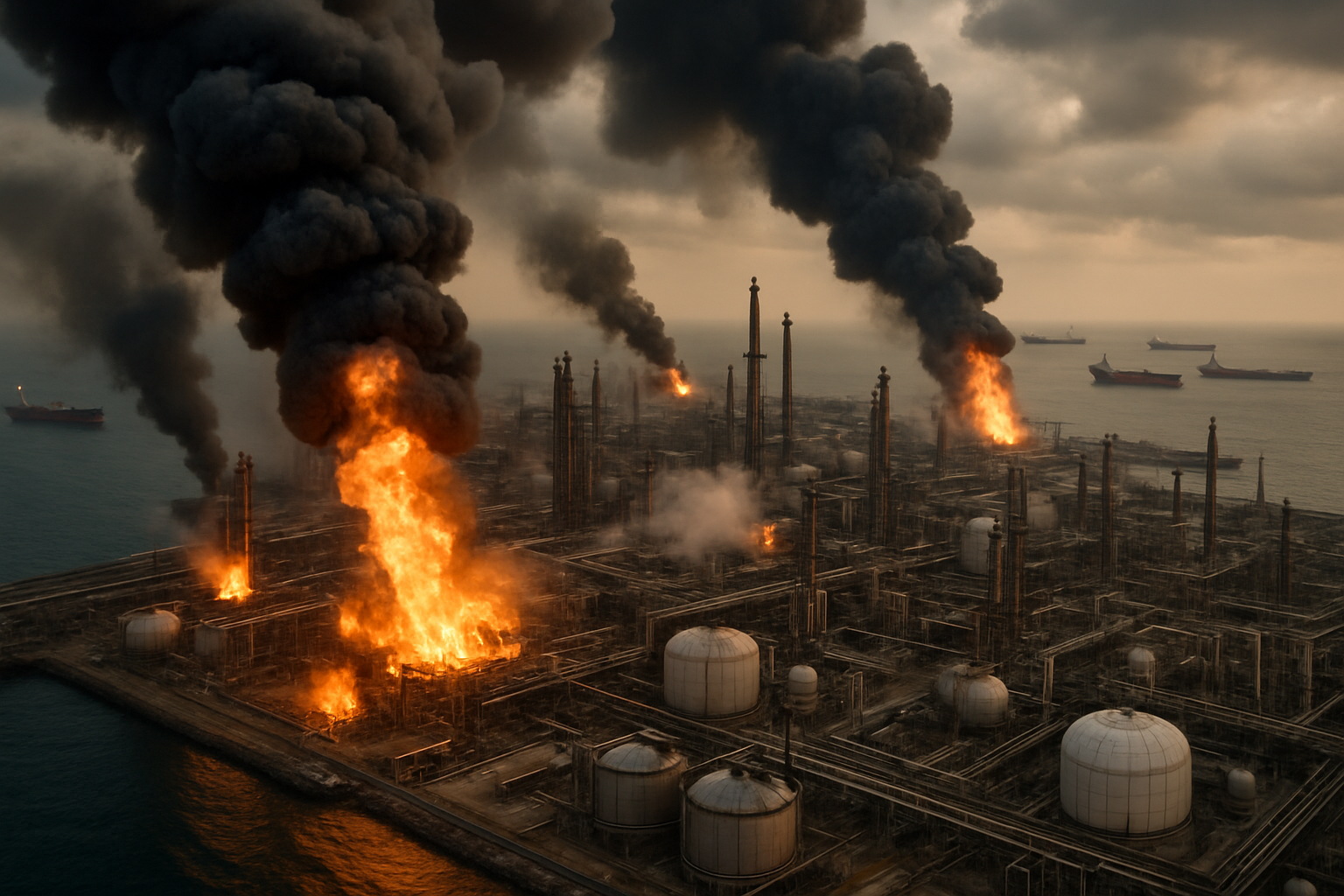
Energy facilities across the Gulf region are under systematic attack as the month-long Middle East crisis expands to target critical oil and gas infrastructure, with missile and drone strikes hitting refineries in Kuwait and gas plants in the UAE, marking a dangerous escalation in regional energy warfare.
The coordinated attacks on April 3rd represent the most significant targeting of Gulf energy infrastructure since the crisis began in March, with Iranian forces deploying advanced ballistic missiles, cruise missiles, and drone swarms against facilities that collectively handle millions of barrels of oil daily and supply significant portions of global LNG exports.
Kuwait Under Sustained Attack
Kuwait's Mina al-Ahmadi oil refinery, one of the region's largest processing facilities, sustained direct hits from multiple hostile drones in the early hours of Friday morning, triggering massive fires across several operational units. The facility, which processes over 466,000 barrels per day, represents a cornerstone of Kuwait's oil industry and a critical node in global energy supply chains.
Kuwaiti armed forces confirmed intercepting seven ballistic missiles, two cruise missiles, and 26 drones within the country's airspace over a 24-hour period, according to military spokesman Colonel Saud Al-Atowan. The unprecedented volume of incoming projectiles has overwhelmed some defensive systems, allowing several strikes to penetrate to their targets.
"The Iranian aggression resulted in targeting the Mina al-Ahmadi refinery, which led to fires breaking out in a number of operational units, in addition to one of the power and desalination stations being hit."
— Colonel Saud Al-Atowan, Kuwait Defense Ministry Spokesperson
Beyond the refinery strikes, Kuwait's critical infrastructure faced systematic targeting, with power and water desalination plants also hit. Interior Ministry spokesman Colonel Nasser Bousleib reported nine incidents of falling shrapnel from defensive interceptions over the past 24 hours, bringing the total number of such incidents to 649 since the beginning of what officials term "Iranian aggressions."
UAE Gas Facilities Targeted
The United Arab Emirates faced its own barrage of attacks, with missile debris sparking fires at one of the country's largest gas facilities. The Habshan gas processing complex, a critical component of the UAE's energy infrastructure that has been targeted multiple times during the current crisis, suffered operational disruptions from debris falling during successful missile interceptions.
This marks the second major attack on Habshan facilities, following a previous incident on March 19th that forced temporary closure of operations. The facility plays a crucial role in processing natural gas for both domestic consumption and export, making its targeting particularly significant for regional energy security.
UAE authorities confirmed that 12 people were injured during missile interception operations, as air defense systems worked to protect critical infrastructure from incoming threats. The pattern of attacks suggests a systematic campaign targeting the UAE's energy production capabilities.
Regional Energy Warfare Intensifies
The attacks represent a dangerous escalation in what military analysts describe as "energy infrastructure warfare" – the systematic targeting of oil and gas facilities to cripple economic capabilities and disrupt global energy markets. This strategy has emerged as a central component of the ongoing conflict, with Iran's Revolutionary Guard declaring Gulf energy facilities "legitimate targets."
Saudi Arabia has also faced increased pressure, with defense forces intercepting multiple drones and missiles targeting the kingdom's eastern oil-producing regions. The country's advanced air defense systems have largely succeeded in protecting major facilities, but the sustained nature of the attacks is straining defensive capabilities across the region.
According to intelligence assessments, Iran has deployed an estimated 2,000-6,000 naval mines in the Strait of Hormuz, effectively closing the waterway that handles 40% of global seaborne oil transit. This has left more than 150 oil and LNG tankers stranded in the Persian Gulf, with billions of dollars worth of cargo unable to reach international markets.
Global Energy Market Impact
The targeting of Gulf energy infrastructure has sent shockwaves through global energy markets, with oil prices surging past $100 per barrel for the first time since 2022. Brent crude reached a peak of $119.50, while WTI futures jumped to $108.15 in what represents the largest single-day percentage increase on record at 18.98%.
Natural gas prices have exploded by 24% in Europe and 78% in the United States, reaching €47.32 per megawatt-hour – the highest level since February 2025. Qatar's decision to halt LNG production at its Ras Laffan and Mesaieed facilities, which together account for approximately 20% of global LNG exports, has created severe supply shortages affecting European consumers.
The International Energy Agency (IEA) has responded with the largest strategic petroleum reserve release in its 50-year history, deploying 400 million barrels from 32 member countries – more than double the 182.7 million barrels released during the 2022 Ukraine crisis. Japan is contributing 80 million barrels, marking the first such deployment since the 2011 Fukushima disaster.
"We are facing the most severe energy security crisis in decades, with single-chokepoint vulnerabilities exposed at a scale we have never seen before."
— Samuel Ciszuk, Energy Security Analyst
Aviation and Supply Chain Disruption
The Gulf crisis has created unprecedented disruption to global aviation networks, with over 18,000 flights cancelled worldwide – the most extensive disruption since the COVID-19 pandemic. Eight Middle Eastern countries have simultaneously closed their airspace, creating an "aviation black hole" that severs critical Europe-Asia air corridors.
Dubai International Airport, the world's busiest with 86 million passengers annually, remains shut down due to missile damage. Major carriers including Emirates, Air France-KLM, and Wizz Air have suspended operations indefinitely, stranding hundreds of thousands of passengers globally.
Supply chain networks dependent on Persian Gulf logistics are experiencing severe disruptions across manufacturing sectors including automotive, electronics, and textiles. Major shipping companies Maersk and MSC have suspended all Persian Gulf operations, while China has suspended refined fuel exports to preserve domestic supplies.
Regional Coalition Under Strain
The systematic targeting of energy infrastructure has placed enormous strain on the Saudi-UAE-Qatar-Egypt coalition that has supported diplomatic solutions to the crisis. Iranian attacks on member territories have forced difficult choices between alliance commitments and protection of national interests.
Egyptian President Abdel Fattah el-Sisi condemned the attacks on "sisterly countries" and warned of "comprehensive chaos" spreading throughout the region if the targeting of civilian infrastructure continues. The coalition faces the impossible choice between supporting US military operations and avoiding Iranian retaliation against their own territories.
Kuwait has been particularly affected, with 32 foreign nationals injured in airport strikes and repeated targeting of critical infrastructure. Qatar has reported 8 injuries despite successful Patriot missile interceptions of 65 missiles and 12 drones, demonstrating both the effectiveness of defense systems and the scale of the threat.
International Response and Diplomatic Efforts
The targeting of energy infrastructure has prompted urgent diplomatic intervention from international partners. Pakistan's Foreign Minister Ishaq Dar has confirmed "indirect talks" between the US and Iran using a "message relay system," with China expressing "full support" for Pakistani mediation efforts.
However, the fundamental scope of disagreement remains insurmountable, with Iran maintaining that ballistic missiles and proxy forces represent "red lines" that cannot be included in any agreement, while the United States demands comprehensive arrangements covering missiles, armed groups, and human rights issues.
The collapse of nuclear diplomacy, despite February's Geneva "broad agreement on guiding principles" that represented the most progress since the 2018 JCPOA collapse, has eliminated hopes for a negotiated resolution. Iran continues 60% uranium enrichment with over 400 kilograms of weapons-grade material sufficient for multiple nuclear weapons.
Economic and Financial Consequences
Financial markets have crashed globally as the energy infrastructure attacks demonstrate the vulnerability of interconnected supply chains to geopolitical disruption. Pakistan's KSE-100 index suffered its largest decline in history at -8.97%, while South Korea's KOSPI fell 12% with circuit breakers triggered and the Korean won hitting 17-year lows.
Consumer impacts are being felt worldwide, with Sweden experiencing electricity price increases of 10-20 öre and gasoline rises of 1-2 kronor. Ireland faces heating oil approaching €2 per liter, while Pakistan has implemented wartime austerity measures including four-day government work weeks. Bangladesh has imposed fuel rationing affecting 170 million people.
Government emergency responses have been unprecedented in scope, with Hungary implementing immediate price caps on gasoline and diesel to combat "war-driven price explosions." France has deployed 500 fuel station inspectors to prevent price manipulation, while Romania has prepared five scenarios to prevent diesel exceeding 10 lei per liter.
Strategic Implications and Future Outlook
The systematic targeting of Gulf energy infrastructure represents a watershed moment in modern conflict, demonstrating how regional wars can rapidly escalate to threaten global economic stability. The attacks have exposed dangerous over-dependence on strategic chokepoints, particularly the 21-mile Strait of Hormuz that serves as a single point of failure for modern global logistics.
Energy security experts warn that the crisis highlights the urgent need for fundamental restructuring of global energy architecture to reduce geopolitical volatility. While strategic petroleum reserves provide temporary buffers, sustained disruptions require years or decades of supply diversification and renewable energy transitions.
"This situation is going on longer than initially thought, with financial markets becoming the ultimate constraint on prolonged conflict."
— Damien Boey, Financial Markets Analyst
UN Secretary-General António Guterres has described the crisis as "the greatest test of multilateral cooperation and crisis management in the modern era." The rapid transition from diplomatic breakthrough to military escalation demonstrates the fragility of crisis management mechanisms in an increasingly multipolar world.
The template-setting nature of this crisis will likely influence international approaches to territorial and nuclear disputes for decades to come. Success in containing the conflict could provide a framework for future nuclear crisis resolution, while failure may accelerate the preference for military solutions over diplomatic engagement globally.
As the crisis enters its second month, the targeting of energy infrastructure has fundamentally altered the nature of the conflict from military confrontation to economic warfare with global implications. The coming days will be critical in determining whether diplomatic mediation can prevent the most dangerous international crisis since the end of the Cold War from escalating into a broader regional conflict with consequences extending far beyond the Middle East.