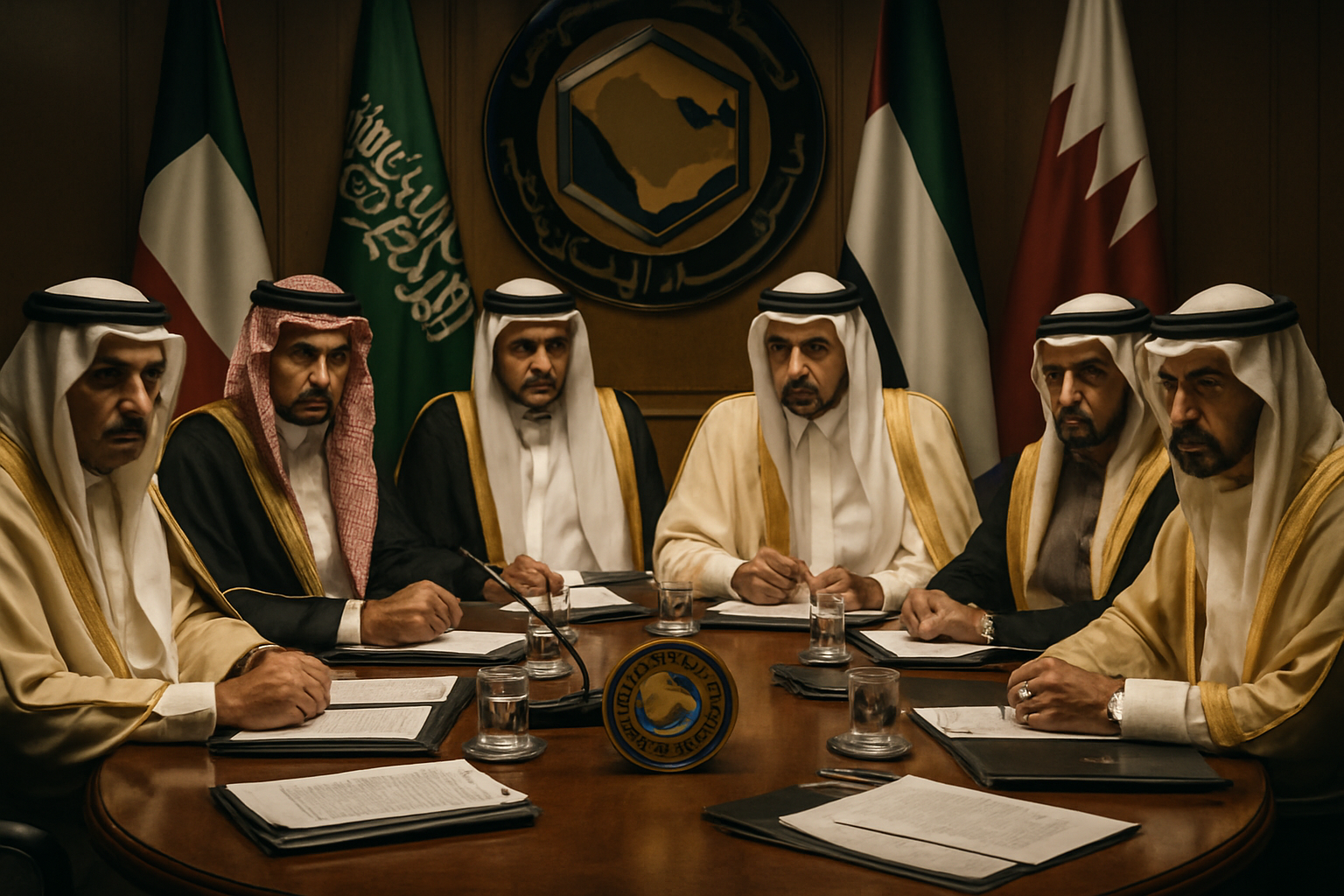
Gulf nations delivered their strongest condemnation yet of Iran's escalating military aggression on Wednesday, as Kuwait warned that international silence is "no longer acceptable" while Saudi Arabia dealt with missile debris striking residential areas in the Eastern Province.
The coordinated response from Kuwait, Saudi Arabia, Qatar, and the UAE represents the most significant Gulf diplomatic alignment in decades, as Iranian Revolutionary Guard forces continue their systematic "Operation True Promise 4" campaign across the region. The crisis has transformed from a bilateral Iran-Israel conflict into a broader regional confrontation threatening the stability of the entire Persian Gulf.
Kuwait Issues Urgent Warning
At an emergency session of the UN Human Rights Council in Geneva, Kuwait's Permanent Representative Nasser Al-Hain delivered what diplomatic sources described as the most forceful Kuwaiti condemnation of Iranian actions since the 1980s Iran-Iraq War. "Global silence is no longer acceptable in the face of this blatant and shameless aggression," Al-Hain declared, emphasizing that Iran's actions "violate all international laws and treaties."
The 47-member Human Rights Council subsequently approved a resolution sponsored by all six GCC states and Jordan, condemning Iran's "egregious attacks" on Gulf neighbors and demanding immediate cessation of "all unjustified attacks." The resolution also calls for Iran to pay compensation to all victims of its regional military campaign.
Kuwait's strong stance reflects growing alarm over Iran's systematic targeting of civilian infrastructure. Earlier this week, Iranian drones struck Kuwait International Airport's Terminal 1, causing employee injuries, while three military personnel were wounded at Ali Al Salem Air Base. The US Embassy in Kuwait has been closed indefinitely due to the "ongoing regional tensions."
Saudi Arabia Under Direct Attack
Saudi Arabia's Eastern Province experienced one of the most significant Iranian strikes yet on Wednesday, when debris from an intercepted ballistic missile fell on two residential homes in a neighborhood near Dammam. While Saudi Civil Defense confirmed "limited material damage" with no injuries reported, the incident marked the first time Iranian missile fragments have directly impacted Saudi residential areas during the current crisis.
According to Major General Turki Al-Malki, spokesperson for the Saudi Ministry of Defense, Saudi air defense systems intercepted one ballistic missile and 33 drones over the Eastern Province in a coordinated attack that lasted throughout Wednesday. The systematic nature of the assault demonstrates Iran's commitment to maintaining pressure across multiple fronts simultaneously.
The Saudi response has been swift and uncompromising. Crown Prince Mohammed bin Salman received urgent phone calls from both British Prime Minister Keir Starmer and Pakistani Prime Minister Muhammad Shehbaz Sharif, with both leaders expressing condemnation of Iranian attacks and reaffirming support for Saudi security.
International Support Emerges
The diplomatic isolation of Iran has become increasingly apparent as major powers rally behind Gulf states. During his call with Crown Prince Mohammed bin Salman, Prime Minister Starmer "stressed that Iran's actions pose a threat to regional security and stability" and reviewed the impact on "global maritime security and the world economy."
Pakistan's prime minister went further, reiterating "Pakistan's full support and commitment to standing firmly with Saudi Arabia against repeated Iranian attacks threatening its security and sovereignty." Such explicit language from Pakistan, which traditionally maintains careful neutrality in Middle Eastern disputes, underscores the gravity of the current situation.
"This aggression that shows no respect for sanctity or law requires the international community to take a firm stance to end it."
— Ambassador Nasser Al-Hain, Kuwait's Permanent Representative to the UN
Regional Coalition Under Strain
The unprecedented Saudi-UAE-Qatar-Egypt consensus that had supported diplomatic efforts to prevent military confrontation now faces severe testing. Iranian attacks have directly targeted the territories of coalition members, forcing Gulf leaders to balance their historical preference for regional diplomacy against the immediate security threats posed by Iranian missile and drone strikes.
Egyptian President Abdel Fattah al-Sisi has repeatedly condemned what he terms attacks on "sisterly Arab countries," warning that continued Iranian aggression threatens "comprehensive chaos" across the region. The Arab League has called emergency ministerial sessions, while the GCC seeks UN Security Council action against Iranian violations of member states' sovereignty.
Qatar's experience illustrates the regional dilemma. Despite successfully intercepting 65 Iranian missiles and 12 drones using Patriot air defense systems, eight people were injured by falling debris. The small Gulf nation has been forced to maintain heightened alert levels while attempting to preserve its traditional role as a regional mediator.
Broader Security Implications
The crisis has exposed fundamental vulnerabilities in Gulf security architecture. Iran's Revolutionary Guard has declared that "no red lines remain," effectively abandoning previous restraints on targeting civilian infrastructure. This escalation follows the death of Supreme Leader Ali Khamenei on March 1 and the subsequent appointment of his son, Mojtaba Khamenei, as Iran's new leader—the first hereditary succession in the Islamic Republic's 47-year history.
The attacks have severely disrupted regional aviation and shipping. Dubai International Airport, the world's busiest international hub with 86 million annual passengers, remains closed due to missile damage. Over 18,000 flights have been cancelled worldwide, representing the most extensive aviation disruption since COVID-19.
Energy security has become equally precarious. Iran's threats to close the Strait of Hormuz—through which 40% of global seaborne oil passes—have already driven oil prices past $100 per barrel for the first time since 2022. Major shipping companies Maersk and MSC have suspended operations in the Persian Gulf, leaving over 150 tankers stranded with billions of dollars worth of cargo.
Escalating Humanitarian Concerns
The humanitarian toll continues to mount across the region. The UAE confirmed one civilian death in Abu Dhabi from missile debris, while Kuwait has relocated its national airline operations to Saudi Arabia due to repeated drone attacks on its airport facilities. These incidents represent the first civilian casualties from Iranian actions in Gulf states since the current crisis began.
International evacuation efforts are now underway on a scale not seen since the Arab Spring of 2011. Australia has 115,000 nationals trapped in the region, while Germany is coordinating the evacuation of 30,000 tourists and residents. Multiple countries have issued urgent travel warnings advising against all travel to Gulf states.
The crisis has also triggered the first use of European evacuation protocols. When Iranian drones struck RAF Akrotiri in Cyprus—the first attack on European territory since World War II—the EU activated its ESTIA evacuation plan for the first time in the bloc's history.
Nuclear Diplomacy in Ruins
The current military escalation emerged from the complete breakdown of nuclear negotiations between the US and Iran, despite what had been characterized as a breakthrough in February. Geneva talks had achieved "broad agreement on guiding principles"—representing the most progress since the collapse of the Joint Comprehensive Plan of Action (JCPOA) in 2018.
However, fundamental disagreements proved insurmountable. Iran insisted on nuclear-only discussions, excluding ballistic missiles and regional proxy forces as "red lines." The United States demanded a comprehensive agreement covering Iran's missile program, support for armed groups, and human rights record.
Iran continues uranium enrichment at 60% purity with over 400 kilograms of enriched material—approaching the quantity and quality needed for multiple nuclear weapons. The failure of diplomacy occurs amid a broader nuclear governance crisis, with the New START Treaty between the US and Russia having expired in February without renewal, leaving the world without major power nuclear arms control for the first time in over 50 years.
Economic Disruption Spreads
The economic ramifications extend far beyond energy markets. Stock markets worldwide have experienced severe volatility, with Pakistan's KSE-100 index suffering its largest single-day decline in history at -8.97%. South Korea's KOSPI index fell 12%, triggering circuit breakers as the Korean won hit 17-year lows.
Supply chain disruptions are affecting industries from automotive to electronics to textiles, all of which depend heavily on Gulf logistics networks. The Persian Gulf serves as a critical trade hub connecting Asia and Europe, and its compromise has exposed dangerous vulnerabilities in global commerce.
Consumer impacts are being felt worldwide. Sweden faces electricity price increases of 10-20 öre and gasoline increases of 1-2 kronor. Ireland reports heating oil approaching €2 per liter. Bangladesh has implemented fuel rationing for 170 million people, while Bosnia-Herzegovina has only two days of gas reserves remaining.
International Response Intensifies
The International Energy Agency has announced its largest strategic petroleum reserve release in 50 years—400 million barrels from 32 member countries, more than double the release during the 2022 Ukraine crisis. Japan is releasing 80 million barrels, marking its first such deployment since the 2011 Fukushima disaster.
European nations are coordinating unprecedented military support for regional allies. Spain has confirmed willingness to provide military support to Cyprus, while Italy plans to deploy SAMP-T air defense systems to Gulf countries. France has redeployed the aircraft carrier Charles de Gaulle from the Baltic to the Mediterranean, and the UK has sent HMS Dragon destroyer with advanced Sea Viper missile systems.
This represents the largest European military mobilization in the Eastern Mediterranean since the 1974 Turkish invasion of Cyprus, demonstrating how the crisis has expanded beyond Middle Eastern boundaries to directly threaten European security interests.
Looking Forward
UN Secretary-General António Guterres has described the current situation as "the greatest test of multilateral cooperation in crisis management in the modern era." The coming days and weeks will determine whether the international community can contain what has become the most dangerous crisis since the end of the Cold War.
The stakes extend far beyond the immediate military confrontation. Success in preventing broader regional war could provide a framework for future nuclear and territorial dispute resolution. Failure risks accelerating a global preference for military solutions over diplomatic ones, potentially encouraging nuclear proliferation and undermining international law enforcement for decades to come.
As Gulf states continue to call for international action while managing the immediate security threats to their populations, the world watches to see whether the post-World War II international order can adapt to manage crises in an increasingly multipolar era. The outcome will establish precedents for 21st-century conflict resolution that could influence international relations for generations.