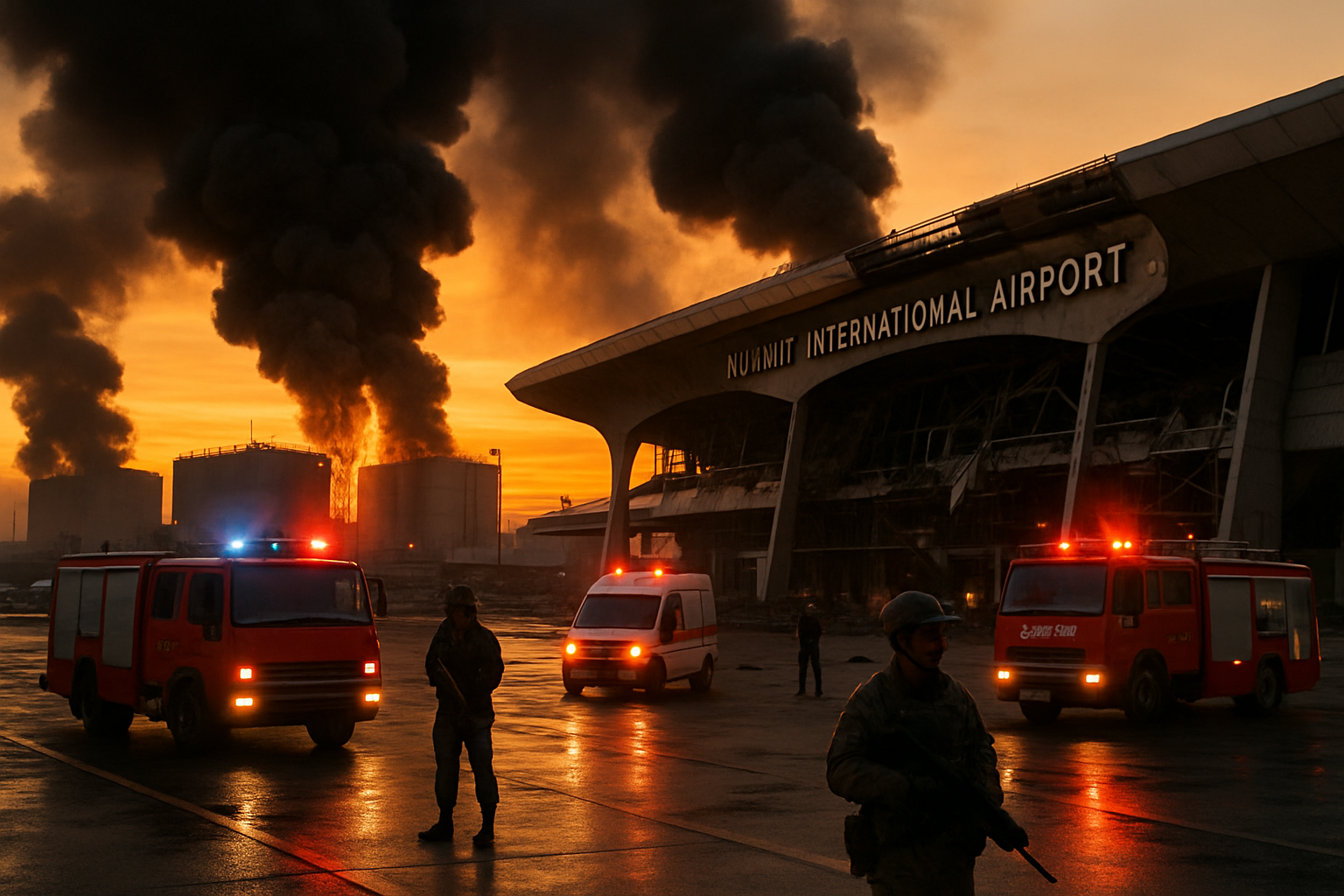
Kuwait International Airport came under sustained drone attack Wednesday morning, triggering a massive fire at fuel storage facilities, while maritime vessels near Qatar's Ras Laffan industrial complex were struck by projectiles, marking a dramatic escalation in the regional conflict that has already plunged global energy markets into crisis.
The coordinated attacks, attributed by Kuwaiti authorities to Iran and Iranian-backed armed formations, represent the latest phase of escalating hostilities that began in late February 2026. According to Abdullah Al-Rajhi, spokesperson for Kuwait's Civil Aviation Authority, the drone strikes targeted fuel storage tanks at the airport, causing significant infrastructure damage but no reported casualties.
Simultaneously, a commercial tanker operating approximately 17 nautical miles north of Qatar's critical Ras Laffan industrial hub was struck by two projectiles. The United Kingdom Maritime Trade Operations (UKMTO) confirmed that one projectile caused a fire that has since been extinguished, while a second unexploded projectile remains lodged in the vessel's engine room. The crew has been reported safe with no environmental impact recorded.
Historical Context of Regional Escalation
These attacks occur within the context of what United Nations Secretary-General António Guterres has described as "the greatest test of multilateral cooperation and crisis management in the modern era." The current crisis traces its origins to the complete breakdown of US-Iran nuclear negotiations in February 2026, despite what had been characterized as a "broad agreement on guiding principles" - the most progress since the JCPOA collapse in 2018.
The diplomatic failure led to Operation Epic Fury, the largest coordinated US-Israeli military campaign since the 2003 Iraq invasion, which resulted in the killing of Supreme Leader Ali Khamenei on March 1, 2026, ending his 37-year rule. This triggered Iran's systematic retaliation under "Operation True Promise 4," with the Revolutionary Guard declaring "no red lines remain" in targeting regional infrastructure and US allies.
The current attacks follow a month-long pattern of Iranian strikes across the Gulf region. Previous incidents have resulted in casualties across multiple nations: one civilian killed in the UAE from missile debris in Abu Dhabi, 32 people injured in Kuwait from earlier airport strikes, and eight wounded in Qatar despite Patriot missile systems successfully intercepting 65 missiles and 12 drones in previous attacks.
Global Energy Crisis Context
The latest attacks come as the region remains at the epicenter of the most severe global energy crisis since the 1970s oil shocks. Iran's Revolutionary Guard has declared the Strait of Hormuz "unsafe for shipping," effectively closing the waterway that handles 40% of global seaborne oil transit. This has driven oil prices to historic highs, with Brent crude reaching $119.50 per barrel and West Texas Intermediate hitting $108.15 - representing the largest single-day jump on record.
The International Energy Agency responded with the largest strategic petroleum reserve release in its 50-year history - 400 million barrels from 32 member countries, more than double the releases during the 2022 Ukraine crisis. Japan alone is releasing 80 million barrels, the first such deployment since the 2011 Fukushima disaster, highlighting the country's vulnerability with 95% Middle East oil dependence and 70% of imports transiting through the now-compromised Hormuz passage.
Major shipping companies Maersk and MSC have suspended all Persian Gulf operations, with over 150 oil and LNG tankers stranded, representing billions of dollars in cargo. Qatar's halt of LNG production at the Ras Laffan and Mesaid facilities - which account for approximately 20% of global exports - has triggered severe supply concerns, particularly for European markets.
Aviation and Transportation Disruption
The crisis has created unprecedented disruption to global transportation networks. More than 18,000 flights have been cancelled worldwide - the most extensive aviation crisis since COVID-19 - as eight Middle Eastern countries maintain simultaneous airspace closures. Dubai International Airport, the world's busiest with 86 million annual passengers, remains completely shut down due to missile damage, while major carriers including Emirates, Air France-KLM, and Wizz Air have suspended operations indefinitely.
The attacks on Kuwait's airport represent a direct threat to one of the region's remaining operational aviation hubs. Kuwait's Civil Aviation General Directorate has initiated emergency protocols to assess damage and maintain alternative fuel supply chains, though the full extent of operational impact remains under evaluation.
Regional Coalition Under Strain
The targeting of Kuwait and Qatar has severely strained the unprecedented diplomatic coalition that emerged earlier in the crisis. Saudi Arabia, UAE, Qatar, and Egypt had formed an unusual consensus supporting diplomatic solutions, but the direct attacks on coalition member territories have fundamentally altered regional calculations.
Egyptian President Abdel Fattah el-Sisi's warning of "comprehensive chaos spreading across the region" if attacks on "sisterly Arab countries" continue reflects the coalition's growing instability. The attacks force Gulf states to choose between their long-standing security arrangements with the United States and the immediate threat of Iranian retaliation on their territories.
"The international community cannot remain silent as civilian infrastructure comes under systematic attack. These strikes represent a dangerous escalation that threatens regional stability and global economic security."
— Senior Western Diplomat, speaking on condition of anonymity
Maritime Security Implications
The targeting of commercial vessels near Qatar's Ras Laffan complex represents a direct threat to global energy infrastructure. The industrial hub is critical not only for Qatar's LNG exports but also serves as a major petrochemical center supporting global supply chains. The fact that an unexploded projectile remains lodged in a commercial vessel highlights the ongoing maritime security risks in Gulf waters.
UKMTO's inability to confirm the source of the projectiles, stating that investigations are ongoing, reflects the complex nature of attribution in the current conflict environment. However, the pattern of attacks and geographical proximity to previous Iranian operations suggests continued systematic targeting of energy infrastructure.
Nuclear Governance Crisis
The current escalation occurs within a broader nuclear governance crisis that has emerged as one of the most dangerous aspects of the regional conflict. Iran continues uranium enrichment at 60% purity levels, with an estimated 400+ kilograms of weapons-grade material - sufficient for multiple nuclear weapons if weaponized. This development coincides with the February 2026 expiration of the New START treaty, marking the first time in over 50 years without US-Russia nuclear constraints.
UN Secretary-General Guterres has characterized nuclear risks as being at their "highest levels in decades," while the complete collapse of diplomatic engagement with Iran has eliminated near-term prospects for negotiated resolution of the nuclear standoff.
Economic and Supply Chain Impact
The attacks have sent shockwaves through global financial markets, with Pakistan's stock exchange recording its largest single-day decline in history at -8.97%, while South Korea's KOSPI fell 12%, triggering circuit breakers as the Korean won hit a 17-year low. The disruption extends beyond energy markets, affecting manufacturing supply chains dependent on Gulf logistics networks in automotive, electronics, and textiles sectors.
Consumer impacts are being felt worldwide, with Bangladesh implementing fuel rationing for 170 million people, Pakistan introducing wartime austerity measures including four-day work weeks, and European countries facing heating oil prices approaching €2 per liter. Natural gas prices have exploded 24% in Europe and 78% in the US, reaching levels not seen since the height of the Ukraine crisis.
Emergency Response Measures
Governments worldwide have implemented unprecedented emergency measures to address the crisis. France has deployed 500 fuel station inspectors to prevent price manipulation, while Romania has developed five scenarios to prevent diesel prices from exceeding critical thresholds. Hungary has imposed immediate price caps on gasoline and diesel, and Slovakia has activated strategic petroleum reserves for the first time under current protocols.
The scale of international evacuation efforts has reached proportions not seen since the 2011 Arab Spring, with Australia reporting 115,000 nationals trapped in the region and Germany coordinating the evacuation of 30,000 tourists. The European Union activated Cyprus's ESTIA evacuation plan for the first time in the bloc's history following Iranian drone strikes on RAF Akrotiri - the first attack on European territory since World War II.
Template-Setting Crisis
Energy security experts warn that the current crisis exposes fundamental vulnerabilities in global energy architecture that have been decades in the making. Samuel Ciszuk, senior energy analyst, characterizes this as "the most severe energy security crisis in decades, with single-chokepoint vulnerabilities fully exposed." The 21-mile Strait of Hormuz represents a geographic single-point failure for modern logistics with no realistic alternatives for the volume of energy transit it typically handles.
The crisis demonstrates how rapidly diplomatic engagement can collapse into military confrontation in the current multipolar international environment. Success in containing the current escalation could provide a framework for future nuclear crisis resolution, strengthening diplomatic precedents. However, failure risks accelerating military solutions over diplomatic approaches, potentially encouraging nuclear proliferation globally while undermining diplomatic credibility worldwide.
Looking Forward
As the crisis enters its second month, the latest attacks on Kuwait and Qatar represent a concerning expansion of targeting that threatens to further destabilize regional coalition dynamics and global energy security. The recovery timeline remains uncertain, dependent on military operations resolution and diplomatic normalization rather than the predictable patterns typical of weather-related disruptions.
The international community faces a critical test of multilateral cooperation in crisis management, with implications that will extend decades beyond current events. The fundamental transformation required in energy security planning to reduce dependence on strategic chokepoints has become an urgent priority, though implementation of supply diversification and renewable transitions requires years to decades of sustained effort.
The current attacks underscore that what began as a bilateral US-Iran nuclear dispute has evolved into a regional crisis with global implications for energy security, nuclear governance, and international law enforcement. The template being established for 21st-century conflict resolution - whether diplomatic or military solutions prevail - will influence international approaches to territorial and nuclear disputes for generations to come.