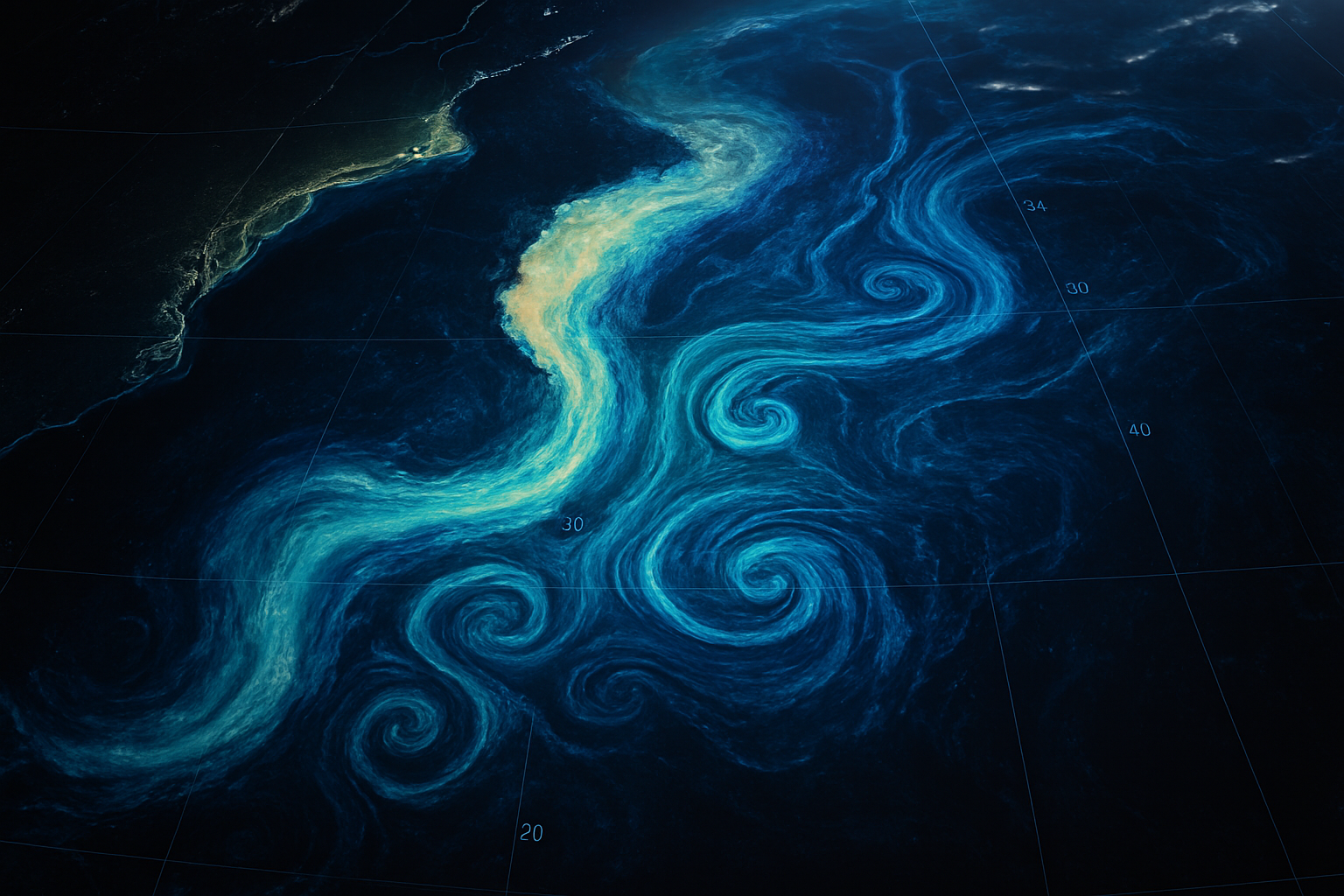
Groundbreaking climate simulations reveal that the Gulf Stream is undergoing dramatic path changes decades before the complete collapse of major Atlantic circulation systems, marking a critical acceleration of climate change impacts during the 20th consecutive month of global temperatures exceeding 1.5°C above pre-industrial levels.
According to new research reported by Austrian scientists, the Gulf Stream's path is shifting abruptly—a process that has already begun and signals the impending collapse of the Atlantic Meridional Overturning Circulation (AMOC), the massive ocean current system that regulates global climate patterns and provides vital heat distribution to Europe and North America.
Historic Climate Milestone Amplifies Ocean System Stress
The alarming findings emerge as Earth experiences unprecedented warming conditions. January 2026 remains the hottest month ever recorded in human history, extending an extraordinary 20-month streak of temperatures exceeding the critical 1.5°C threshold established by the Paris Climate Agreement. This sustained warming is now fundamentally overriding natural climate variability, including La Niña cooling effects that typically moderate global temperatures.
German research from the University of Potsdam, as reported by Azerbaijan sources, confirms that global warming has accelerated significantly in recent years. Scientists have successfully separated human-caused warming from natural climatic factors, revealing that the pace of temperature rise has increased by 75%—from an average of 0.2°C per decade between 1970-2015 to a staggering 0.35°C per decade through 2025.
The Gulf Stream's Critical Role in Global Climate
The Gulf Stream forms a crucial component of the AMOC, transporting warm tropical waters northward along the eastern coast of the United States before crossing the Atlantic toward Europe. This massive oceanic conveyor belt delivers approximately 15 times more water than all the world's rivers combined, making it one of Earth's most powerful climate regulation systems.
The circulation system has been weakening steadily since the mid-20th century, but the new simulations suggest that dramatic path changes occur decades before complete system failure. These early warning signs are now visible in real-time ocean monitoring data, indicating that the process of collapse has already begun.
"The Gulf Stream's path changes represent a fundamental shift in how we understand ocean circulation collapse. Rather than a gradual weakening, we're seeing abrupt transitions that occur well before complete system failure."
— Climate Researcher, Austrian Climate Institute
Global Context of Environmental Crisis
The Gulf Stream research emerges amid a broader pattern of accelerating climate impacts across multiple Earth systems. Recent months have witnessed unprecedented environmental crises spanning six continents, with emergency services reaching capacity limits globally as traditional disaster response frameworks prove inadequate for simultaneous, compound climate events.
The convergence of ocean circulation changes with record global temperatures creates what scientists term a "climate volatility paradox"—where sustained warming enables both extreme heat records and devastating regional weather events through disrupted atmospheric circulation patterns. This phenomenon has been evident in recent months through simultaneous flooding in Australia, tornadoes in the United States, and extreme winter conditions across Europe.
Scientific Evidence of Accelerating Change
The Austrian findings align with mounting evidence that climate change is accelerating beyond previous projections. Key indicators include:
- Ocean temperatures rising faster than atmospheric warming, disrupting marine ecosystems and circulation patterns
- Arctic warming occurring at twice the global average, reducing the temperature gradient that drives major circulation systems
- Greenland ice sheet melting contributing fresh water that disrupts the density-driven circulation essential to AMOC function
- Changes in precipitation patterns affecting the salinity balance crucial for deep water formation
Marine ecosystem research reveals that every 0.1°C of ocean warming per decade reduces fish populations by 7.2%, with compound effects threatening food security for billions of people dependent on marine protein sources. The Gulf Stream's role in maintaining marine habitat stability makes its disruption particularly concerning for global food systems.
Implications for Weather Patterns and Human Societies
A weakening or collapsed AMOC would trigger dramatic changes in global weather patterns. Europe could experience significantly colder temperatures despite overall global warming, while the eastern United States might face more intense hurricanes and altered precipitation patterns. The system's disruption could also accelerate sea level rise along the North American coast and shift tropical rainfall patterns affecting agriculture across multiple continents.
The timing of these changes, occurring decades before complete system collapse, provides both warning and opportunity. Current conditions offer a preview of what scientists project will become routine in the 2030s without immediate and comprehensive climate action. However, the window for effective intervention is narrowing rapidly as natural systems approach critical thresholds that could trigger irreversible changes.
International Response and Adaptation Imperatives
The Gulf Stream findings underscore the urgent need for enhanced international cooperation in climate monitoring and response. Ocean circulation systems cross political boundaries, making unilateral efforts insufficient for comprehensive understanding and adaptation. Success requires coordinated policy frameworks, shared monitoring systems, and collaborative response protocols that can address transnational environmental challenges.
The European Union has responded to accelerating climate impacts with expanded Civil Protection mechanisms, including €246 million in coordinated assistance—the largest European climate response on record. However, the scale of ocean circulation disruption demands even more comprehensive international coordination as traditional mutual aid mechanisms prove inadequate when multiple regions face simultaneous climate impacts.
Technology Integration and Traditional Knowledge
Effective response to circulation system changes requires sophisticated integration of cutting-edge monitoring technology with traditional ecological knowledge and community-based management. Advanced ocean monitoring systems, satellite tracking, and environmental DNA analysis provide real-time data on circulation patterns, while traditional maritime knowledge offers crucial context for understanding long-term ocean behavior patterns.
The combination of high-tech surveillance with community engagement creates robust frameworks for both monitoring and adaptation. This approach has proven successful in various environmental challenges, from marine conservation to climate-resilient infrastructure development across multiple continents.
Economic Dimensions of Ocean System Collapse
The economic implications of Gulf Stream disruption extend far beyond environmental concerns. Coastal infrastructure worth trillions of dollars worldwide depends on predictable ocean circulation patterns for protection from storms and sea level stability. Tourism industries, particularly in Europe and eastern North America, rely on climate conditions maintained by current circulation patterns.
Agricultural systems across multiple continents could face fundamental disruption as precipitation patterns shift and growing seasons become increasingly unpredictable. The fishing industry, already under stress from warming oceans, would face additional challenges as circulation changes alter marine ecosystem distribution and productivity.
Critical Decision Point for Global Climate Action
March 2026 represents a critical juncture for global climate response. The convergence of Gulf Stream changes with sustained record temperatures and accelerating environmental impacts worldwide demands a fundamental shift from reactive crisis management to proactive climate resilience building. Current conditions may establish the "new normal" for extreme weather frequency and intensity, challenging traditional emergency response frameworks on a permanent basis.
The tools, knowledge, and cooperation frameworks exist for comprehensive environmental protection, but success depends on unprecedented speed and coordination through sustained international cooperation. Environmental protection must be recognized as essential infrastructure for human prosperity and planetary sustainability, requiring the same priority and investment as traditional infrastructure systems.
Path Forward: Adaptation and Mitigation
The Gulf Stream research provides both urgency and direction for climate action. Immediate priorities include enhanced ocean monitoring systems, climate-resilient infrastructure development, and coordinated international response frameworks designed for the compound climate challenges of the coming decades.
Success requires balancing immediate emergency response with long-term sustainability, ensuring that short-term climate adaptations contribute to rather than undermine lasting system stability. The choice between transformative infrastructure adaptation and increasingly expensive reactive crisis management will likely determine the trajectory of global climate resilience for decades ahead.
As Earth enters what may prove to be the most challenging climate period in human history, the Gulf Stream's early warning signals demand immediate, coordinated action. The window for effective intervention remains open, but it is closing rapidly as natural systems approach thresholds that could fundamentally alter the planet's habitability for future generations.