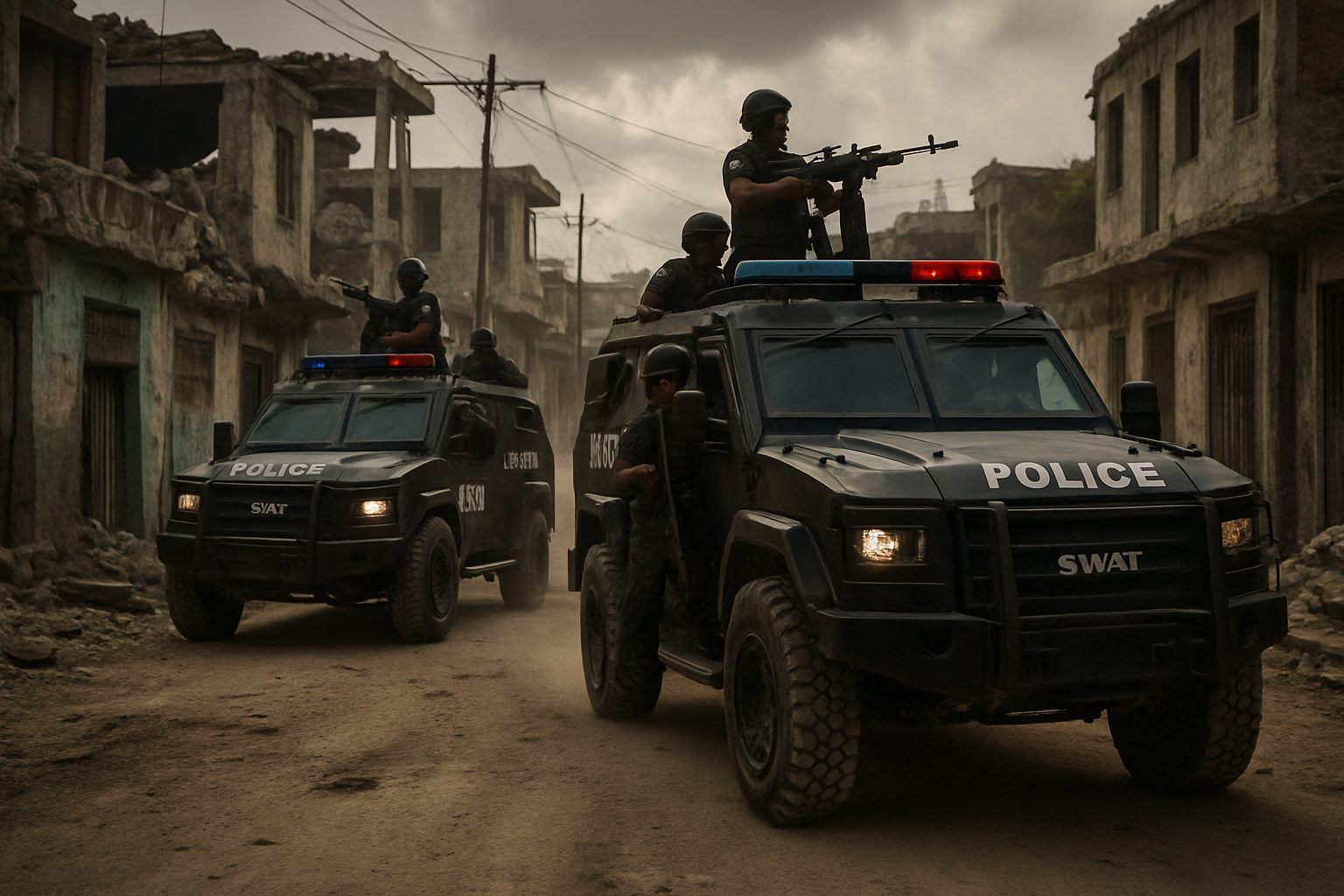
At least 70 people were killed and 30 injured during a coordinated gang attack near Petite-Rivière in Haiti's Artibonite region, according to human rights organizations, with casualties far exceeding official government estimates that put the death toll at only 16.
The devastating assault began early Sunday morning in rural communities around the agricultural heartland of Haiti, marking one of the deadliest single incidents in the country's escalating security crisis. The Defenseurs Plus human rights group documented the significantly higher casualty figures, underscoring the massive discrepancy between official state reporting and on-ground reality in gang-controlled territories.
Massive Discrepancy Reveals Institutional Collapse
The stark difference between the government's reported 16 deaths and the human rights organizations' documentation of 70 fatalities represents more than statistical variance—it demonstrates what experts describe as "structural failure in intervention capacity" and the complete breakdown of state authority in vast swaths of Haitian territory.
Local residents and officials confirmed to international media that the coordinated attack began in the pre-dawn hours, with armed groups systematically targeting civilian populations across multiple rural localities. The methodical nature of the assault and the delayed government response highlight the extent to which state institutions now operate only retrospectively in areas under gang control.
This institutional breakdown has reached unprecedented levels, with gangs assuming quasi-governmental functions including tax collection, security services, and control of basic necessities throughout territories they dominate. The police intervention in Artibonite occurred only after the attacks had concluded, demonstrating the limited reach of government authority.
Haiti's Deepening Humanitarian Catastrophe
The Artibonite massacre occurs within the context of Haiti's worst humanitarian crisis in decades. Over 1.45 million people are now internally displaced—representing a 33% increase within just one year—while gang control has expanded to 60% of Port-au-Prince and key maritime and road routes throughout the country.
According to UN documentation covering the period from March 2025 to January 2026, gang violence has killed 5,519 people and injured 2,608 others. Of these casualties, 1,424 deaths and 790 injuries resulted directly from gang violence, while additional casualties came from security operations and self-defense group activities.
The systematic nature of this violence extends far beyond territorial disputes. Armed groups have deliberately targeted healthcare facilities, schools, and water treatment plants as part of a territorial expansion strategy that creates what humanitarian officials describe as "medical deserts" throughout affected regions.
Political Vacuum Amid Crisis
The massacre comes as Haiti operates under unprecedented political concentration. Prime Minister Alix Didier Fils-Aimé now wields executive authority following the expiration of the Transitional Presidential Council mandate, creating what analysts describe as governance without traditional democratic checks and balances during the institutional collapse.
This political vacuum has coincided with the systematic breakdown of essential services. The civil defense system has shut down due to fuel shortages, hampering emergency response capabilities precisely when they are most desperately needed. The justice system operates sporadically at best, with many courts and police stations having been destroyed or abandoned.
International Response and Regional Implications
The international response has struggled to match the scale of Haiti's crisis. Chad has deployed 800 police officers for gang suppression, replacing Kenya's scaled-back involvement, but the force remains insufficient for the scope of the challenge.
The crisis has far-reaching implications beyond Haiti's borders. Regional migration pressures are affecting Caribbean and North American countries, while the complete breakdown of a functioning state just hundreds of miles from major population centers raises fundamental questions about international responsibility for civilian protection.
The United States has expanded immigration restrictions affecting Haitian nationals under Presidential Proclamation 10998, despite a federal judge's ruling blocking termination of Temporary Protected Status for 350,000 Haitians, citing discriminatory intent in the Trump administration's policy.
Systematic Violence as Territorial Control
The patterns of violence documented in Artibonite reflect broader systematic approaches employed by Haitian gangs. Armed groups routinely use sexual violence as a weapon of territorial control, deliberately target educational and healthcare infrastructure, and disrupt agricultural production and traditional markets.
Women and children bear a disproportionate burden of this violence, with 88% of female-headed households unable to meet minimum living requirements. The targeting of schools and hospitals represents not just immediate destruction but long-term developmental damage that will affect Haiti for generations.
These tactics demonstrate that Haiti's gangs have evolved far beyond traditional criminal organizations into entities that challenge the fundamental concept of state sovereignty through systematic infrastructure destruction and civilian targeting.
Template for International Response
The Artibonite massacre represents a critical test case for international intervention in situations of complete state collapse. Traditional peacekeeping models have proven inadequate for the complex intersection of criminal violence, institutional breakdown, and humanitarian emergency that characterizes modern Haiti.
The crisis unfolds amid competing global emergencies, from conflicts in Ukraine and the Middle East to climate disasters worldwide, creating challenges for sustained international attention and resources. Yet Haiti's proximity to major powers and the precedent-setting nature of its institutional collapse make it a template for how the international community responds to state fragility in the 21st century.
Success or failure in Haiti will influence global approaches to similar crises created by the intersection of organized crime, economic instability, and climate change impacts that are increasingly threatening vulnerable states worldwide.
Critical Decision Point
The March 30, 2026 massacre in Artibonite underscores that Haiti faces a critical decision point between comprehensive international intervention and complete state collapse. The implications extend far beyond Haiti's borders to fundamental questions about international responsibility for protecting civilian populations when traditional state structures cease to function.
The devastating casualties in Haiti's agricultural heartland, combined with the massive discrepancy between official and documented death tolls, demonstrates that current approaches are failing to protect vulnerable populations or restore basic governance functions.
As Haiti approaches what many observers see as a point of no return, the international community faces unprecedented challenges in developing frameworks that can address the complex intersection of humanitarian crisis, criminal governance, and institutional collapse that has made Haiti one of the world's most dangerous places for ordinary civilians.