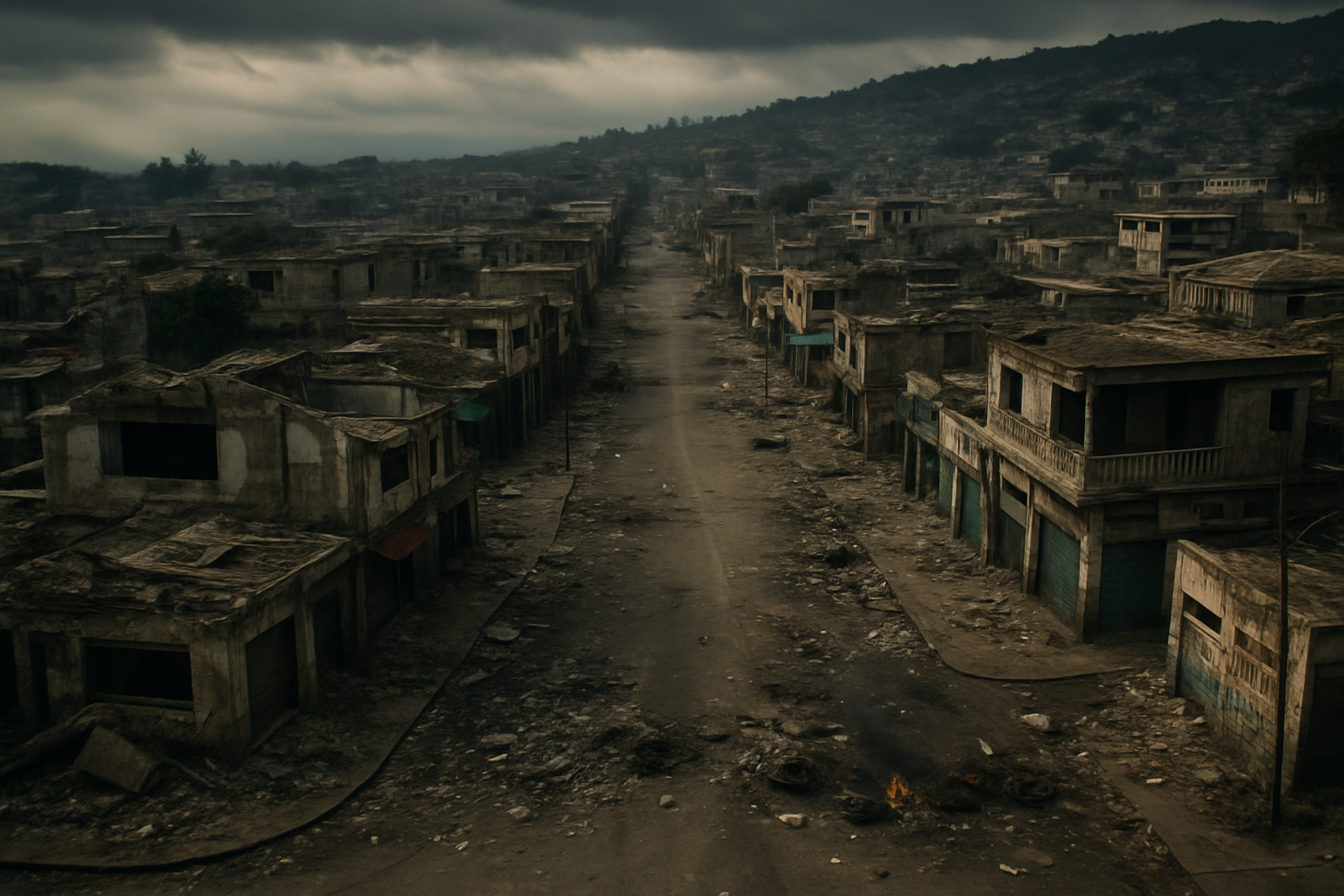
Armed gangs launched devastating coordinated attacks across Haiti's Artibonite region on March 30, 2026, killing at least 70 people in what local human rights organizations describe as one of the deadliest single incidents in the Caribbean nation's escalating crisis.
The Gran Grif gang, one of Haiti's most powerful armed groups, conducted systematic attacks in Jean-Denis within the commune of Petite-Rivière de l'Artibonite, with casualty figures varying dramatically between official police reports and local human rights organizations—highlighting the profound institutional collapse that has left authorities unable to accurately document the scale of violence affecting their own population.
Conflicting Casualty Reports Expose Institutional Breakdown
Local human rights organizations and community sources report between 30 and 99 victims from the Gran Grif attacks, while Haiti's National Police (PNH) officially acknowledges only 16 deaths. This significant discrepancy reveals what analysts describe as a "structural failure in intervention capacity" that extends beyond the uncertainty of initial emergency response to fundamental questions about state authority and information gathering capabilities.
According to official police statements dated March 30, the delayed intervention came after attacks had already concluded, underscoring the limited reach of government authority in areas now effectively controlled by armed groups. The temporal gap between violence and official response demonstrates how gang territorial expansion has created zones where state institutions operate only retrospectively, if at all.
Italian news agency ANSA attributed the attacks directly to the Gran Grif faction, while Serbian media reported similar casualty figures, indicating international concern about the deteriorating security situation. The attacks represent the latest escalation in a pattern of systematic violence that has transformed Haiti from a struggling democracy into what United Nations officials describe as a "catastrophic" humanitarian emergency.
Deepening Humanitarian Crisis Beyond Gang Violence
The Artibonite attacks occur within the broader context of Haiti's unprecedented humanitarian collapse, which now affects over 1.45 million internally displaced persons—a 33% increase in less than a year according to recent UN assessments. The UN High Commissioner for Human Rights describes the situation as "catastrophic," driven by the intensification of gang violence combined with the impact of natural disasters on an already devastated infrastructure.
"Water, food, healthcare, and education are beyond the reach of millions of Haitians."
— Nada Al-Nashif, UN Deputy High Commissioner for Human Rights
Essential services have collapsed across vast territories now under gang control. Armed groups have systematically targeted healthcare facilities, schools, and water treatment plants as part of territorial expansion strategies that involve assuming quasi-governmental functions in areas abandoned by the state. The gangs collect taxes, provide security services, and control access to basic necessities—filling a vacuum created by institutional breakdown following the 2021 assassination of President Jovenel Moïse.
Gang control now extends over approximately 60% of Port-au-Prince and has expanded to control key maritime and road routes throughout the country. This territorial dominance allows armed groups to regulate commerce, control food distribution, and determine population movement—functions traditionally reserved for sovereign governments.
Political Leadership Concentration Amid Crisis
The escalating violence comes as Prime Minister Alix Didier Fils-Aimé has assumed unprecedented executive authority following the expiration of the Transitional Presidential Council's mandate. Political analysts describe him as operating with "dual roles as PM and economic sector influence" during ongoing institutional collapse, representing a dangerous concentration of political and economic power in a single individual without traditional democratic checks and balances.
This concentration of authority occurs as the country faces what experts characterize as the worst security crisis in decades, with regional implications for Caribbean stability and migration patterns. Traditional peacekeeping models have proven inadequate for addressing the complex intersection of criminal violence, institutional collapse, and humanitarian emergency that defines contemporary Haiti.
International Response and Regional Implications
The international community's response has been marked by competing priorities and resource constraints. Chad's unprecedented deployment of 800 police officers to Haiti for gang suppression operations, replacing Kenya's scaled-back involvement, demonstrates the evolving nature of international engagement with the crisis. However, these efforts remain insufficient to address the systematic nature of gang territorial expansion and institutional collapse.
Previous UN documentation reveals that between March 2025 and January 2026, gang violence killed 5,519 people and injured 2,608 others across Haiti. This includes 1,424 killed and 790 injured directly from gang violence, with additional casualties resulting from security operations against gangs and self-defense group activities. The systematic nature of this violence has created what experts describe as a "complete state collapse" scenario requiring comprehensive international intervention.
The crisis represents more than localized violence—it constitutes a template-setting challenge for how the international community responds to complete institutional breakdown in small states. Success or failure in Haiti will influence approaches to similar crises globally, particularly as climate change and economic instability create conditions for state fragility in vulnerable nations worldwide.
Economic and Social Infrastructure Collapse
Beyond immediate violence, the gang attacks in Artibonite represent part of a systematic dismantling of Haiti's economic and social infrastructure. Armed groups have targeted educational institutions repeatedly, forcing widespread school closures that affect an entire generation's access to education. Healthcare facilities face similar systematic attacks, creating medical deserts in areas with populations numbering in the hundreds of thousands.
The economic activities that sustain local communities have been systematically disrupted by gang territorial expansion. Agricultural production, essential for food security in a nation facing widespread hunger, has been compromised by violence and territorial control disputes. Traditional markets that serve as economic lifelines for rural communities now operate under gang taxation systems or have been forced to close entirely.
Women and children bear a disproportionate burden of this violence, facing systematic sexual violence used as a weapon of territorial control. UN Human Rights officials document how armed groups employ sexual violence strategically to terrorize populations and consolidate territorial gains—a practice that constitutes war crimes under international humanitarian law.
Path Forward: International Intervention Debates
The March 30 Artibonite attacks underscore the urgent need for comprehensive international response mechanisms that go beyond traditional peacekeeping approaches. The current crisis represents a critical decision point between comprehensive international intervention and complete state collapse, with implications extending far beyond Haiti's borders to fundamental questions of international responsibility for protecting civilian populations.
Regional migration pressures continue to affect neighboring Caribbean states and North American countries, as Haitians flee systematic violence and economic collapse. The crisis tests international cooperation mechanisms at a time when multiple global emergencies compete for attention and resources, potentially establishing dangerous precedents for how the international community responds to complete institutional breakdown.
As Haiti faces this unprecedented convergence of gang violence, institutional collapse, and humanitarian emergency, the international community confronts fundamental questions about the effectiveness of current intervention models and the development of new approaches to protecting civilian populations when traditional state structures cease to function.
The tragic events in Artibonite serve as a stark reminder that without immediate, coordinated international action, Haiti risks becoming a template for state collapse that could be replicated in other vulnerable nations facing similar pressures from organized crime, economic instability, and climate change impacts in the years ahead.