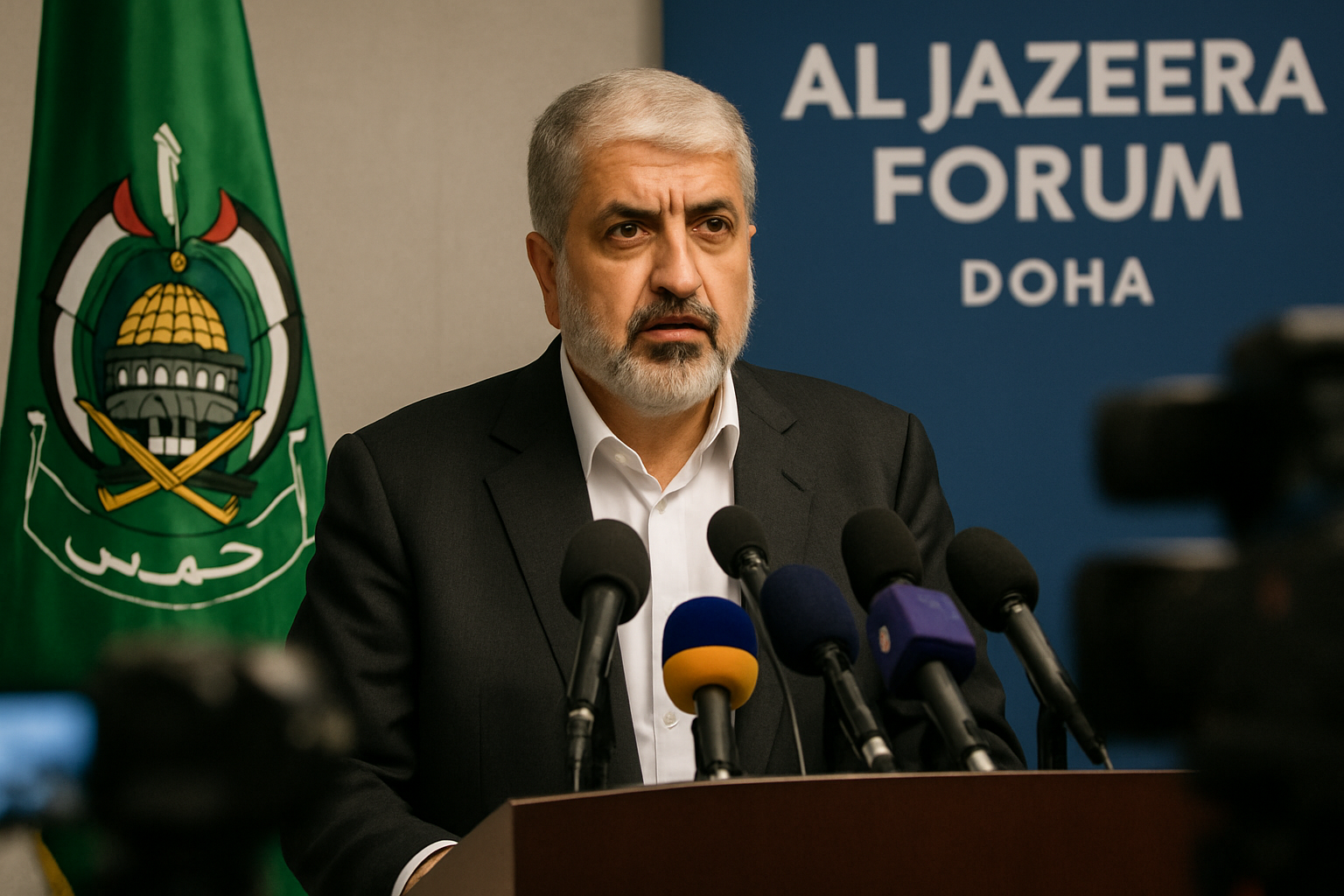
Senior Hamas leader Khaled Meshaal delivered a categorical rejection of disarmament demands and foreign governance proposals for Gaza during a major policy address in Doha on Sunday, maintaining the organization's armed resistance stance despite mounting international pressure for demilitarization.
Speaking at a conference in the Qatari capital, Meshaal, who heads Hamas's diaspora office and formerly led the organization's political bureau, declared that "criminalizing the resistance, its arms and those who carried it out" was unacceptable. The statement represents Hamas's most definitive public position on post-conflict arrangements since ceasefire negotiations began.
"While there is occupation, there is resistance. Resistance is the right of peoples under occupation," Meshaal emphasized during his address. "It is something that nations are proud of." The remarks directly challenge Israeli and U.S. demands for Hamas to surrender its weapons as part of any long-term peace agreement.
Rejection of Foreign Administration
Meshaal's declaration went beyond weapons issues to categorically reject any foreign control over Gaza's governance. The Hamas leader made clear that the organization would not accept outside rule in the territory, which houses 2.3 million Palestinians and has been under various forms of international oversight proposals.
According to Israeli sources cited in multiple reports, Hamas maintains an estimated 20,000 fighters and tens of thousands of weapons stockpiled throughout Gaza despite the ongoing ceasefire period. This substantial military capability underlies the organization's negotiating position in refusing disarmament demands.
The policy statement comes amid documented ceasefire violations that have persisted for 121 consecutive days since the October 10, 2025 truce agreement. Gaza's Government Media Office has documented over 1,520 alleged violations resulting in 556 Palestinian deaths during the ceasefire period, with the total Gaza death toll reaching 71,800.
Diplomatic Context and International Response
Meshaal's rejection complicates upcoming international reconstruction efforts, particularly President Trump's Board of Peace initiative scheduled for February 19, 2026. The meeting at the Donald Trump Institute of Peace in Washington is expected to bring together 27 member nations targeting over $1 billion in Gaza reconstruction commitments, with Hungarian Prime Minister Viktor Orban confirmed to attend.
The Hamas position directly contradicts traditional post-conflict demilitarization models typically required for international reconstruction assistance. European officials have expressed private concerns about how reconstruction aid can proceed without security guarantees that typically include weapons control mechanisms.
Eight Arab nations—Saudi Arabia, Jordan, Egypt, UAE, Qatar, Indonesia, Pakistan, and Turkey—have maintained their condemnation of alleged ceasefire violations, while over 400 European Union diplomats have called for increased pressure on Israeli authorities to ensure truce compliance.
Ceasefire Implementation Challenges
The policy declaration occurs against a backdrop of severely limited humanitarian access through the recently reopened Rafah crossing. Despite the February 2, 2026 reopening after nearly two years of closure, operations remain far below capacity with only 27 Palestinians crossing on the first day versus a 200 daily quota.
Hamas has condemned what it describes as "systematic harassment" by Israeli security forces, with 38 of 50 planned Palestinian returnees denied passage. The Gaza Civil Defense has shut down operations due to fuel shortages, hampering emergency response capabilities while 20,000 Palestinians await medical evacuation.
Egypt maintains 150 hospitals on alert with 300 ambulances deployed to support medical evacuations, but the limited crossing capacity has created a bottleneck for critically needed medical assistance.
Armed Resistance Philosophy
Meshaal's statement reinforced Hamas's fundamental position that armed resistance remains justified as long as what the organization terms "occupation" continues. This philosophical stance represents a core obstacle to international peace frameworks that typically require the transformation of armed groups into political entities.
The Hamas leader characterized international disarmament demands as a "strange paradox" while Israeli military forces maintain their presence in Gaza. This argument reflects the organization's position that security arrangements must address the underlying political issues before weapons concerns can be resolved.
Regional implications of Hamas's stance extend to ongoing diplomatic efforts by Arab nations to mediate between the various parties. The organization's rejection of foreign intervention in Gaza governance challenges traditional international conflict resolution approaches that often involve transitional administrative arrangements.
Impact on Reconstruction Efforts
The categorical rejection of disarmament threatens to undermine international reconstruction commitments that typically require security guarantees. European sources indicate that substantial reconstruction funding often depends on recipient territories meeting demilitarization criteria to ensure aid reaches civilian populations.
The Board of Peace initiative represents an innovative "business approach" to conflict resolution, departing from traditional UN frameworks. However, Hamas's position creates fundamental challenges for this approach, which requires demonstrable progress on security issues to maintain international support.
Qatar's role as a mediator becomes increasingly complex given Hamas's political presence in Doha and Qatar's participation in international reconstruction efforts. The Gulf state must balance its mediation role with international expectations for peace process advancement.
Regional and International Implications
Meshaal's declaration represents a fundamental challenge to international conflict resolution frameworks in occupation scenarios. The statement argues that traditional post-conflict demilitarization models cannot be applied when underlying territorial and sovereignty issues remain unresolved.
European pressure on ceasefire implementation has intensified, with a petition against EU-Israel partnership agreements exceeding 400,000 signatures. Global protests in Berlin, Paris, and Rome have demanded cessation of arms exports, reflecting growing international concern about the humanitarian situation.
The Hamas position complicates the Trump administration's Middle East strategy, which seeks to achieve diplomatic breakthroughs through business-oriented approaches while maintaining security guarantees for regional allies. Success of the February 19 Board of Peace meeting may depend on addressing these fundamental disagreements about post-conflict arrangements.
As international diplomatic pressure mounts and reconstruction needs become increasingly urgent, Hamas's categorical rejection of disarmament and foreign governance proposals represents a significant obstacle to sustainable peace agreements. The organization's insistence that armed resistance continues as long as "occupation" exists challenges the international community to address underlying political issues before technical security arrangements can be finalized.